Agentic Architecture Design Principles
Distinguish agentic systems from automation by understanding their core architecture layers.
There is a version of "agentic AI" that is just a regular automation script wearing a trench coat.
It runs a fixed sequence of steps. It calls an API. It returns a result. Somewhere in the marketing copy, someone used the word "autonomous." And technically, no laws were broken.
But it isn't an agent, and that much is clear.
A genuine agentic system does something fundamentally different. It sustains purposive behavior across time. It observes its environment, reasons about what to do, acts, checks what happened, and then decides what to do next. That loop — observe, reason, act, reassess, repeat — is the thing. And keeping that loop coherent across dozens of steps, across tool failures, across handoffs between components, is exactly what makes this hard.
Here is a number worth sitting with. On the OSWorld benchmark, agent task success jumped from roughly 12% to about 66% in benchmark conditions, with real-world task success reaching 77.3% per the 2026 Stanford AI Index. Impressive results. And yet autonomous agent deployment across business functions remains in the single digits. Only about 16% of enterprise AI deployments, per Menlo Ventures, qualify as true agents at all. Most are fixed-sequence workflows with better branding.
That gap between benchmark performance and production deployment is not a model problem. It is an architecture problem. And the architecture either rests on a clear set of design principles, or it doesn't.
The two-layer structure every agentic system is built on
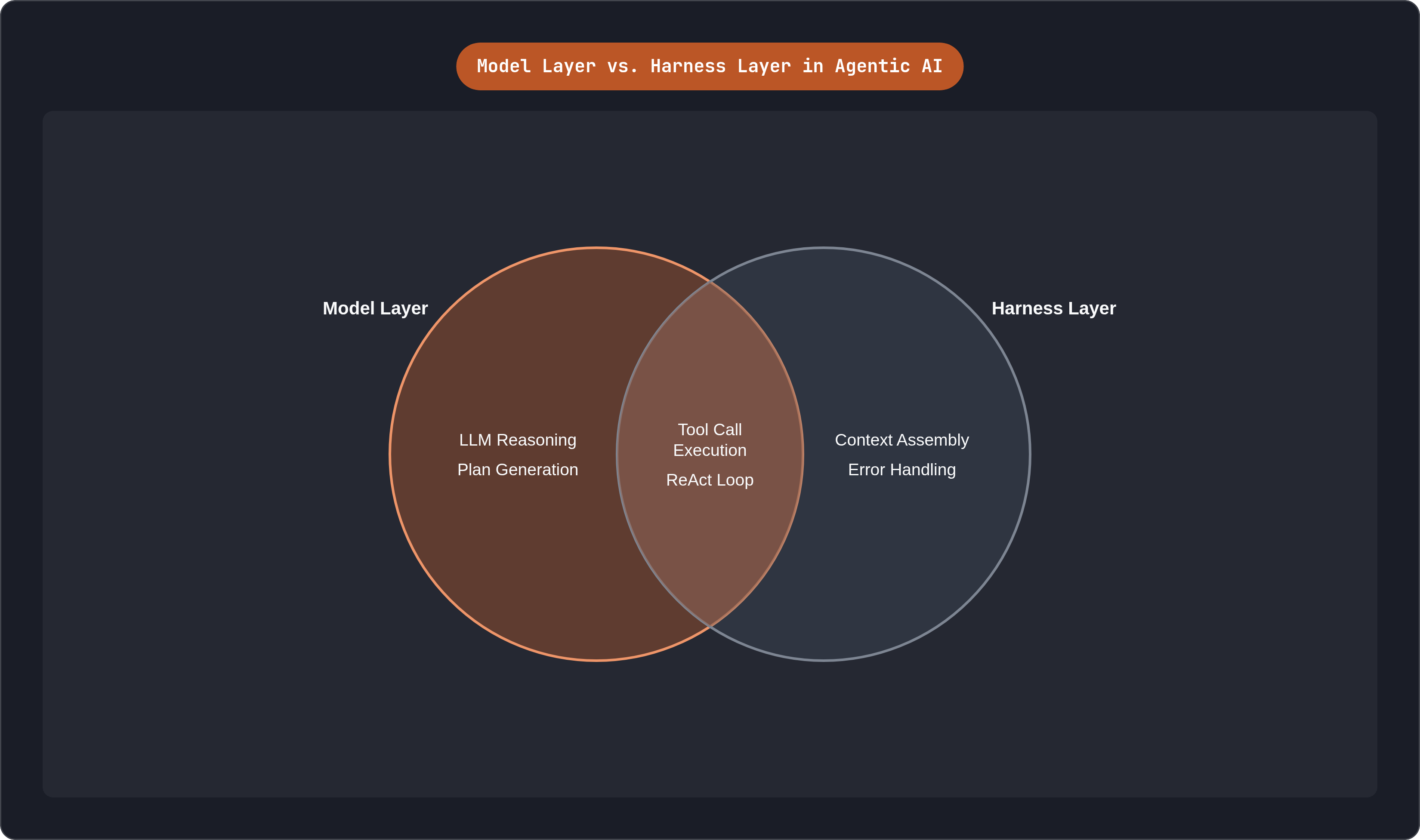
Every agentic system, regardless of how complex it gets, is built on two distinct layers. They have different jobs. Conflating them is where most teams get into trouble.
The first is the model layer. This is the LLM doing the reasoning. It generates plans, interprets tool outputs, decides what to do next. It is the part everyone talks about.
The second is the harness layer. This is the surrounding code. It prepares context before the model ever sees it. It executes tool calls. It enforces constraints. It persists state between steps. It catches errors.
Here is the part that surprises people: most of the actual engineering work in a reliable agentic system happens in the harness, not the model. When an agent fails, the instinct is to swap in a better model. But more often, the failure is in how context was assembled, or how a tool error was handled, or how state was lost between steps. That is all harness.
The harness is also where design principles become concrete. Abstract ideas like "ground your agent in real-time data" or "enforce least privilege" don't live in the model. They live in the code wrapping it. Which means improving a struggling agent usually means looking at the harness first.
Why does this matter so much? Because most enterprise failures don't start when the model reasons badly. They start at the perceive step, before the model even gets involved. Garbage context in, garbage decisions out. The quality of the model is beside the point.
Perception: what the agent knows about its situation and why that determines everything downstream
Perception is the agent's intake. Before any reasoning happens, the harness assembles a picture of the world: text, structured data, API responses, tool outputs, current environment state. Whatever ends up in the context window is, from the agent's perspective, reality.
That's a little unsettling when you think about it. The agent cannot see anything the harness doesn't show it.
So the quality of perception equals the quality of that context window. What's included. What's excluded. How it's structured. How current it is. Four failure modes show up again and again:
- Stale context. The agent reasons about a world state that has already changed.
- Missing context. Relevant facts weren't retrieved, so decisions get made on incomplete information.
- Noisy context. Irrelevant information dilutes the signal and degrades reasoning quality.
- Conflicting signals. Multiple sources disagree, and the agent has no mechanism to resolve the conflict.
Any one of these can silently poison every downstream decision. And none of them are model problems.
Tool use extends perception in a meaningful way. An agent equipped with search, live APIs, and database access can ground its reasoning in real-time facts. Without tools, the agent's perception is frozen at training cutoff. It is reasoning about a world that may no longer exist as described.
Retrieval-Augmented Generation, RAG, is worth naming here because it often gets categorized as a "knowledge" technique when it is actually, architecturally speaking, a perception pattern. It extends what the agent can see before it reasons.
The design principle this implies: treat context preparation as a first-class engineering concern. Not a prompt-engineering afterthought. Not something you optimize after the model is picked. The thing you design for, deliberately, up front.
Memory: how agents maintain continuity across steps, sessions, and agents
An agent with no durable memory restarts its understanding of the world on every step. It can't remember what it tried. It can't remember what failed. It can't remember what the goal was three steps ago. This is the architectural root of agents that appear to "forget" what they were doing mid-task.
There are four types of memory worth distinguishing.
Short-term or working memory is the active context window. It's what the agent holds during a single reasoning step. When the step ends, it's gone unless the harness explicitly saves it somewhere.
Episodic memory is the record of past actions and outcomes. It's how an agent learns from what it has already done, whether earlier in the same session or in a prior one.
Semantic memory is general factual knowledge. What the agent knows about the world independent of any specific task. This is largely baked in at training but can be extended.
Long-term storage is the persistent layer, typically vector databases, that enables retrieval of stored episodes and facts. Some architectures rewrite key episodes on a regular cycle to keep this store relevant rather than just ever-growing.
No single type is sufficient on its own. The fusion of working, episodic, and semantic memory is what produces intelligent multi-step decision-making. Most major agentic frameworks, LangChain, LangGraph, LlamaIndex, CrewAI, include memory systems ranging from simple buffers to long-term retrievers. Emerging memory-as-a-service architectures aim to make this more automatic: filtering what to retain, consolidating related memories, surfacing the right ones at the right time.
But here is the design tension. More memory means more context, which means higher cost and slower reasoning. The challenge isn't storage. It's relevance-filtering. What does the agent actually need to remember right now to take its next step well?
That question doesn't have a universal answer. It has a context-dependent one. Which means it requires a design.
Planning: how agents decompose goals into sequences of actions that can actually be executed
Planning is where a lot of agent systems look impressive in demos and fall apart in production.
The job of a planner is to take a high-level objective and break it into subtasks: ordered, assigned to specific tools or sub-agents, executable with available capabilities. That sounds straightforward. It is not.
Why? Three reasons.
First, plans must be executable, not just logically correct. A plan that requires a tool the agent doesn't have, or a capability that doesn't exist, is not a plan. It is a wish list.
Second, plans must be revisable. Mid-task failures happen. Tools return unexpected results. New information changes the picture. The agent has to be able to re-plan without losing track of the overall goal.
Third, error compounds. A wrong assumption in step two may not surface as a failure until step eight. By then, the agent has made several downstream decisions based on a faulty foundation.
Andrew Ng, in his widely-circulated articulation of agentic design patterns, explicitly flagged planning as less mature and less predictable than reflection and tool use. That was in early 2024 and it remains accurate in production systems today.
The foundational planning pattern is ReAct: Reasoning plus Acting. The agent alternates between reasoning about what to do next and actually doing it, in a loop, until the goal is satisfied or abandoned. Chain-of-Thought prompting supports this by making the model's intermediate reasoning explicit, which improves plan quality and, critically, makes failures debuggable.
One design principle worth stating clearly: plans should be represented as explicit, inspectable structures. Not implicit in the model's activations. The harness needs to be able to checkpoint a plan, resume it after a failure, and audit it after the fact.
There is also a deeper tension here worth acknowledging. Symbolic planners are deterministic and auditable. Neural planners are flexible but stochastic. Production systems increasingly need both: adaptability where tasks are ambiguous, reliability where stakes are high. Hybrid approaches are emerging, but this remains an active and unresolved design challenge.
Action and tool use: where reasoning meets the real world and real consequences begin
Everything before this section is internal. Perception, memory, planning — the agent observing, remembering, and thinking. Action is where it reaches out and touches something.
An agent invoking a search API is acting. Writing to a database is acting. Sending an email, purchasing something, deploying code, calling another agent. All of it is action. And once an agent acts on the real world, the stakes change.
The most important distinction to internalize is between read actions and write actions.
- Read actions, searching, retrieving, querying, are reversible. Low risk. They can be executed freely.
- Write actions, sending, updating, deleting, purchasing, deploying, are irreversible or hard to reverse. They require different authorization handling.
This sounds obvious. It is not always implemented. And the failure to make this distinction explicit in the architecture is how agents accidentally delete things, send emails prematurely, or make purchases that can't be undone.
Per 2026 NSA/CISA guidance, the privileges assigned to agents directly determine the level of risk they can introduce. Least privilege is a first-order design requirement, not a security afterthought. Agents should be granted only the permissions needed for their current task. A superset of everything they might conceivably need is the wrong model entirely.
Without tool use grounded in real-time data, an agent reasons on probability. It generates answers based on what seems likely given training data. With tool use properly designed, it can verify facts before acting on them. That is the difference between a planning agent and a hallucinating one.
Common failure modes worth naming:
- Tool call with wrong parameters
- Misinterpreted tool output
- Tool returns an error the agent doesn't handle
Each of these can silently derail a plan if the harness has no error-recovery logic. The model won't always know something went wrong. The harness has to be designed to catch it.
Control, oversight, and the principle of least privilege in practice
The honest question to ask here is: how much do you actually trust your agent?
The answer in 2025, across most production systems, is: not enough to let it run fully autonomous on anything with real consequences. And that is the right answer, at least for now.
The established pattern for production agentic systems is hybrid autonomy. Automate routine, low-stakes, reversible actions. Route high-impact decisions to humans who have the authority and context to override.
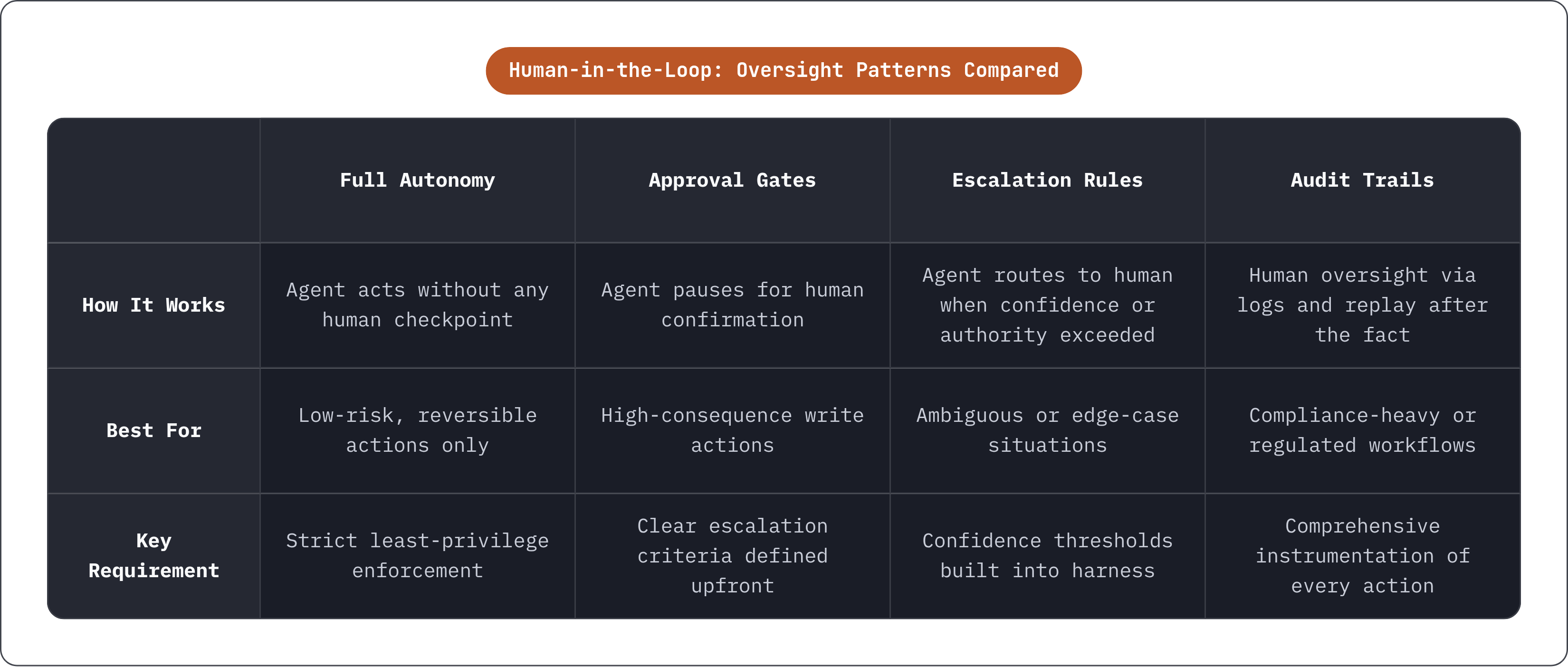
Human-in-the-loop is not a single design choice. It is a spectrum.
- Full autonomy. Agent acts without any human checkpoint. Appropriate only for low-risk, reversible actions.
- Approval gates. Agent pauses and surfaces a decision for human confirmation before executing high-consequence actions.
- Escalation rules. Agent detects when a situation exceeds its confidence or authority and routes to a human rather than guessing.
- Audit trails. Human oversight happens after the fact through logs and replay. Requires comprehensive instrumentation.
Gartner has projected that more than 40% of agentic AI projects will be cancelled by 2027, primarily from unclear business value, runaway cost, and weak governance. That is not a prediction about model capability. It is a prediction about what happens when control design is treated as optional.
There is a practical checklist implied by these principles:
- Classify all agent actions by risk level and reversibility
- Implement approval checkpoints at write-action boundaries
- Enforce least privilege via identity and access governance scoped per task
- Instrument everything: every action, every tool call, every state transition
The last one is underrated. Governance without instrumentation is just hope.
Graceful degradation deserves its own mention. A well-designed agent should fail safely: detect that it cannot proceed, preserve state, and hand off cleanly. The alternative, proceeding with low confidence and making irreversible mistakes, is a design choice — and the wrong one.
Multi-agent coordination: when to split work across agents and how to keep the system coherent
At some point, a single agent isn't enough. The task is too long for one context window. It requires capabilities that are genuinely specialized and cleanly separable. Or parts of it can run in parallel and speed matters.
Those are the legitimate reasons to go multi-agent. Not because it sounds more sophisticated.
There are three coordination topologies worth understanding.
Hierarchical. An orchestrator agent delegates to specialized sub-agents. Strategic oversight is centralized; execution is distributed. This is the dominant pattern in enterprise systems where alignment and safety matter, because someone (or something) is always accountable for the overall goal.
Sequential or chain. Output of one agent becomes input of the next. Simple. Auditable. Brittle if any single step fails.
Mesh or peer. Agents communicate laterally without a central coordinator. Powerful. Harder to govern. Much harder to debug.
The observability problem at scale is real. A multi-agent system handling a single user request can produce dozens to well over a hundred spans of activity. Raw log inspection becomes impractical. Structured tracing and span aggregation stop being nice-to-haves and become architectural requirements.
Least privilege applies at the agent-to-agent level, not just the agent-to-tool level. An orchestrator agent should not inherit the full permissions of every sub-agent it coordinates. Each sub-agent's access should be scoped to its designated function.
Andrew Ng described multi-agent collaboration as "very powerful, but more emergent." That word, emergent, is doing a lot of work. It means system-level behavior can diverge from intended behavior in ways that no single agent's logic predicts. The agents can each be behaving correctly and the system can still go wrong.
The design implication: test at the coordination boundary. Not just at the individual agent level. Failures in multi-agent systems often live in the handoff state between components, not inside any single one.
Reflection as the mechanism by which agents catch and correct their own errors
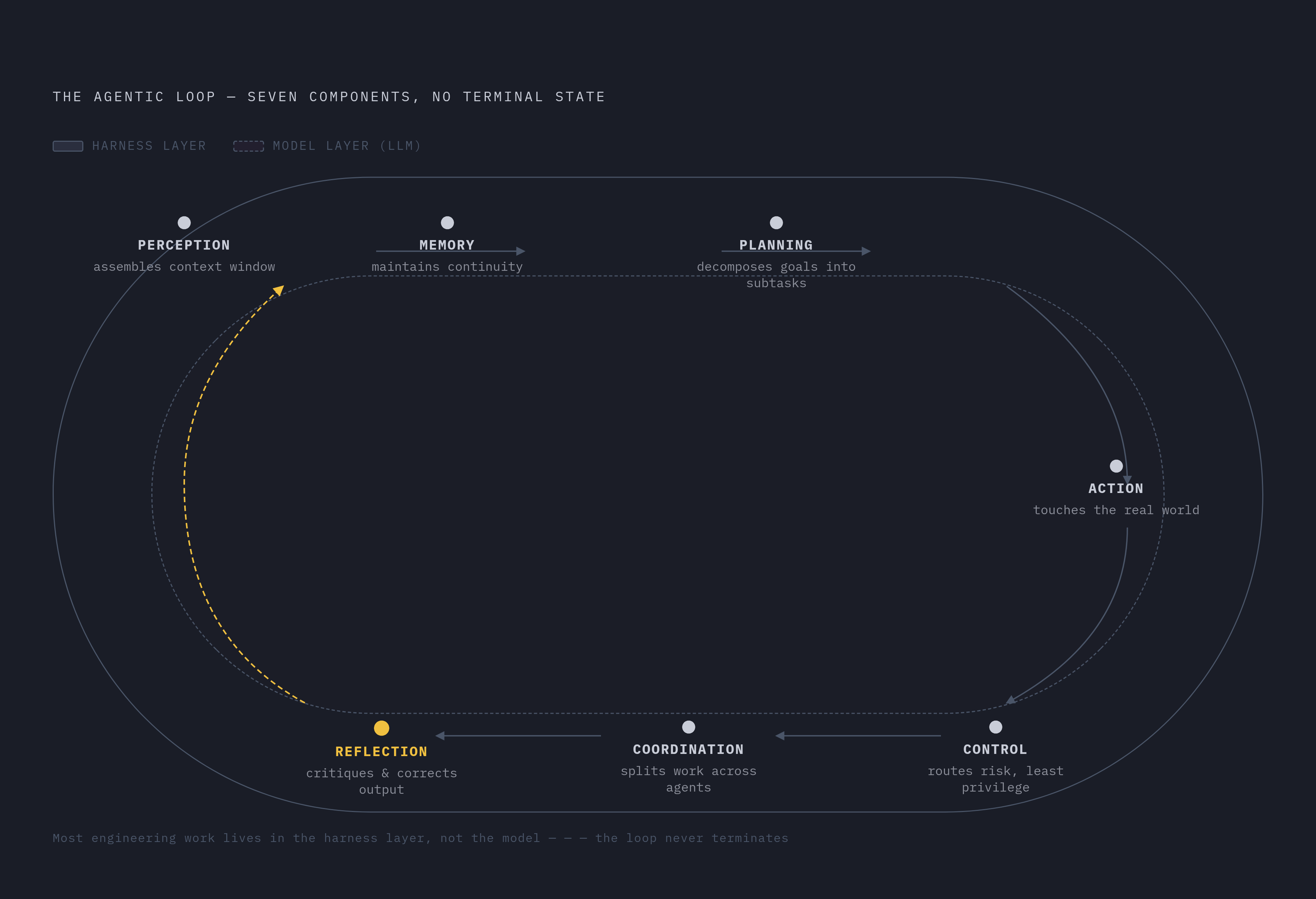
Reflection is the agent critiquing its own output. It looks at what it produced, assesses whether it's good enough or correct, and uses that self-assessment to revise the next action, or restart a subtask entirely.
Ng rated reflection as one of the most consistently effective agentic patterns, and the reason is structural. Unlike planning, which can go wrong during decomposition before any action is taken, reflection operates on something concrete. It compares something the agent actually produced against what was needed. That is a much more tractable problem.
Reflection shows up in production in a few practical forms:
- Self-critique pass. The model evaluates its own draft before acting on it.
- Verifier agent. A separate agent checks the primary agent's output against specified criteria.
- Tool-grounded verification. The agent retrieves external evidence to confirm or disconfirm a claim it generated.
It also functions as an error-recovery mechanism. When a tool call fails or returns something unexpected, a reflecting agent can diagnose what went wrong and try a different approach, rather than propagating the error forward as if nothing happened.
But it is worth challenging the premise slightly. Is reflection always worth it? Reflection adds latency and cost. Every reflection pass is another inference call. Applied uniformly, it makes everything slower and more expensive without proportional gains.
The design challenge is scoping reflection to where output quality materially affects downstream actions. Not every step needs a critic. The steps that feed irreversible write actions, or that other agents depend on, probably do.
This connects back to graceful degradation. An agent that reflects well fails less catastrophically. It catches its own mistakes before they become irreversible actions. That is not glamorous. But in production, it is the difference between a system people trust and one they turn off.
...
The gap between benchmark performance and real production deployment isn't going to close by scaling models alone. It closes by getting the architecture right. Perception, memory, planning, action, control, coordination, reflection. These aren't abstract principles. They are the load-bearing walls. Get them right and the system can sustain purposive behavior across complex, multi-step tasks. Get them wrong and you have a very expensive fixed-sequence workflow with a good cover story.
The label "agentic" is easy to apply. The architecture is the harder thing. And it is where the actual work lives.