Agent Runtime State Management and Persistence
Persistent state management is what separates production agents from demos that fail silently.
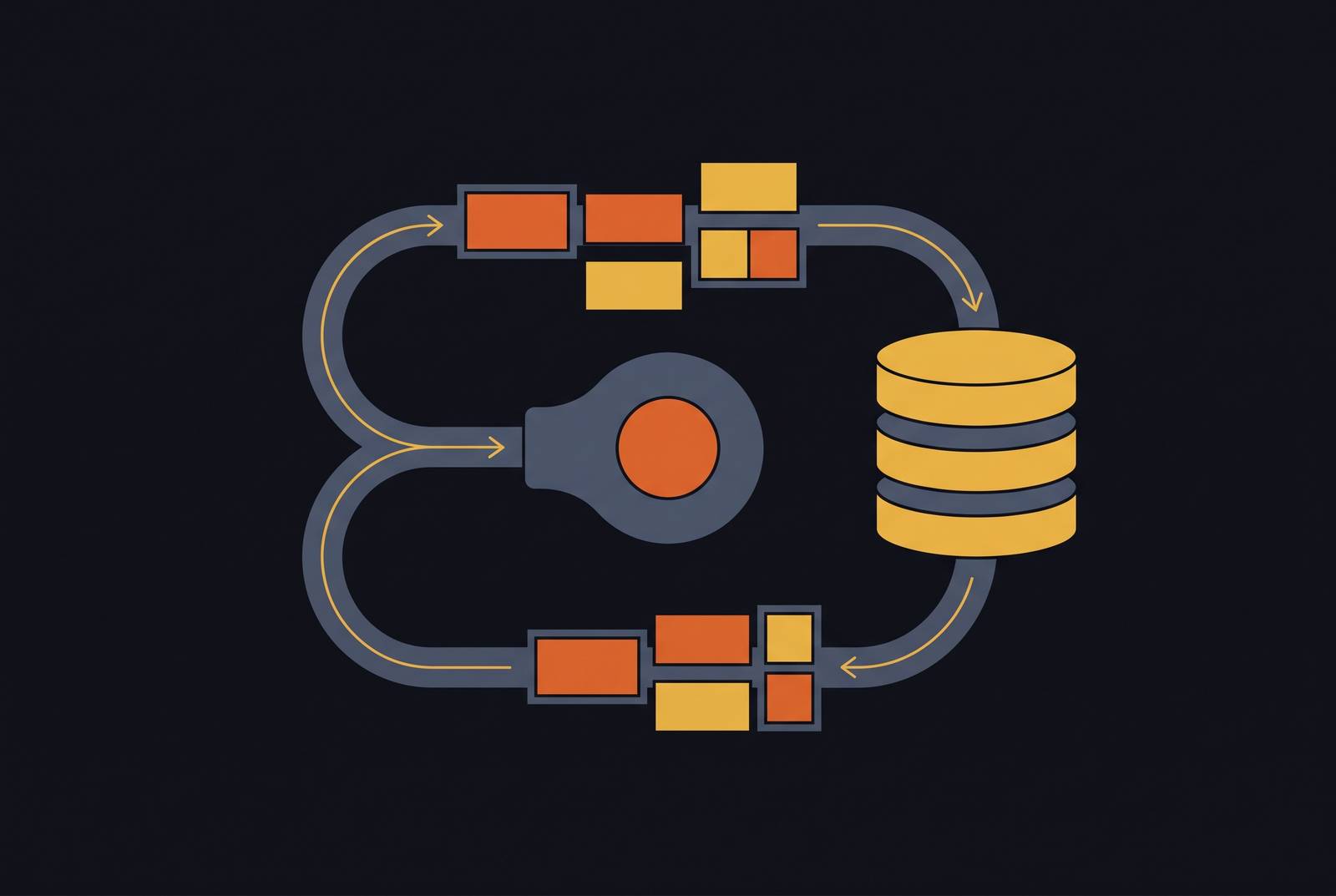
Agents are supposed to run for hours, chain dozens of tool calls, and pick back up exactly where they left off after a crash. Most agents in production today can't do that: a timeout, a dropped connection, or a bad tool response wipes the slate clean, and the agent starts over like nothing happened. That gap comes down to one architectural decision most teams treat as an afterthought: how state gets captured, stored, and resumed.
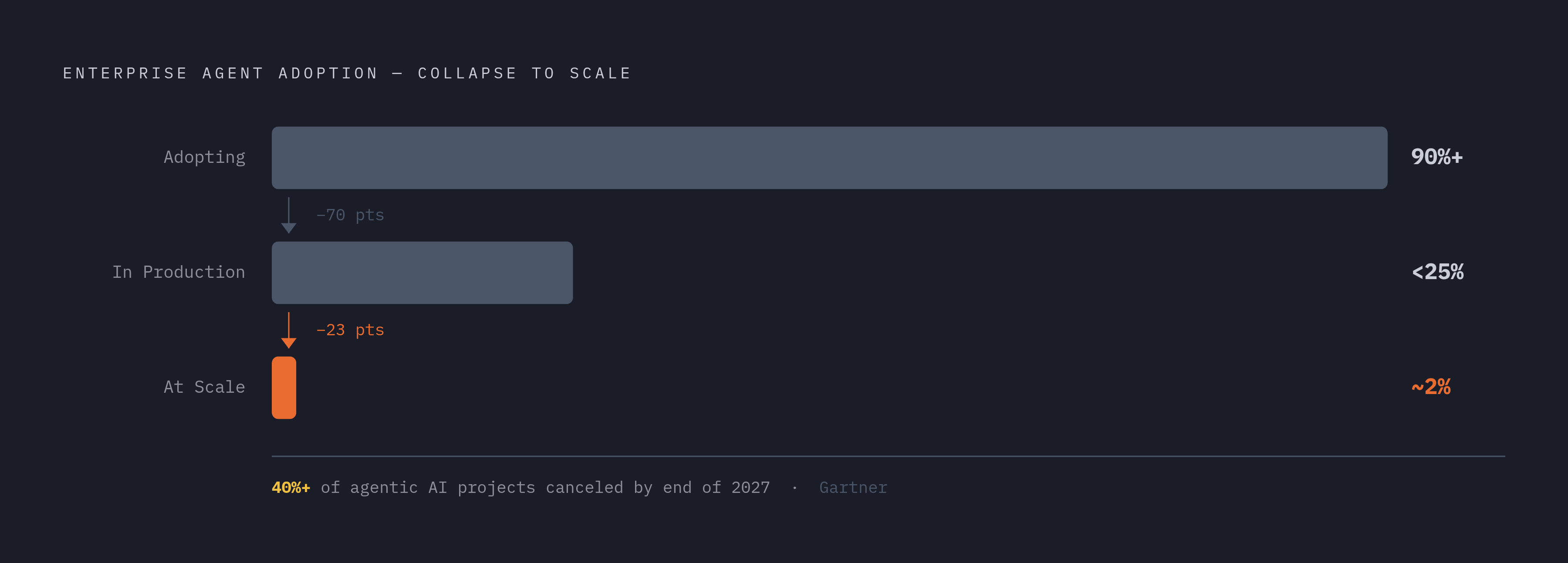
The numbers on this are stark. More than 90% of enterprises are adopting agent-based systems, but fewer than 25% have gotten any of that work into production, and only about 2% have reached anything resembling scale. Gartner has predicted that over 40% of agentic AI projects will be canceled by the end of 2027, citing cost, unclear value, and inadequate risk controls. Ask what's actually killing these projects, and the answer is rarely the model itself. More often, nobody built a place for the agent to put things down when it needs to stop and pick them back up later.
That's worth sitting with, because it reframes the whole problem. Every API call to a language model is stateless by design; the model holds no memory of what came before it. The runtime around that model is supposed to be the thing that remembers, checkpoints, and resumes. When that runtime doesn't exist, or exists only as a thin wrapper that assumes nothing will go wrong, the agent has no way to survive an interruption. What follows walks through what it actually takes, layer by layer, to build an agent runtime that treats state as a guarantee rather than a lucky accident.
What separates a framework from a runtime, and why the distinction matters for state
Frameworks help build agents. They define how a tool gets called, how a prompt gets assembled, how one decision leads to the next. A runtime is the execution infrastructure that keeps agents alive in production: it manages their lifecycle, their compute, their state, and their calls out to the rest of the world so the agent behaves reliably at scale. Guild.ai's glossary on agent runtimes draws this line clearly, and it's worth taking seriously, because a lot of teams don't discover the difference until something breaks in a way the framework never warned them about.
Most teams get this backwards, and it's worth naming directly: they pick a framework first, build the agent's logic around it, and only start asking questions about state persistence once something crashes in production with nothing to restore from. That sequencing is the mistake, not a defensible tradeoff. By the time the crash happens, the framework's assumptions are baked into every tool call and every prompt chain, and retrofitting a runtime underneath costs far more than choosing one up front would have.
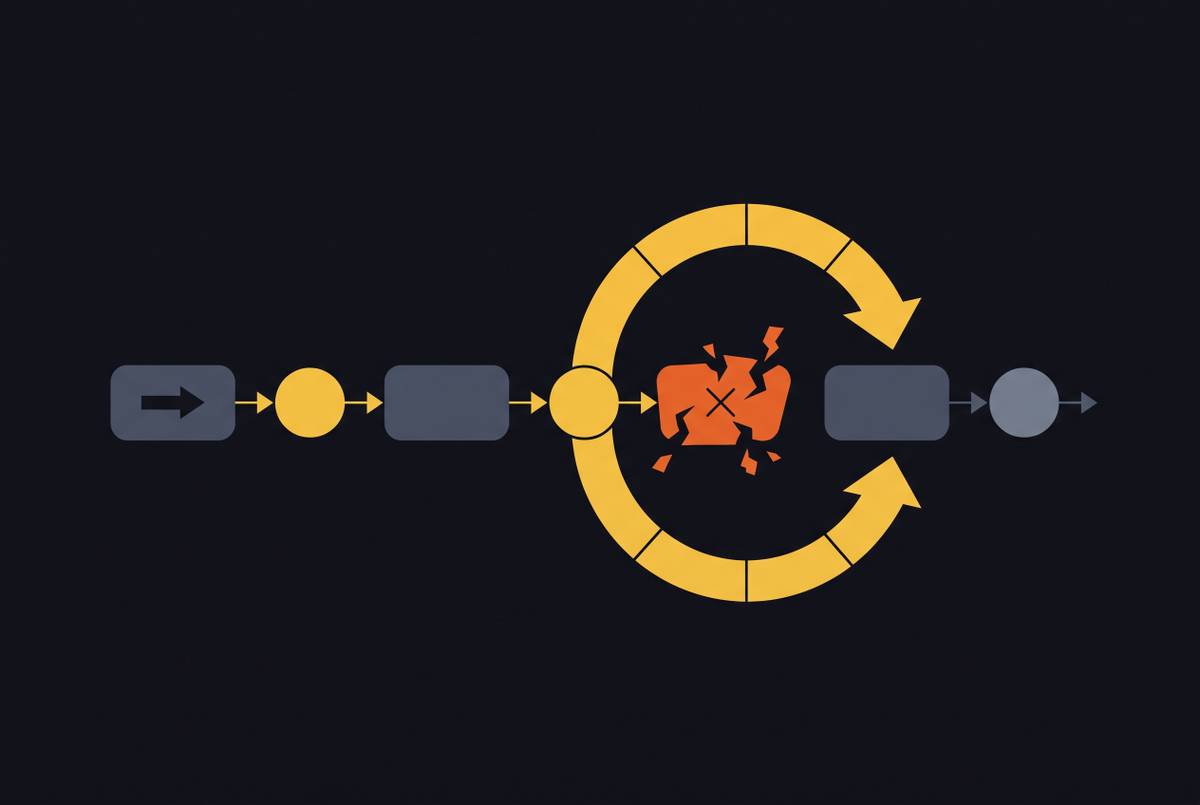
The runtime's defining job is durable execution. If an agent crashes halfway through a task, the runtime should restore the last known state and pick the workflow back up, rather than restart it from zero. That sounds small, but it isn't: most agentic frameworks either treat agents as stateless by default, or hand the whole state-management problem to whoever is writing the agent code. In practice that means persistence is the developer's burden, not something the platform guarantees. Teams building on frameworks with no runtime layer underneath end up writing their own crash recovery logic, usually as an afterthought, and usually not very well, since crash recovery is genuinely hard to get right when it's competing for attention against actual product features.
Agent interactions are stateful by nature, and that's what makes this unavoidable. Every tool call, every reasoning step, every retrieved document changes something, either in the agent's internal state or in the environment it's operating on. A stateless web request works differently; each call stands alone, and the server doesn't need to remember anything about the last one. An agent without a runtime that manages state reliably belongs to a different category of thing entirely, closer to a demo than a system. Skipping this distinction is how teams end up rebuilding the same recovery logic eighteen months in, and it's the single most avoidable failure in this entire stack.
The three memory tiers every agent runtime must manage
Language models carry no memory between calls on their own. Anything that needs to persist beyond a single request has to be handled deliberately by whatever sits around the model, and that means building a memory layer with actual structure to it, a structure someone can query and reason about rather than a growing log file that someone greps through when things go wrong.
Three tiers cover most of what an agent runtime needs, and each has a different scope and storage profile. Session memory holds the current conversation, the tool results from this run, the intermediate reasoning the agent has done so far. It lives only as long as the session does, and disappears the moment that session ends unless something explicitly writes it somewhere else first.
Thread memory sits one level up. It groups related sessions together so an agent can carry context across a multi-step task without the developer manually wiring continuity between each step. A research agent working across multiple sessions needs thread memory to know what it already found in an earlier session when it returns to the task later.
Long-term memory is the tier most early builds skip, and it's the one that matters most once an agent operates with any real autonomy. It lives in external storage: key-value stores for structured facts like user preferences or accumulated configuration, and vector databases for semantic recall, where the agent pulls relevant context out of a much larger knowledge base through similarity search rather than exact lookup.
Treating these tiers as interchangeable is the mistake worth naming directly, and it's the same mistake underneath the framework-versus-runtime confusion above: collapsing distinct layers because they look similar on the surface. Each tier carries its own latency profile, its own cost curve, its own consistency requirements. Collapse them into one undifferentiated blob and the failure is predictable: either everything gets shoved into expensive hot storage that was never meant to hold cold, rarely-accessed data, or long-term memory gets under-provisioned and the agent starts missing recalls it should be able to make.
Tiered storage, moving data between hot, warm, and cold layers based on how often it's actually touched, can cut memory costs by a factor of three or four without giving up recall quality. That's a meaningful gain, not a minor optimization; it's the difference between an architecture that scales economically and one that doesn't. The tier model also doubles as a diagnostic: when an agent loses context mid-task, tracing which tier failed points directly at where the persistence gap actually is.
Checkpointing: the mechanics of capturing state without losing execution progress
Checkpointing is the mechanism that turns the tier model into something a runtime can actually recover from. There are two broad approaches, and most systems lean toward one or blend both.
Complete state snapshots save everything: the agent's internal state, its context window, any intermediate data, the surrounding system state, at each checkpoint. Storage cost goes up, but recovery logic stays simple: restore the snapshot and resume where it left off. Clean breakpoints work differently. They only let the workflow pause at predefined safe points, which keeps overhead low but requires the workflow to be designed up front with those safe points in mind, so an operation never gets interrupted halfway through.
Getting this wrong has a measurable cost. Agents running longer than four hours without any state persistence face a 90% higher risk of total task failure from API timeouts or infrastructure hiccups. That's a significant share of long-running tasks failing outright, not a rounding error, and it's the clearest argument against treating checkpointing as optional plumbing.
A few frameworks have already built this in structurally. LangGraph's persistence layer writes each execution step to a durable backend automatically. Microsoft's Agent Framework exposes checkpointing explicitly through a Checkpoint Manager interface. CrewAI's Flow feature persists flow state across executions using SQLite by default. AutoGen supports saving and loading full agent and team state, including message threads and group-chat manager state. Implementations vary across these frameworks, but they all point at the same requirement: checkpointing has to be structural to the runtime, not a helper function someone bolts on later.
Checkpointing also opens the door to human-in-the-loop workflows that actually work. An agent can pause at a checkpoint, wait for a human to approve the next step, and resume without losing any context in between, which matters enormously for workflows that need an audit trail. Checkpointing alone, though, leaves a gap: it captures state inside a workflow, but doesn't guarantee the workflow itself comes back to life after the underlying infrastructure fails. That guarantee belongs to a different layer entirely, covered further down.
Graph-based execution state and why the industry converged on directed graphs
The industry's answer to orchestrating multi-step agents at production scale has settled on something specific: an explicit directed graph, with typed state, conditional routing, checkpointed execution at each node, and observability layered on top. Worth asking why a graph, specifically, won out over a simpler linear pipeline. The mechanics answer it directly: a linear pipeline can't branch, can't be diffed against another run, and can't be replayed from the middle without re-running everything before it. A graph does all three by design, and that's why the field converged on graphs rather than sticking with the chain-of-calls model most early agent frameworks started from.
Every node in the graph receives the current state, transforms it in some way, and hands back the updated state to whatever comes next. The full execution history is just a sequence of state snapshots, one after another, and each can be inspected, replayed, or diffed against another run. Conditional routing lets the graph branch based on what's actually in the state at that moment, rather than following a workflow definition fixed before the agent ever ran.
This gives teams three things linear checkpointing on its own doesn't. Replay lets any subgraph re-run from a prior snapshot without re-executing the whole workflow from the start. Diffability means two runs of the same workflow can be compared directly to see exactly where and why their state diverged. Observability turns every transition between states into a named, logged event, which makes the graph itself an audit trail rather than a black box that only produces a final answer.
That audit trail carries real weight for governance. For agents making decisions with real consequences, financial, medical, legal, the graph is the paper trail that regulators and internal risk teams actually need. Scattered logs rarely hold up under scrutiny; a structured, queryable history of every state transition does, and that difference alone is reason enough to build on graphs rather than retrofit them in later.
There's a useful parallel in the AIOS research proposal for an LLM-agent operating system, which argues for isolating memory, storage, context, scheduling, and access control into a kernel that manages multiple concurrent agents. The graph model, at the application level, does a version of the same thing: it gives structure to what would otherwise be an unmanageable mess of concurrent, stateful processes. Agent orchestration has moved past the experimental stage. The live question now is less about whether agents can handle complicated multi-step tasks, and more about how that execution gets modeled, inspected, and governed once it's running.
Durable execution as the runtime guarantee that checkpointing alone cannot provide
Checkpointing saves state; durable execution guarantees the workflow actually resumes. That distinction matters more than it sounds like it should. It separates having a backup from having a recovery contract that something is obligated to honor, and conflating the two is how teams end up with snapshots nobody knows how to restore.
Agents fail in ways traditional retry logic was never built to handle. Orchestration itself can fail, and the model can produce an output nobody anticipated, because it's probabilistic by nature and not every output fits the expected shape. Tool calls time out or return errors mid-chain. A human approval step in a human-in-the-loop workflow can take longer than the server connection is willing to stay open. Durable execution is built to absorb all of that: automatic state persistence, automatic retries, and workflow resumption handled by the runtime itself, rather than bolted onto the agent's own code as an afterthought.
This has moved from niche concern to mainstream infrastructure fast. Durable execution crossed into early majority adoption in 2025, and AI agent workloads were the main driver. Cloudflare Workflows brought durable multi-step execution to its Workers platform. AWS launched Lambda Durable Functions in December 2025, with steps, waits, checkpoints, replay, retries, and support for long suspensions built in. Microsoft updated its Durable Task offering for AI agents in April 2026, positioning the Durable Task Scheduler as coordination infrastructure that agent frameworks can build on top of. DBOS persists workflow and step state directly in a database, with integrations for AI stacks including OpenAI's Agents SDK. Temporal uses an event-sourcing architecture for long-running, stateful workflows with exactly-once execution guarantees, and it's already running production workloads like multi-step loan processing and CRM automation.
Even model providers are catching on. OpenAI's April 2026 update to its Agents SDK points toward externalized agent state, snapshotting, sandbox-aware orchestration, and rehydrating a paused agent into a fresh container. When a model provider starts building for that, durable execution has become a property the runtime itself has to hold, underneath whatever framework the agent happens to be written in.
Why the sandbox the agent runs in determines whether state persistence is actually safe
Everything above assumes the place storing and restoring state can be trusted. That assumption doesn't hold automatically, and a stateful agent running in a poorly isolated environment introduces a risk that has nothing to do with checkpointing or durability.
The threat model starts from a blunt premise: AI-generated code has to be treated as potentially hostile, not because the model is malicious, but because it can produce something exploitable without knowing it. LLM-generated patches introduce new security vulnerabilities in roughly 1 in 10 cases, even while fixing the bug they were meant to fix. Frontier models' performance on apprentice-level cybersecurity tasks, meanwhile, jumped from under 10% in late 2023 and early 2024 to around 50% in 2025. Sandbox designs calibrated to what models could do two years ago are already behind what models can do now, and that gap is the whole problem in one sentence.
The incidents aren't hypothetical. PromptArmor's early 2026 disclosure on Snowflake's Cortex Code CLI found an indirect prompt injection that bypassed human-in-the-loop approval entirely, enabled arbitrary code execution, and reached cached credentials. That's a state-persistence attack, documented and real. CVE-2024-21626, known as Leaky Vessels, involved a file descriptor leak in a container runtime that allowed container escape and access to the host filesystem, a clear reminder that ordinary container isolation is a weaker guarantee than sandbox isolation built specifically for untrusted code.
For state management, the consequence is direct. A compromised sandbox means the state an agent relies on can be read, altered, or quietly poisoned, so the agent resumes its work with context that's no longer trustworthy. State sitting on shared infrastructure can leak across tenants if the isolation boundary between them isn't drawn correctly. Isolation isn't a separate concern from state recovery; it's the precondition for it. There's no coherent way to reason about restoring state safely without first reasoning about whether that state was ever safe to begin with.
That's why shared containers should be considered disqualified for anything holding persisted agent state, and purpose-built sandbox infrastructure, fully isolated and running on customer-managed compute, is the foundation the rest of this architecture depends on. Treating shared containers as an equivalent default is a costly assumption, one that gets discovered the hard way once an incident forces the question. Enterprise compliance requirements like SOC 2, HIPAA, and GDPR follow the same logic: persisted agent state is frequently sensitive data, and compliance either gets built into the runtime from the start or it's never really there at all.
What purpose-built agent runtimes handle that retrofitted infrastructure cannot
Generic containers were built for stateless workloads. They have no native concept of thread memory, no built-in checkpoint coordination, nothing that expects a process to pause for hours and pick back up later. Developer sandboxes carry a different limitation: they were built for short interactive sessions where a human is watching and a restart is a minor annoyance, not a failed production task.
Neither one was designed for what agentic workloads actually need, and reaching for whichever is already sitting in the stack is the shortcut that causes the most damage later. This is the same mistake as picking a framework before a runtime, just one layer down, and it deserves the same verdict: don't do it. Agents need sub-second provisioning, so a process spawning a sub-agent or resuming a paused task doesn't sit there waiting on infrastructure, Daytona, for instance, is cloud sandbox infrastructure built to spin up isolated environments in under 90 milliseconds for exactly this kind of workload. Statefulness has to be a structural property of the sandbox itself, built in rather than layered on after the fact. Runtime can't be bounded by a container timeout or a session limit, because long-running work doesn't fit into either. And isolation has to be the default between every agent execution, so a compromised agent has no shared kernel surface to climb through into something else.
The compute demand on top of all this is substantial: agentic AI systems can require up to 100 times more compute per task than standard generative AI workloads. Scale infrastructure that was never designed for that kind of load, and the failures that show up aren't just slower performance. They're unpredictable, hard-to-diagnose breakage, the kind that surfaces three steps downstream from where it actually started, long after the initial cause has scrolled off the logs.
Platforms built specifically for agentic code execution, with Docker-native compatibility so teams aren't rewriting their existing stacks, customer-managed compute for data control, and compliance built in rather than retrofitted, address this whole set of requirements together instead of patching each one separately as it comes up. Openness matters here too. Teams running AI-generated code in production need to audit the environment that code runs in, rather than take a vendor's word for it. A black-box sandbox is a strange thing to trust when the code running inside it is, by definition, not trusted either. The choice of runtime infrastructure isn't a deployment detail decided after the architecture is settled. It's where the architecture either holds up under a real workload or comes apart.
A practical state
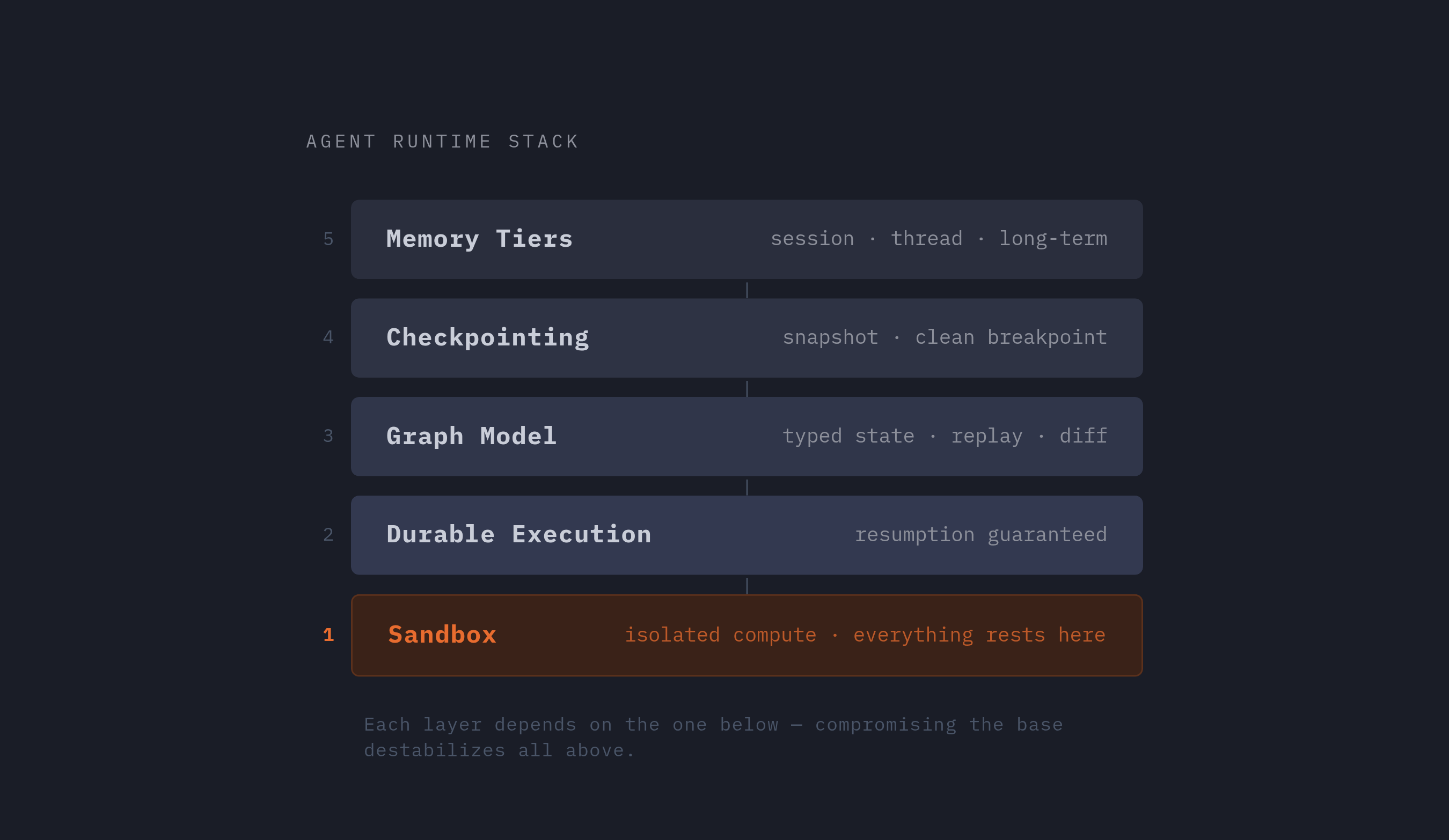
None of this is a single fix. It's a stack: memory tiers that separate what's cheap to store from what needs instant recall, checkpointing that captures progress without betting everything on one giant snapshot, a graph model that makes execution inspectable rather than opaque, durable execution that turns "the workflow should resume" into something the runtime actually guarantees, and a sandbox underneath all of it trustworthy enough to make persisted state worth persisting in the first place.
Skip any layer and the ones above it get shakier. Durable execution without a graph model resumes the workflow but can't explain what happened inside it. A graph without checkpointing is elegant on paper and useless the moment a process dies mid-run. Nothing here matters if the sandbox underneath can be compromised, because then state is a liability instead of an asset, and no amount of clever orchestration above it fixes that.
The gap between the roughly 25% of enterprises reaching production and the 2% reaching real scale traces to infrastructure more than to models, and it's fully specifiable: three memory tiers, checkpointing with a clear mechanism, a graph that's inspectable, durable execution guaranteed at the runtime level, and a sandbox built to hold all of it safely. Teams that keep treating this as a framework choice, something to pick off a shortlist and move on from, are the ones still rebuilding crash recovery by hand a year later. Betting that way is a mistake, and it's an avoidable one. Agents that survive real workloads run on infrastructure built to let them remember, and that infrastructure decision matters more than raw model intelligence ever will.