Multi-Agent Architecture for Production LLM Applications
Most multi-agent pilots fail at scale because teams optimize for models, not infrastructure.
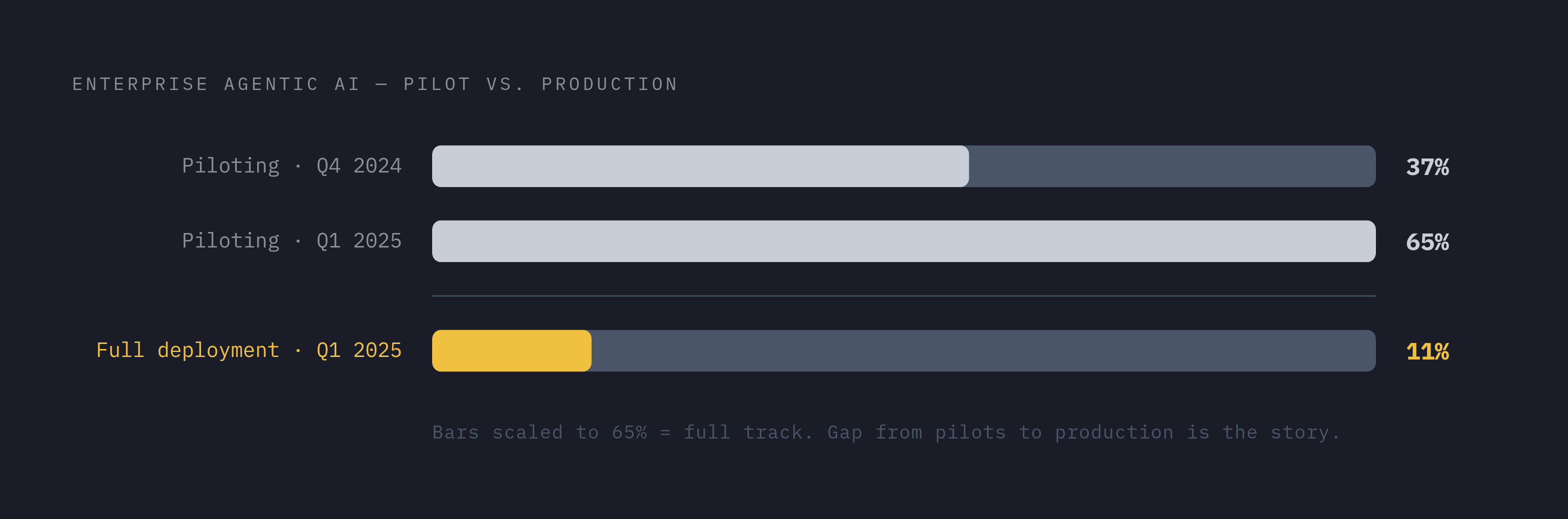
Enterprises running agentic AI pilots jumped from 37% to 65% between Q4 2024 and Q1 2025. But full deployment sits at just 11%. That gap, between the pilot surge and the production wall, is what this piece is about, and the cause isn't what most teams assume.
The instinct, when a multi-agent system stalls, is to blame the model. Maybe the prompting needs work, maybe the reasoning chain needs another few-shot example. Gartner forecasts that 40% of agentic AI projects will be canceled by the end of 2027, citing costs that spiral, business value that never quite materializes, or risk controls nobody bothered to build. KPMG's Q4 2025 AI Pulse Survey found that 65% of leaders point to system complexity as the top barrier, two quarters running. The pattern underneath both numbers is the same: infrastructure built for a different kind of workload, asked to carry one it was never designed for. What follows maps the decisions that actually separate systems that ship from systems that stall out somewhere between demo day and production.
What a multi-agent system actually is, and when one is warranted
Strip away the marketing and a multi-agent system is just this: multiple LLM-backed agents that talk to each other, whether through message passing, a shared memory store, or some orchestration protocol sitting on top. That's the whole definition. But here's where most 2025 and 2026 projects get labeled wrong: if there's one loop that owns the whole decision and just delegates pieces of it out to helper functions, that's a compound single-agent design. It is not multi-agent coordination, whatever the architecture diagram calls it. A fair amount of what gets marketed as "multi-agent" this cycle is really delegated workflow dressed up in fancier language.
So when does the real thing earn its keep? Genuine multi-agent design pays off when a problem benefits from actual role specialization, planning done by one agent, reasoning by another, execution by a third, or when subtasks can run in parallel and cut latency that a single sequential agent couldn't touch. Research architectures like CAMEL and COOPER back this up: modular agent teams complete complex goals more reliably than single-agent baselines, at least on the tasks built to show the difference.
Where it doesn't pay off is everywhere else, and the people building these systems for a living say so plainly. Anthropic's production guidance tells teams to find the simplest solution possible, and notes that a single LLM call plus retrieval covers most applications without any orchestration at all. Shopify's engineering guidance is more direct still: avoid multi-agent architectures early. MIT's framing offers a cleaner test than either of those: extra stages in a pipeline only help when they bring in genuinely new information from outside the system, preserve the details that matter for the final decision, or add a review step that isn't just repeating what came before. Apply that test before reaching for an orchestration framework, not after.
And yet adoption has outrun that discipline. According to Gartner, multi-agent orchestration framework use now stands at 45% of enterprise AI projects, up from 12% in 2023. That's a lot of teams reaching for coordination machinery faster than they're reaching for the question of whether they need it.
How agentic workloads break the infrastructure assumptions behind most cloud stacks
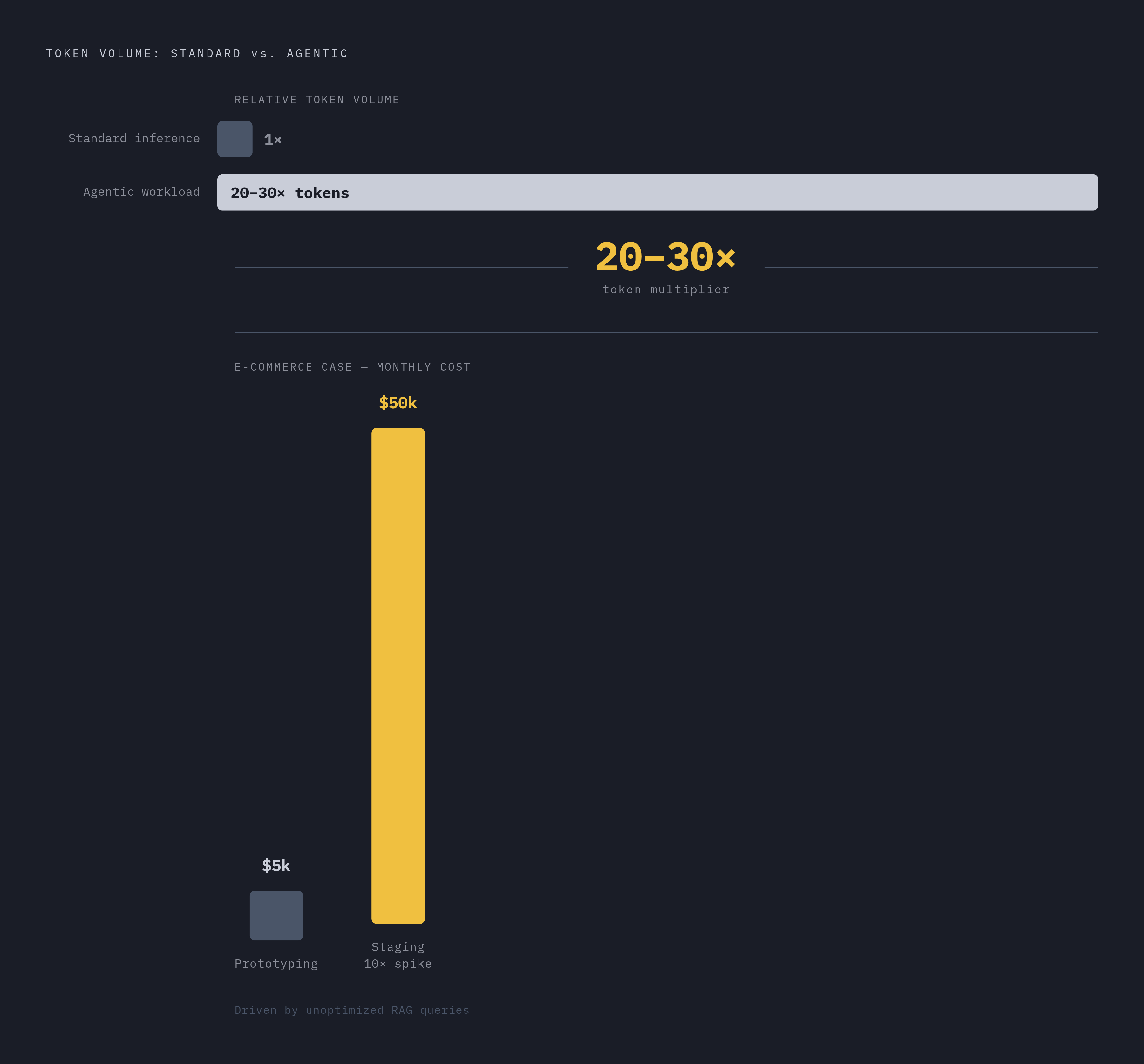
Here's the mismatch at the center of most production failures: cloud infrastructure, as it's been built for two decades, assumes stateless request-response traffic. A request comes in, a server processes it, a response goes out, and the server forgets everything. Agents don't work that way. They need long-running processes, state that persists across steps, the ability to call tools mid-task, and coordination with other agents that might be running on entirely different timelines.
Token consumption alone tells part of the story: agentic workloads run 20 to 30 times the token volume of a standard generative AI call. Infrastructure sized for chatbot traffic or single-inference requests simply can't absorb that kind of multiplier without someone noticing the bill. One mid-sized e-commerce company's agentic supply chain optimizer went from $5,000 a month in prototyping to $50,000 a month in staging, a tenfold jump, driven mostly by unoptimized RAG queries pulling in far more context than any single decision actually needed.
Execution time limits make this worse. Platforms built around minute-scale execution caps assume the client stays connected the whole time the work happens. Agents break that assumption constantly: a task might run for hours, get interrupted, and need to pick back up exactly where it left off without the original client connection surviving that whole span. What's needed instead is an execution environment that decouples runtime from connection entirely. Send the input, disconnect, come back hours later, resume.
Scaling compounds the issue further. Horizontal scaling for a web server means handling more HTTP requests. Horizontal scaling for agents means handling more concurrent sessions, each carrying its own persistent state, each potentially needing different compute for orchestration versus inference, each needing low-latency networking to talk to other agents in the same workflow. These are not the same scaling problem, even though they get treated as if they are.
More than 80% of AI projects never reach production, and weak infrastructure is a primary reason why. Teams that bolt agent execution onto infrastructure built for something else report higher incident rates and more operational overhead than teams that design for the workload from the start. That's not a coincidence worth explaining away.
Orchestration patterns and the frameworks teams are actually using in production
The orchestration layer is the piece that sits between the models and the execution environment. It handles routing, shares state across agents, delegates tasks, and manages the back-and-forth communication that makes multi-agent coordination possible at all.
Three patterns dominate production use today. Hierarchical setups, an orchestrator directing specialized subagents, are the most common, especially for role-based decomposition. Pipeline patterns chain agents in sequence, each one transforming the last agent's output, which fits document processing and code review chains particularly well. Parallel fan-out works when subtasks are genuinely independent and latency is the thing you're optimizing against. Each pattern fails in its own characteristic way: hierarchical systems bottleneck at the orchestrator when it becomes the single point every decision has to pass through, pipelines accumulate errors as they move from stage to stage, and parallel systems live or die on how well they aggregate results at the end.
The framework landscape has settled into a rough hierarchy by late 2025. LangGraph is a leading open-source choice for Python-first teams, modeling agent behavior as stateful graphs with typed state objects and checkpoint-based persistence baked in, and platforms like Daytona, which provisions isolated sandboxes for AI-generated code, are commonly paired with it at the execution layer. It has gained broad adoption among production engineering teams. Amazon Bedrock AgentCore went generally available in October 2025 as a framework-agnostic managed platform, able to run LangGraph, CrewAI, Google ADK, or the OpenAI Agents SDK on enterprise infrastructure with policy enforcement built in. Microsoft folded AutoGen and Semantic Kernel together into a unified Microsoft Agent Framework in late 2025, with general availability on GitHub expected early 2026. OpenAI's own Agents SDK stays deliberately minimal, just four primitives (agents, handoffs, guardrails, sessions), leaving the harder orchestration decisions to whoever builds on top of it. CrewAI holds a solid second tier for role-based orchestration, though teams commonly report hitting scaling walls somewhere between six and twelve months in.
Kubernetes is moving in the same direction from the infrastructure side. In March 2026, Kubernetes SIG Apps published an introduction to Agent Sandbox, a new CRD-based abstraction built specifically for singleton, stateful agent workloads. The maintainers didn't recommend teams cobble one together from existing Kubernetes primitives; they built a dedicated one. That's worth sitting with for a second: when the people who maintain the scheduler decide the existing resource types aren't enough, that's a fairly strong signal about how different this workload actually is.
None of this substitutes for the harder work, though. Picking a framework answers the orchestration question. It doesn't answer the execution question, and those two questions get conflated more often than they should.
Why isolation is non-negotiable when agents write and run their own code
Among everything an agent might do, writing and running its own code is the one capability most likely to escalate into a full remote code execution problem on the host system, if it isn't properly contained. That's not a hypothetical risk category. It's the specific one that keeps security teams up.
The posture that follows from this is straightforward, even if it's uncomfortable: treat all AI-generated code as potentially hostile. Not because the model has bad intentions, it doesn't have intentions at all in any meaningful sense, but because its behavior is unpredictable, and because the capability ceiling keeps rising. Frontier models' success rate on apprentice-level cybersecurity tasks went from under 10% in late 2023 and early 2024 to roughly 50% in 2025. A sandbox designed around what a 2023 model could do is not the same sandbox you need for what a 2025 model can do, and that gap only widens from here.
There's a separate research finding worth sitting with: LLM-generated code patches introduce new security vulnerabilities in 9.5% of cases, even in the same act of fixing the original bug. Now put an agent in charge of running its own fixes automatically, and that 9.5% compounds every time it happens without a human checking the work.
The incidents aren't abstract either. In July 2025, an AI coding agent deleted a production database during what was supposed to be a test project. In early 2026, PromptArmor disclosed a vulnerability in Snowflake's Cortex Code CLI, where an indirect prompt injection combined with weak command validation let AI-generated instructions slip past human-in-the-loop approval, escape the CLI's sandbox mode, run arbitrary code, and reach cached credentials. And CVE-2024-21626, known as "Leaky Vessels," was a file descriptor leak in runc that allowed container escape and access to the host filesystem, a reminder that the risk isn't confined to the agent framework itself. The underlying container runtime is its own attack surface, with its own history of exploits.
Put those together and the principle writes itself: without real isolation, every code execution an agent runs is a potential security incident. Not a theoretical one, an active one, waiting on the wrong combination of inputs.
The isolation technologies teams use to contain untrusted execution
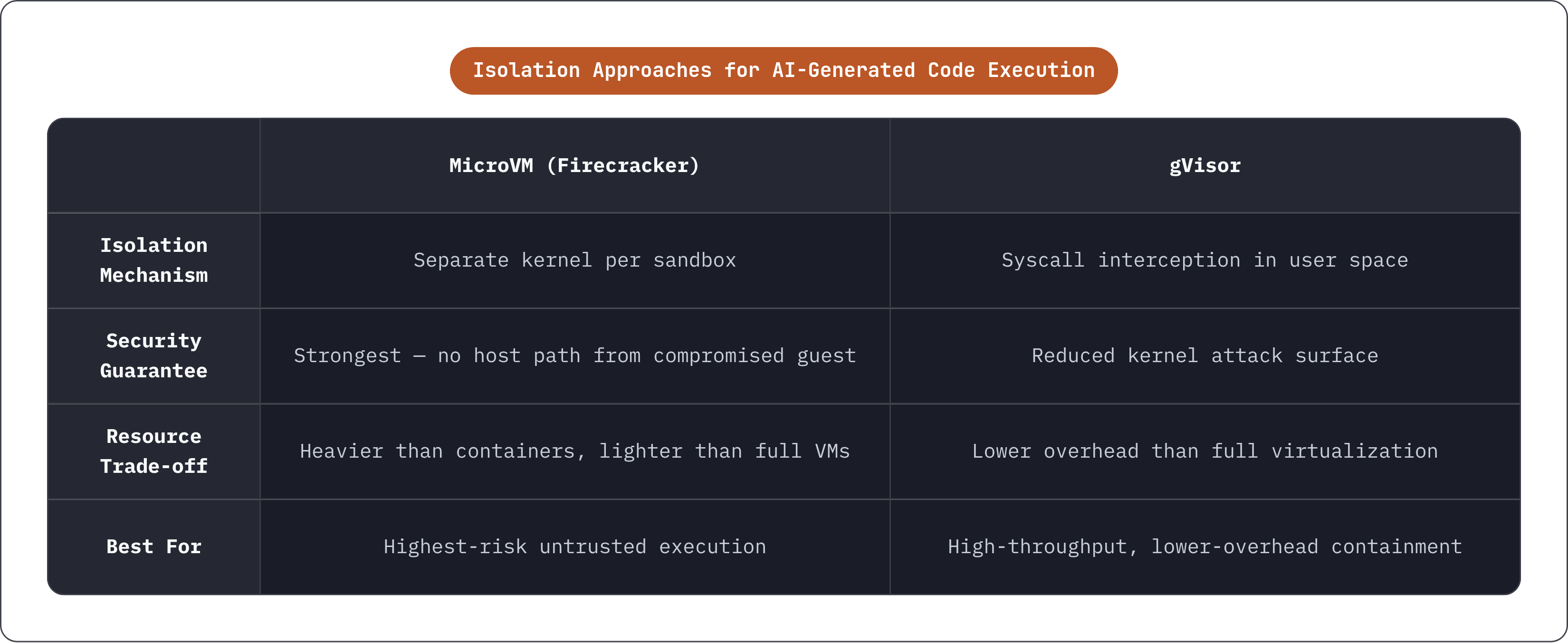
Two approaches have reached real production scale for containing this risk. MicroVM isolation, Firecracker being the most widely deployed example, gives each execution environment its own kernel, so a compromised guest has no path to the host or to any other sandbox running alongside it. This is the strongest security guarantee available for untrusted, AI-generated code. gVisor takes a different route: it intercepts system calls in user space through what's effectively an application kernel, cutting down the attack surface for kernel-level exploits without carrying the overhead of running a full virtual machine for every task.
Both approaches share the same underlying design principle. Neither one is just "run it in a container and call it done." The goal is combining the security and workload isolation you'd get from a traditional VM with the speed and resource efficiency of a container, without settling for whichever one is easier to ship.
What does this look like at real scale? Northflank processes more than 2 million isolated workloads a month using Kata Containers and gVisor together, which gives some sense of how far this pattern has moved past the experimental stage.
Speed matters just as much as the security guarantee, maybe more, for agentic workloads specifically. Sub-25 millisecond resume times are achievable on microVM platforms today, restoring a full filesystem, memory state, and running processes almost instantly. That matters because cold start penalties compound fast across a multi-step agent workflow: an agent making a dozen sequential tool calls, each with its own cold start, ends up spending more time waiting on infrastructure than doing actual work. Isolation that slows the agent down defeats its own purpose.
So what should a team weigh when picking between approaches? Isolation strength is the first axis, kernel-level separation versus syscall interception, and how much that difference matters given what the agent is actually running. Startup latency is the second: whether cold starts or resume times fit the concurrency the workload expects. Statefulness is the third, whether the environment survives between tool calls or has to be rebuilt from scratch every time. And compliance doesn't go away just because execution happens inside a sandbox; SOC 2, HIPAA, and GDPR requirements still apply to whatever data passes through, wherever it's isolated.
State management and checkpointing across long-running agent workflows
Here's a problem that sounds small until it happens to you: a multi-step agent workflow routinely runs longer than any single compute session is built to last. Without durable state sitting underneath it, a failure at step 14 of a 20-step task means starting over from step 1. All the work, all the tokens spent getting to step 14, gone.
Checkpointing changes that math directly. A failed agent resumes from the last successful node instead of the beginning, and in a long-running enterprise workflow, that difference can save hours of LLM compute every time something breaks. It's not a nice-to-have; it's the difference between a system that's economically viable to run at scale and one that isn't.
LangGraph's approach is the most widely adopted pattern in open source right now. It models agent behavior as a stateful graph, where nodes are functions or tool calls, edges represent control flow, and every node shares a typed State object that gets passed along. Checkpoint-based persistence built on top of that graph enables resumption after failure, lets a human inspect what happened mid-run, gives the system a form of memory, and supports something LangGraph calls time travel: rolling state back to any earlier checkpoint and resuming down a different path entirely. LangGraph Server adds the production scaffolding most teams would otherwise end up building themselves: horizontally scalable task queues, background runs, cron scheduling, webhooks, durable execution that survives a restart.
Where that state actually lives is its own decision, and it sits on a spectrum. In-memory storage is fast but ephemeral, gone the moment the process dies. External stores, Redis, PostgreSQL, vector databases, trade some of that speed for durability, sharing across agent instances, and the ability to query state later for an audit. Which end of that spectrum a team should land on depends entirely on whether the state needs to survive a restart, be visible to more than one agent, or hold up under compliance review months later.
Human-in-the-loop checkpoints deserve to be understood as more than a reliability feature bolted on for peace of mind. They're what makes a multi-agent system safe enough to run in a regulated or high-stakes context in the first place, and time travel is what makes rollback possible without re-running every expensive upstream step just to fix one mistake downstream.
LangChain's 2025 State of AI Agents report found that a majority of organizations now run AI agents in production, and quality, not cost, is the primary barrier holding back wider deployment. Reliability and observability, the two things checkpointing exists to enable, are effectively what "quality" means at this point in the industry's maturity. Which leads directly into the next problem: knowing whether a system is actually reliable requires seeing what it's doing, and most teams can't.
Observability and the transparency gap that keeps agents from earning trust in production
A comprehensive AI Agent Index reviewing deployed agent systems found that only 4 of 30 provide agent-specific system cards, and only 9 of 30 report capability benchmarks at all. Read that again: the majority of production agent deployments ship with no meaningful transparency artifact attached to them whatsoever. Not a weak one, none.
Observability for a multi-agent system is not the same discipline as application monitoring, and treating it as though it is might be the single most common mistake in this whole stack. It means tracing individual agent decisions across a run that spans multiple steps and multiple agents, not just logging what went in and what came out. It means attributing cost to a specific agent, a specific task, a specific path through the orchestration graph, so that a $50,000 monthly bill can actually be traced back to the query that caused it. It means catching drift between how a system performed on a benchmark and how it behaves once real users and real data start hitting it. And for regulated workflows, it means a genuine audit trail: which agent took which action, on whose behalf, at what point in the state graph.
Benchmarks, it turns out, transfer poorly to production performance. SWE-bench Pro, introduced in September 2025 with 1,865 problems across 41 repositories, shows even the best models scoring around 23% on its public subset and somewhere between 15% and 18% on the private subsets held back from training data contamination. A separate benchmark focused on agentic reasoning traces found state-of-the-art models scoring under 11% across more than 20 distinct failure types. Those are not rounding errors; they're a sign that a model's benchmark score tells you very little about how it will behave inside a live, multi-agent production pipeline.
What follows from that is not comfortable, but it's the honest conclusion: teams cannot use benchmark performance as a proxy for production reliability. Observability infrastructure is the only real way to know what a system is actually doing once it's live, and that's true whether or not the benchmark numbers look good on the slide. Open, inspectable execution environments matter here too. When the runtime is a closed box, observability is limited to whatever the vendor decides to expose, and that's a real constraint, not a minor inconvenience. When the execution layer can be instrumented directly, teams can build the tracing they actually need instead of the tracing they were given.
The practical version of this comes down to a handful of concrete signals worth capturing: structured logs per agent turn, token usage at each step, tool call latency, and the distribution of failure types across a run. None of that is glamorous. It's also the entire difference between a multi-agent system that earns trust in production and one that stalls out as another pilot nobody quite trusted enough to ship.