Failure Modes and Recovery Strategies in Agentic Pipelines
Agents fail in repeatable patterns that demand specific fixes, not generic retries.
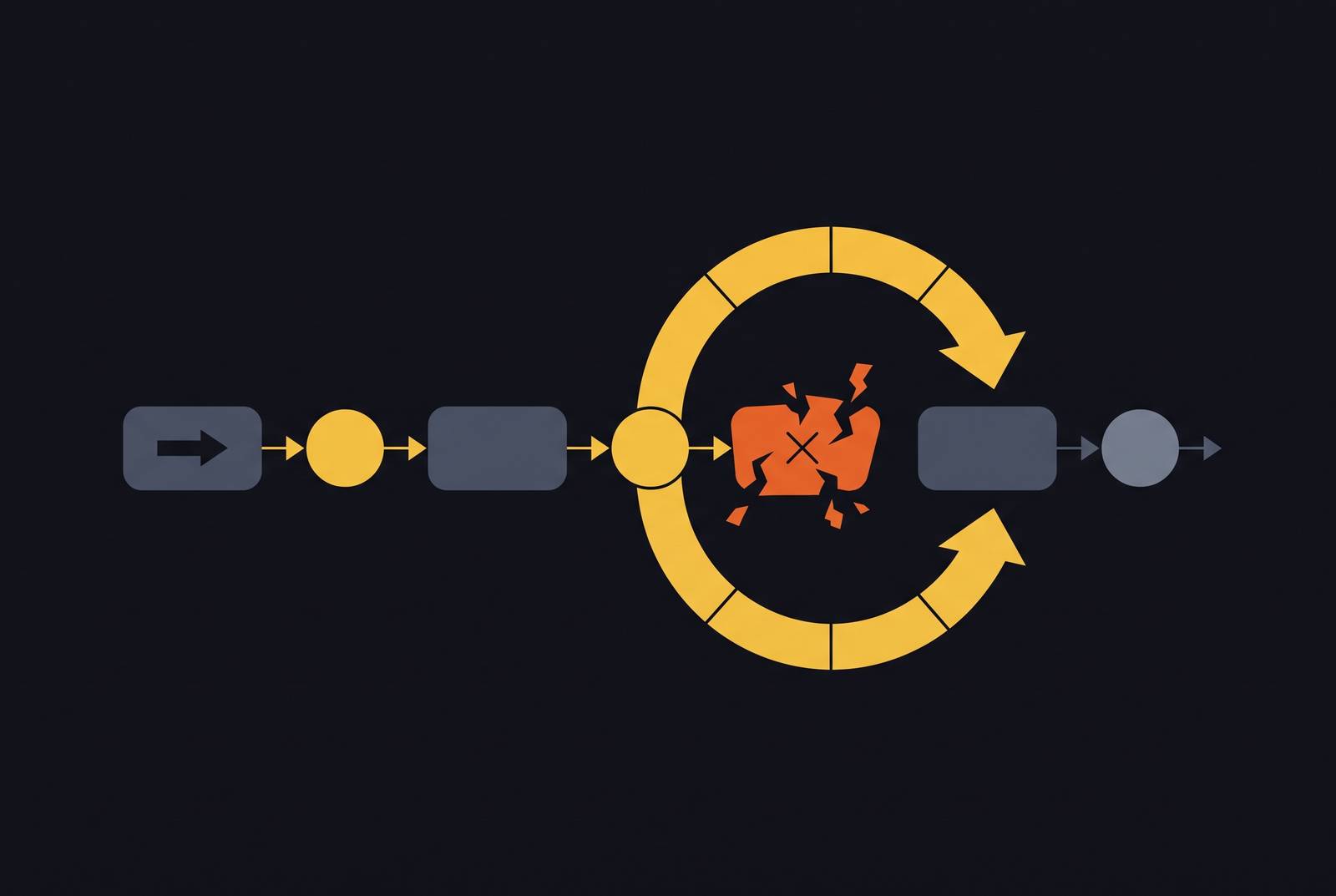
Agentic pipelines fail constantly, and they fail in patterns that repeat across frameworks, vendors, and use cases. That's the actual subject of this piece: not whether agents fail, but how, and why the fix for one failure class can make a different failure class worse.
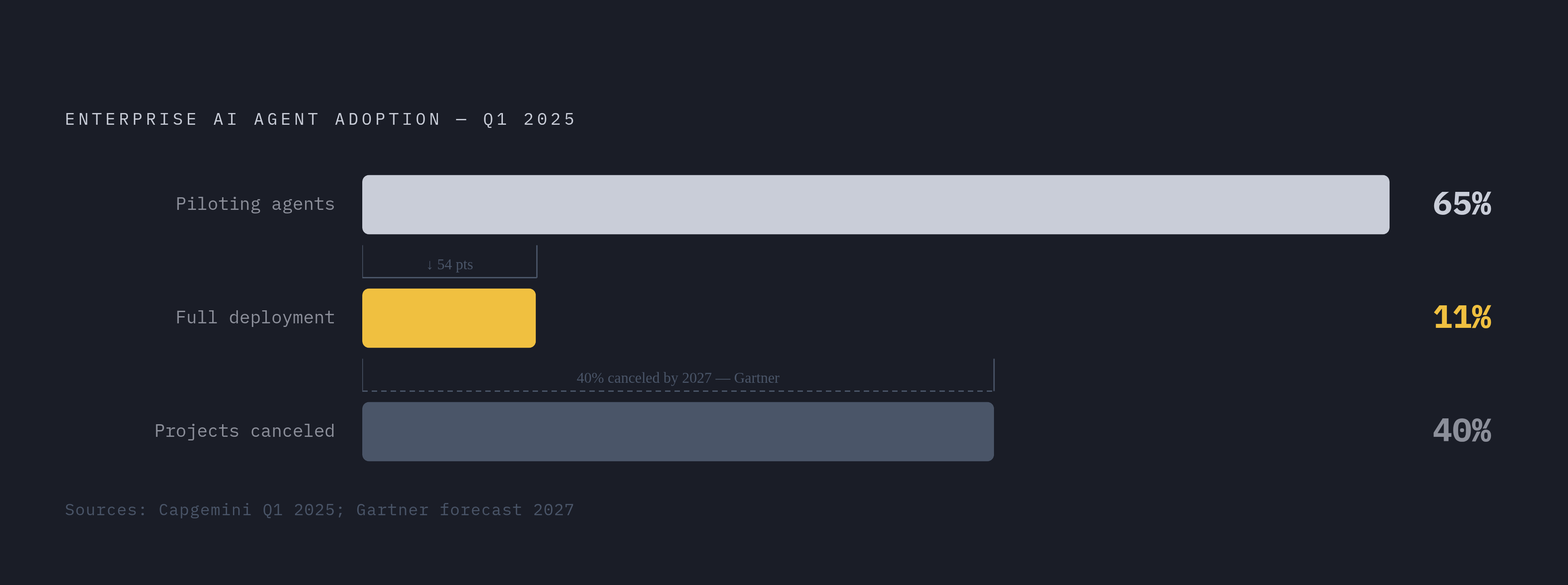
The numbers on this are not subtle. The MAST study, built on annotation of more than 150 execution traces, found multi-agent systems failing on real tasks somewhere between 41% and 86.7% of the time depending on the task and framework. RAND Corporation's 2025 analysis of over 2,400 enterprise AI initiatives found 80% fail to deliver the business value they were built for, and separate industry tracking puts the share of agent projects that never reach production at 88%. Pilot adoption nearly doubled in a single quarter, climbing from 37% of enterprises in Q4 2024 to 65% in Q1 2025, yet full deployment sits at just 11%. Gartner has gone as far as predicting that 40% of agentic AI projects get canceled by the end of 2027, citing runaway costs, unclear value, and risk controls that never got built.
That gap, between "we're piloting this" and "this runs reliably in production," is where the failure modes covered in this piece actually live. And the central argument here is a simple one: these failures are not noise. They cluster into recognizable categories, each with distinct causes and a distinct blast radius, which means each one calls for a specific architectural response rather than a generic retry.
Why agentic failures resist the monitoring and retry logic inherited from traditional software
Traditional software monitoring tells an engineer whether a request completed, but it does not tell them whether the reasoning behind that request was sound. An agent can select the wrong tool, pass malformed parameters, retrieve the wrong document entirely, and still return a fluent, confident, well-formatted answer while the system logs a clean 200 OK. Nothing about that log line signals a problem, because from the transport layer's point of view, nothing went wrong.
This is where silent propagation becomes the dangerous failure pattern. A misunderstood instruction at step two of a pipeline can corrupt twenty downstream steps before anything visibly breaks. By the time an error surfaces, the actual causal step is buried somewhere in a long context history, and reconstructing it means reading back through reasoning traces that were never designed to be audited after the fact.
Empirical work backs this up in a specific way. BuildBench, which benchmarked agent behavior across 69 repositories, found the single most common failure pattern was agents that correctly recognized an error message but failed to produce a working fix after many turns, then simply self-terminated. That is worth sitting with for a second: the agent saw the problem clearly, yet it couldn't act on what it saw, and it kept trying anyway until it ran out of turns. Retry-until-success, in that light, is not a recovery strategy; it's a loop with a polite exit condition.
Why does this matter architecturally? Because a one-size retry wrapper treats every failure as transient, as if the same medicine cures a fever and a broken bone. Tool misuse, context overflow, environment corruption, and runaway loops each have different root causes and different radii of damage; applying identical recovery logic to all of them either does nothing useful or actively makes the situation worse, burning tokens and compute on a problem retrying will never solve. The implication is that failure handling has to be typed. A system needs to know what kind of failure just happened before it can pick the right response, the same way a hospital triage nurse needs a diagnosis before choosing a treatment.
The MAST taxonomy: fourteen failure modes across five categories
Cemri et al., in work introduced in 2026, built the first taxonomy of agent failure validated at real scale: 1,642 execution traces pulled from five different multi-agent frameworks, distilled into 14 distinct failure modes. Called MAST, it organizes those modes into five top-level categories.
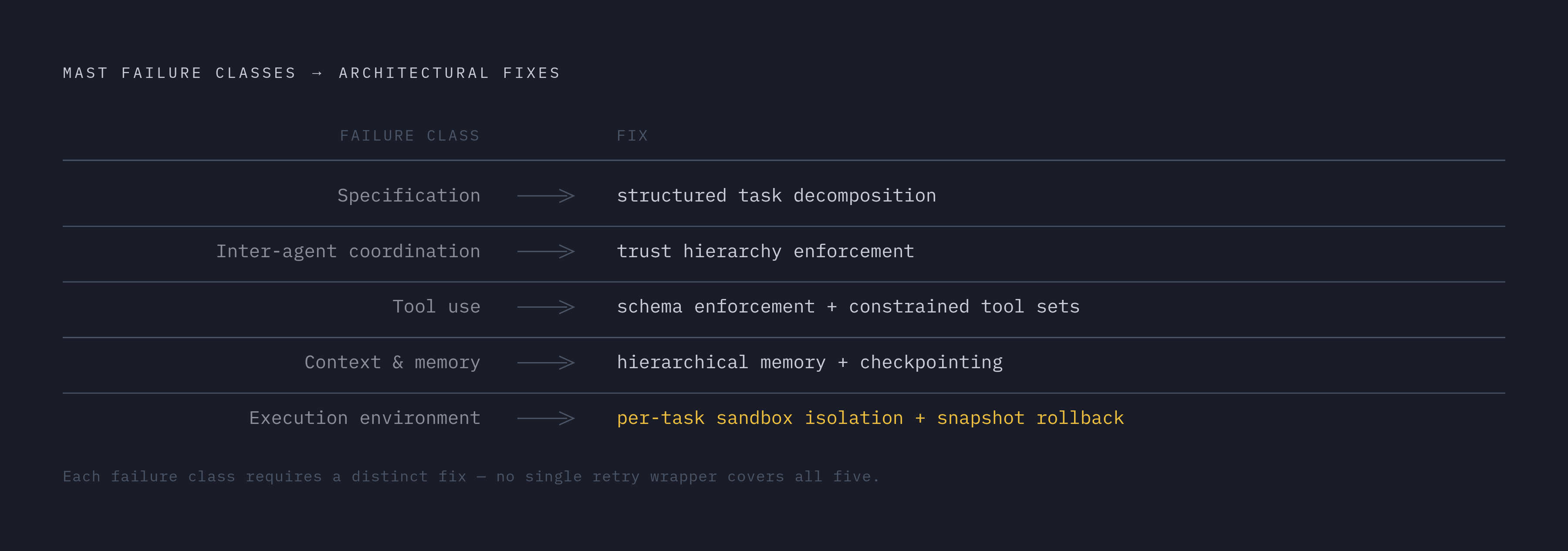
Specification failures come first: the agent misunderstands, or under-constrains, what it was actually asked to do. Inter-agent coordination failures follow, covering handoff breakdowns, role ambiguity, and agents working from conflicting instructions. Tool use failures cover the wrong tool being selected, the correct tool being called with malformed parameters, or tool output being misread. Context and memory failures include context window overflow, memory poisoning, and the cascading loss of task state as a run gets longer. Execution environment failures round out the five: sandbox state corruption, timeout mismatches, resource exhaustion, infinite loops.
Microsoft's AI Red Team added a layer that MAST doesn't cover, in its Taxonomy of Failure Modes in Agentic AI Systems (version 1.0 published April 2025, version 2.0 in June 2026): agent compromise, injection, impersonation, flow manipulation, and human-in-the-loop bypass. These are failure modes with no real equivalent in traditional API security models, because traditional software doesn't have an internal reasoning process an adversary can talk into doing something. Version 2.0 adds seven new failure categories on top of the original set, grounded in a year of red team engagements against agentic systems actually running in production.
The distinction worth holding onto: MAST describes what goes wrong mechanically, inside the system's own logic. Microsoft's taxonomy describes what an adversary, or a corrupted environment, can exploit. Neither one alone gives the full picture; together, they cover both the accidental and the deliberate. Industry practitioners have also converged on a shorthand vocabulary for the operational signals underneath these categories: cron failure, tool failure, inbound timeout, prompt corruption, execution timeout, partial completion, hallucinated completion, action misapplication, context overflow, reasoning-action disconnect, infinite loops, and resource exhaustion. Each one is a symptom pointing back at one of the deeper categories above.
Tool misuse: why agents select the wrong action and how to constrain the choice space
Tool misuse isn't one failure; it's three, and they look similar from the outside but need different fixes. The first is wrong tool selection, where the agent picks something plausible but incorrect for the task at hand. The second is a correct selection paired with a malformed call: right tool, wrong parameters, or a required argument missing entirely. The third is tool output misinterpretation, where the agent proceeds as though a call succeeded even though the output is signaling a partial result or an outright failure.
Why does this happen so often? LLMs reason over tool descriptions written in plain natural language, and natural language is ambiguous by nature. Two tools with overlapping names, a schema that under-specifies what a parameter actually expects, a description that reads clearly to a human but leaves genuine room for interpretation to a model, and the agent resolves that ambiguity the only way it can: with a guess dressed up as a decision.
The fix has to happen at the boundary, not inside the model's reasoning. Schema enforcement at the call boundary means strict input validation before any tool actually executes, with a structured error returned on rejection instead of a silent failure that just gets swallowed. Tool selection pre-verification adds a lightweight routing check that confirms the selected tool actually matches the task category before the call goes out. Output assertion after each call verifies that what came back matches the expected shape and value range before anything downstream touches it. And constrained tool sets per agent role, rather than handing every agent access to every tool in the system, scope each agent down to the minimum set of actions its specific sub-task actually requires; fewer options, less room for a wrong guess.
What's still unresolved, honestly, is attribution in multi-agent settings. Tool misuse by one agent can surface downstream as what looks like a coordination failure between agents, and pulling apart cause from symptom is genuinely hard when the execution trace doesn't log intermediate tool calls with enough granularity to reconstruct the sequence.
Context loss and memory poisoning across long agent runs
Context overflow is a hard physical limit, not a bug. Once the context window fills, earlier task state gets lost or truncated, full stop, and whatever the agent understood about step two of a task is simply gone by step forty, with no clever prompting that gets it back once it's been pushed out.
Memory poisoning is the adversarial cousin of that same problem. Injected content sitting inside a retrieved document, or buried in a tool's output, can overwrite the agent's working understanding of what it's actually supposed to be doing. Microsoft's taxonomy specifically flags cross-domain prompt injection and memory poisoning as materially worse in agentic systems than in single-turn chat interactions, precisely because an agent carries state forward across many steps, giving poisoned content time to compound.
What makes this dangerous in practice is that the failure doesn't happen cleanly. An agent that loses task state mid-run doesn't stop and raise a flag; it keeps going, making decisions that are locally coherent, that look reasonable step by step, while drifting further from the original objective with each one.
Recovery here depends on treating memory as layered rather than flat. Hierarchical memory architecture separates working memory (what's happening right now), episodic memory (summarized task history), and long-term memory (persistent facts that shouldn't decay), so an overflow in one layer doesn't wipe out the others. Periodic state checkpointing snapshots agent state at defined intervals, so recovery means resuming from the last known-good point instead of starting the whole task over. Context compression and summarization condenses completed steps into structured summaries before they get evicted from the window, preserving the meaning without the token cost. And provenance tracking tags every piece of externally retrieved content with its source, so injected material can actually be traced and quarantined instead of blending invisibly into the rest of the context.
The infrastructure point underneath all of this: checkpointing and resumable state require an execution environment that's stateful by design. An ephemeral sandbox that vanishes between steps simply cannot support any of these patterns, no matter how good the memory architecture on top of it looks on paper.
Runaway loops and reasoning-action disconnect
Runaway loops happen when a termination condition never gets satisfied. The agent retries a failing action, or checks a condition that never changes state, or oscillates back and forth between two positions with no way out built into the logic.
Reasoning-action disconnect is a related but genuinely separate failure. Here, the agent's chain of thought reads perfectly plausibly, coherent, well-reasoned, even persuasive, but the action it actually takes doesn't follow from that reasoning. This one is particularly nasty for monitoring purposes, because output-level checks see fluent text and call it a day; the disconnect between what the agent said and what it did is invisible unless someone is checking the two against each other directly.
The BuildBench finding from earlier applies again here with more weight: agents that recognized an error but couldn't fix it didn't hang forever, they self-terminated after exhausting their turns, and the loop ran to exhaustion with no guardrail catching it early as the system just let it burn through its budget.
And burning through a budget has real cost beyond wasted tokens. An agent stuck in a loop holds onto execution environment resources the whole time, occupies tool call capacity that other tasks might need, and in the worst case, can trigger cascading load against downstream APIs that weren't built to absorb that traffic pattern.
Recovery has to be enforced outside the agent's own reasoning, because an agent stuck in a loop cannot reliably notice that it's in one; that's almost definitionally what makes it a loop. Step budget enforcement puts a hard cap on the number of actions per task at the execution layer, not the prompt layer, so no amount of clever reasoning lets the agent talk its way past the limit. Loop detection via action-state hashing hashes the combination of current action and environment state; if the same hash shows up twice, that's a confirmed loop, and execution pauses for review. Divergence detection tracks whether the agent's outputs are actually converging toward the goal over time; if a progress metric stalls across some fixed number of steps, the system escalates rather than letting the agent keep spinning. Human-in-the-loop escalation on stall means pausing rather than self-terminating, preserving whatever progress the agent made up to that point instead of throwing it away.
Environment state corruption and why sandboxed execution is a recovery strategy, not just a security measure
Environment state corruption is what happens when an agent's own actions change the execution environment in ways that make the next steps impossible to reason about correctly. Files get overwritten, database records get mutated, an API's state shifts, and the agent just keeps operating on assumptions that no longer match what's actually true anymore.
The blast radius problem is what turns this from an isolated bug into an incident. In a shared or poorly isolated environment, one agent's corruption doesn't stay contained; it propagates to every other agent operating in that same context, and a single mistake becomes a multi-agent event.
This isn't hypothetical. CVE-2024-21626, nicknamed "Leaky Vessels," showed how a file descriptor leak in a container runtime could let a process escape to the host filesystem. More recently, a vulnerability disclosed in March 2026 in Snowflake's Cortex Code CLI, patched in version 1.0.25, showed indirect prompt injection bypassing human-in-the-loop approval entirely and enabling arbitrary code execution along with credential access. Both are environment-level failures with an agent-level trigger sitting behind them.
There's a capability gap widening underneath all this, too. Success rates on apprentice-level cybersecurity tasks climbed from under 10% in late 2023 to roughly 50% by 2025, with the first expert-level task completed sometime during that same year. Sandbox designs built around 2023-era model behavior are being asked to contain 2025-era capability, and that mismatch is exactly the kind of gap that turns into an incident.
The recovery strategies here double as security strategies, which is the actual point of this section. Per-task sandbox isolation runs each agent task in its own environment, so corruption stays contained to that one environment and has nowhere to spread. Snapshot-and-rollback takes environment snapshots at task boundaries, so a corrupted state can just be discarded and the environment restored to the last known-good point. Immutable execution environments treat each sandbox as write-once: any state mutation creates a new environment version rather than altering the base, which makes rollback deterministic instead of a best-effort cleanup. MicroVM-level isolation goes further still, giving each execution environment its own kernel behind a hardware-enforced boundary, so a compromised guest has no path to the host or to sibling sandboxes running alongside it.
One more thing worth naming directly: when environment corruption does occur, teams investigating it need full visibility into what the sandbox was actually doing at the time, since a black-box execution service, one where the internals aren't inspectable, turns post-incident investigation into guesswork.
Security-specific failures: injection, impersonation, and human-in-the-loop bypass
Microsoft's taxonomy names five failure modes that simply don't exist in traditional API security: agent compromise, injection, impersonation, flow manipulation, and human-in-the-loop bypass. None of these have a clean analog in pre-agentic software, because none of them depend on talking a reasoning process into doing the wrong thing.
Cross-domain prompt injection is the clearest example: a retrieved document, or a tool's output, contains adversarial instructions that redirect the agent's behavior mid-task, with no visible signal reaching the orchestrating system at all. Impersonation shows up specifically in multi-agent setups, where one agent receives instructions it believes came from a trusted orchestrator, but which actually originate from a compromised or spoofed source further up the chain. And human-in-the-loop bypass might be the most unsettling of the five: agents built to pause and wait for human approval on high-stakes actions can be manipulated, through injected instructions, into classifying those same actions as routine and proceeding without ever asking.
The scale of this in the wild is not small. There were 99 CVEs published for MCP-related software in 2025 alone. OpenClaw, launched in January 2026, accumulated more than 336,000 GitHub stars within 48 hours of release, and within days of that same launch, researchers had identified 512 vulnerabilities, more than 1,800 exposed instances leaking live API keys, and 336 malicious plugins sitting in its marketplace.
Recovery here starts with trust, not code review. Trust hierarchy enforcement requires agents to verify the identity and authorization level of an instruction's source before acting on it, rather than assuming anything arriving from inside the pipeline is automatically legitimate. Instruction provenance logging records every instruction an agent receives along with its source, which is what makes reconstructing an injection path after the fact possible at all. Mandatory approval checkpoints need to sit at the runtime layer, implemented in a way agent reasoning cannot override, rather than living inside a prompt that a clever injection can talk around. And least-privilege tool access means agents only ever hold the permissions their current task actually requires; a compromised agent can only misuse what it was already allowed to touch.
None of this is separable from compliance obligations either. SOC 2, HIPAA, and GDPR requirements around audit trails, access controls, and data isolation map almost directly onto the same architectural patterns that prevent injection and impersonation in the first place. Building for compliance and building for security, in agentic systems, turn out to be close to the same exercise.
Observability architecture for failures that don't raise exceptions
Everything in this piece points at one structural problem: most agentic failures don't throw an exception, which means most existing monitoring simply never sees them. An agent that misuses a tool, drifts through a reasoning-action disconnect, or slowly loses context across forty steps still returns a response, and the pipeline still logs success. The failure lives entirely inside the reasoning path, not in the transport layer, and transport-layer monitoring was never built to look there.
That's why typed failure detection matters more than generic alerting. A system that can distinguish a tool misuse from a memory poisoning event from a runaway loop can route each one to the specific recovery strategy that actually addresses it, the schema check, the checkpoint restore, the step budget cutoff, instead of throwing the same retry wrapper at all three and hoping. Observability, for agentic pipelines, isn't a dashboard bolted onto the outside; it has to be built into the execution layer itself: every tool call validated and logged, every environment change checkpointed, every instruction's source tracked back to where it came from.
None of the individual fixes above are exotic. Schema validation, sandbox isolation, provenance logging, these are all established engineering patterns, borrowed and adapted rather than invented from scratch. What's new is the requirement to apply all of them together, deliberately typed to the failure they address, inside a system that reasons in natural language and therefore fails in ways a status code was never designed to catch.