Agent Evaluation Tools Across the Dev Lifecycle
Different tools work at different stages of agent development, not just one platform for all.
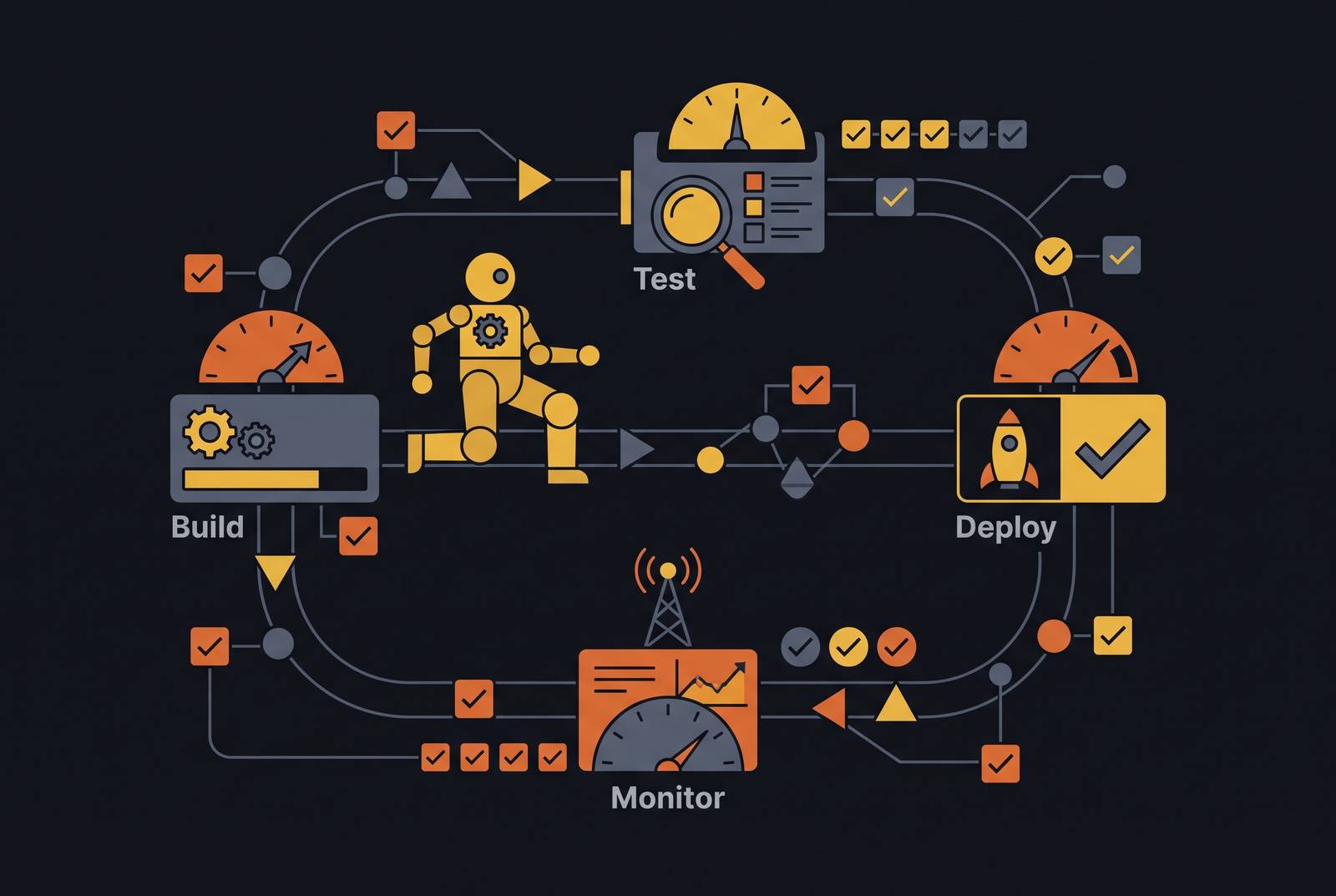
Agent evaluation is a running discipline that shifts shape at every stage of development, from the first synthetic test run through months of live traffic, and the tools that work at one stage often fail at another. It is a running discipline that shifts shape at every stage of development, from the first synthetic test run through months of live traffic, and the tools that work at one stage often fail at another. That mismatch, more than any single modeling flaw, explains why so many agents look sharp in a demo and fall apart once real users start typing into them.
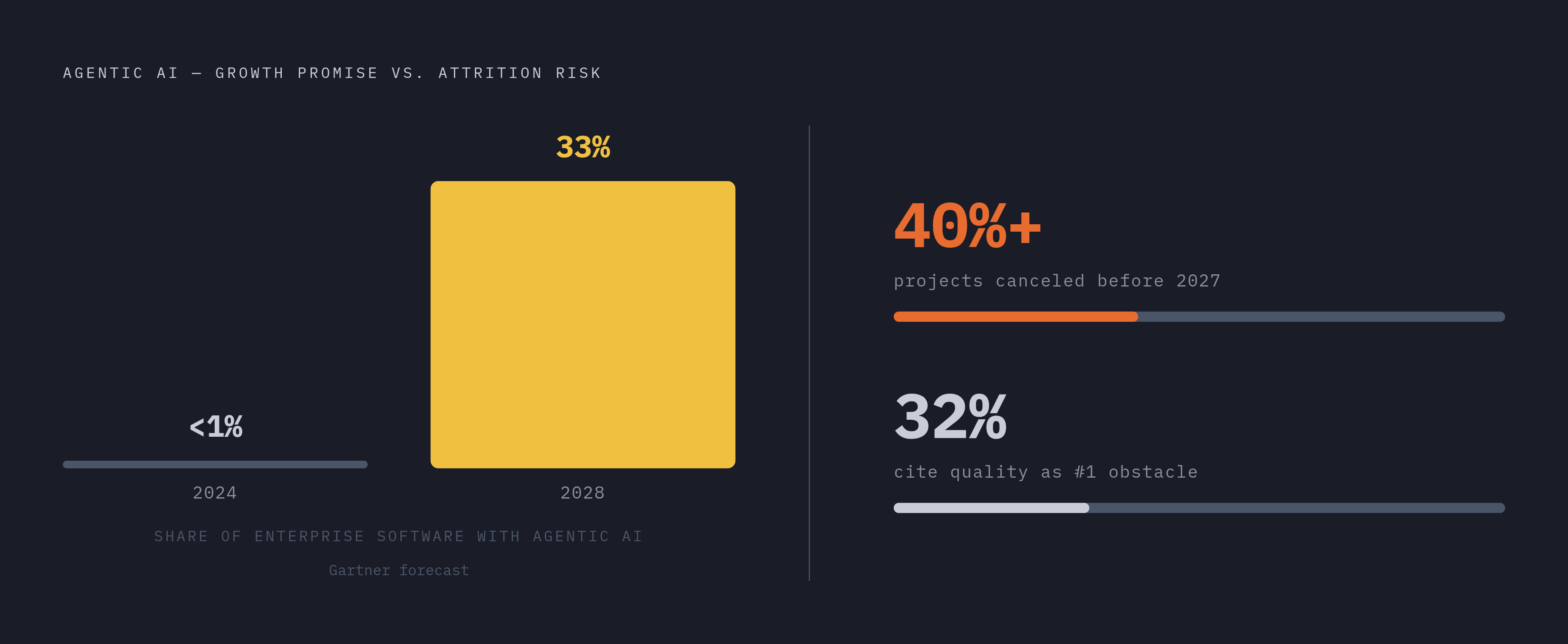
The gap is not small. LangChain's 2026 State of AI Agents report found that 57% of organizations already have agents running in production, yet 32% still name quality as the biggest obstacle to shipping more of them. Gartner's forecast sharpens the stakes further: agentic AI will show up in 33% of enterprise software by 2028, up from under 1% in 2024, but more than 40% of agentic AI projects will get canceled before 2027. Evaluation is the discipline meant to close that gap, so why don't so many projects make it?
Part of the answer sits in how agents behave. Traditional software testing assumes a fixed path: same input, same output, every time. Agents break that assumption structurally. They are non-deterministic, multi-step, and tool-using, so the same prompt can send one run down a database query and another down an API call, with different reasoning chains stitched together in between. One bad decision early in that chain does not just produce a wrong answer. It cascades, because every step downstream inherits the error from the step before it.
Making sense of that requires breaking evaluation into pieces smaller than "did it work." Four dimensions do most of the diagnostic work: reasoning quality (is the plan logically sequenced), tool selection accuracy (did the agent pick the right tool at each step), conversation quality (does it hold context across multiple turns), and trajectory efficiency (how many steps did it take relative to the shortest reasonable path). Each of these needs different signals, collected at different points in the lifecycle, which is why experimentation, pre-release testing, CI/CD gating, and production monitoring end up needing different tools rather than one platform doing everything adequately.
What the four evaluation dimensions require from tooling
Reasoning quality can only be judged if the evaluator sees the whole execution trace, not just the final answer. A framework that grades the last response and nothing else is blind to plans that went wrong three steps earlier and happened to self-correct, or worse, ones that didn't. Tool selection accuracy has a similar trap: without the full tool spec available at evaluation time, a scoring system can only tell you whether the agent called some tool, not whether it called the right one out of everything it had access to. That distinction sounds minor until an agent picks a slow, expensive API when a cached lookup would have worked, and the eval report says nothing about it.
Conversation quality demands multi-turn setups by definition, and most platform comparisons identify it as the dimension with the weakest tooling support across the board. Single-turn tests simply can't see whether an agent remembers what a user said two exchanges ago, recovers gracefully from a misread request, or asks a clarifying question instead of guessing. Trajectory efficiency is a quieter problem: an agent can land on the correct answer after fifteen steps when three would have done it, and the final output looks fine while the token bill and the latency do not. Efficiency scoring needs an optimal-path baseline to compare against, something a lot of eval setups skip because it's harder to define than pass or fail.
Put those four together and a pattern appears. A platform that only covers two or three of them is not incomplete in some abstract sense, it is systematically blind to specific failure modes, and choosing that platform is really a decision about which failures the team is willing to not see. One more requirement cuts across the whole lifecycle: production traces need to become evaluation datasets, and the loop from "found a bug in production" to "confirmed fixed in staging" needs to stay short. Long feedback loops are how known issues linger for months.
Early-stage experimentation: the tools that help before you have production traffic
Before an agent has real users, it has no real data either. Speed matters just as much as coverage, since slow evaluation cycles at this phase just get skipped.
Maxim AI's simulation tooling is built for exactly this gap. It runs AI-generated simulations across hundreds of scenarios and user personas, scores complete agent trajectories rather than single turns, and lets a tester re-run from a specific step to isolate a failure without replaying the whole session. Its no-code configuration (branded as Flexi evals) affects how often testing happens: early-stage teams are usually small, and if a product manager has to file an engineering ticket every time they want to test a new scenario, testing simply happens less often.
Teams already inside the LangChain ecosystem get a lot out of LangSmith's playground for prompt iteration and its Insights Agent, which automatically buckets usage patterns without manual tagging. MLflow, meanwhile, solves a narrower but real problem: the cold start. Its conversation simulation feature generates synthetic multi-turn conversations for test coverage beyond whatever labeled dataset already exists, and most competing tools don't offer this capability.
None of this is free of risk. Simulation quality is only as good as the scenarios someone designs, and early testing has a way of creating a false floor: an agent that scores well against invented personas can still stumble badly on the first week of real traffic, because nobody wrote a synthetic scenario for the thing an actual user asked.
Pre-release evaluation: scoring reasoning and tool behavior before shipping
Pre-release is where trajectories get checked against defined expectations before anyone outside the team sees them, and where the dataset for future regression testing starts to take shape. Five platforms handle this stage with genuinely different strengths.
Maxim AI positions itself as a single interface spanning simulation, evaluation, and observability, with an evaluator store offering both off-the-shelf and custom scorers, and granularity down to the session, trace, or span level. It supports both machine scoring and human review, which makes it a fit for teams where product and engineering are evaluating the same agent from different angles.
MLflow is the most widely installed option here, with a substantial number of monthly downloads as an open-source platform. Its mlflow.genai.evaluate() function works as an evaluation harness: run the agent against test data, apply scorers, get results back in a structured format. Its LLM-judge framework can grade full execution traces, including tool calls and planning steps, not just outputs, and its Agent GPA scorers (Goal-Plan-Action, via a third-party integration with TruLens) break trajectory scoring into those three components directly. What sets it apart is judge alignment: research-backed methods (GEPA, MemAlign) tune the automated judge's prompts against actual human labels, so scores start tracking what human reviewers actually flag instead of drifting off on their own.
DeepEval takes the opposite approach, structurally: it looks and runs like pytest, with a substantial number of monthly PyPI downloads, and integrates natively with MLflow so its metrics can double as MLflow scorers. Engineering teams that already think in terms of test suites tend to adopt it fastest, because eval failures appear in logs the same way a broken unit test does. Ragas, with over a million monthly downloads, narrows its focus to RAG-specific metrics; it's not built for general agent evaluation, but for retrieval-heavy pipelines it goes deeper than the general-purpose tools do, and it also integrates with MLflow. Galileo brings research-backed metrics for factual accuracy and hallucination detection, plus a distinct capability: automatic conversion of pre-production evaluations into live production guardrails, so the work done before launch doesn't need to be redone from scratch after launch.
How easily human feedback turns into automated scoring is another axis that shapes how far a team can scale. MLflow automates this through judge alignment. LangSmith offers manual tuning through a UI. That difference determines how far a team can scale evaluation without scaling headcount alongside it.
Dataset management deserves a mention too, since it's the asset that carries forward into every later phase. Maxim and MLflow both support pulling datasets from production logs as well as generating them synthetically. LangSmith offers annotation queues for subject-matter experts to weigh in. Langfuse builds datasets straight from production traces. DeepEval and Ragas each offer SDK-based tooling for dataset handling and synthetic generation.
CI/CD integration: making evaluation a gate, not a ceremony
Pre-release testing catches problems before a human looks at the output. CI/CD integration is about catching them automatically, every time code changes, without a human remembering to run anything.
Amazon Bedrock AgentCore Evaluations, reaching general availability on March 31, 2026, gives a concrete template for what this looks like: wire an agent and an OAuth-protected MCP server into a GitHub Actions pipeline, run test prompts against it, score the responses, and block the pull request automatically if quality regresses. That's the gate model in its plainest form: no merge without a passing score.
DeepEval's pytest-style design was built for this from the start, since eval runs already resemble unit tests and slot into whatever CI runner a team already uses, producing the same pass or fail signal engineers already read every day. MLflow's advantage here is continuity: because tracing, scoring, and prompt optimization live in one pipeline, a CI failure connects directly back to the development workflow that caused it, rather than sitting in a disconnected reporting tool nobody checks.
Governance belongs in this conversation too, and it sits a layer below evaluation scoring. The Microsoft Agent Governance Toolkit enforces policy decisions deterministically before an action ever reaches the wire, so a blocked action is structurally impossible rather than just statistically unlikely under a well-tuned prompt. Version 3.6.0 added privilege rings and kill switches, treating policy enforcement as infrastructure, something the system cannot violate, not a soft guardrail sitting on top of model outputs and hoping they behave.
But CI evaluation has a ceiling built into its design. It can only test against scenarios someone thought to write down in advance, and no test suite anticipates everything a live user will eventually try. That's necessary work, but it is not sufficient on its own, which is exactly the gap production monitoring exists to fill.
Production monitoring: the tooling that catches what CI misses
73% of enterprises say they require AI agent monitoring in production, yet 63.4% cite a lack of monitoring and observability as a top barrier to deploying AI more broadly. Those two numbers together describe a phase everyone agrees matters and almost nobody has fully built out.
Production is different from every earlier phase because the ground keeps moving. Models drift. User behavior shifts month to month. Edge cases appear in production that no pre-release test ever generated, simply because no one thought to write that scenario down. An agent that cleared every pre-release eval can behave differently once it's handling thousands of real conversations a day, and monitoring is designed to surface the reasons for that gap.
Langfuse runs open-source with self-hosted deployment and builds evaluation datasets straight from production traces, a strong fit for teams that need to keep data in-house or simply can't send production traffic to a third-party cloud. Arize's Phoenix platform uses OpenTelemetry-compatible tracing through OpenInference instrumentation, with integration into AWS Bedrock Agents; it's a natural fit for teams that already run classical ML observability and are extending that same discipline to LLM workloads.
LangSmith reports a very large number of monthly PyPI downloads, though that figure is inflated since LangSmith installs automatically as a dependency of the langchain package rather than reflecting deliberate adoption at that scale. Its online evaluation workflows and annotation queues, paired with native LangChain integration, make it the lowest-friction option for teams already built on that stack. Galileo's Luna-2 small language models cut monitoring costs by 97% at production scale, according to reported figures, which matters once every single agent response is being scored continuously rather than sampled. Its pipeline for converting pre-release evals directly into production guardrails means work done before launch doesn't need to be rebuilt once the agent goes live.
AgentCore's A/B testing feature adds another layer: it splits live production traffic between two agent versions, measures outcomes side by side, and gives statistical evidence that a change actually holds up under real conditions before it rolls out to the whole fleet. That sits right at the boundary between monitoring and deployment decision-making.
The same feedback-loop requirement from earlier applies to all of it: production traces need to convert into evaluation datasets easily, and the cycle from spotting a problem live to confirming a fix in staging needs to stay short. Platforms built around that loop close it. Platforms that treat production data and evaluation data as separate systems leave teams debugging blind.
The runtime layer evaluation depends on: why the sandbox matters for eval quality
Evaluation tools don't run in a vacuum. They run on top of a runtime layer, and that layer shapes what evaluation can actually see, which is a detail that gets skipped over more often than it should.
Take a ten-step agentic task. An ephemeral runtime rebuilds the environment from scratch at every step, ten separate times. A stateful runtime sets it up once and keeps it. That's a fidelity difference, not only a cost difference: ephemeral environments can quietly mask state-dependent failures, bugs that only show up after several steps of accumulated context, because the environment never actually sustains that context long enough for the bug to surface.
Task duration matters here too. Amazon Bedrock AgentCore Runtime Instances support sessions running up to 14 days, while its default serverless microVM-based runtime targets sessions of up to 8 hours. Picking between them is a question of how long the agent's actual work takes, not a preference. Isolation matters just as much as duration. Frontier model performance on apprentice-level cybersecurity tasks climbed from under 10% in late 2023 and early 2024 to roughly 50% in 2025, and a sandbox designed around what a 2023 model could do may simply not hold against what a 2026 model attempts. The eval environment's security posture needs to match, at minimum, whatever the production environment requires.
The isolation mechanism itself varies. Standard containers share a host kernel and were never built to contain AI-generated code safely. MicroVM approaches like Firecracker or Kata Containers give each workload its own dedicated kernel. gVisor takes a different route, intercepting system calls without spinning up a full virtual machine. Which one a team picks affects both security and how reproducible an evaluation actually is when re-run later.
That reproducibility question connects directly back to features like "re-run from any step," which platforms such as Maxim advertise as a debugging tool. That capability only works if the underlying sandbox can be snapshotted at a given point in execution and restored later, exactly as it was. Eval tooling and runtime infrastructure aren't separable concerns here, they need to be designed with each other in mind, not bolted together after the fact. Purpose-built agent infrastructure, open-source and Docker-native, with provisioning times under 90 milliseconds, lets evaluation run at the same pace as development itself. Infrastructure that takes several seconds just to spin up creates enough friction that teams quietly start running fewer evals, because the tool got in the way often enough that skipping it became the path of least resistance.
Compliance matters directly for regulated teams. SOC 2, HIPAA, and GDPR requirements around customer-managed compute matter directly for eval environments that touch production traffic, since regulated data can't be routed to an eval pipeline running on infrastructure the team doesn't control.
Choosing the right tool for each phase: a practical decision framework
No single platform covers all four lifecycle phases equally well. That's not a criticism of any one tool but a structural fact about how differently experimentation, pre-release testing, CI gating, and production monitoring each need to be measured. A primary platform matched to wherever the team spends the most evaluation effort, backed by point integrations to cover whatever that primary tool misses, is usually the practical answer.
A few questions help sort through the options. Where is the team actually spending its time right now: running early experiments, scoring pre-release trajectories, gating pull requests, or watching production traffic? Who owns evaluation day to day: engineers who'll gravitate toward pytest-style tooling like DeepEval, product and engineering working jointly who need no-code configuration and shared visibility, or a dedicated ML or data science function that benefits from MLflow's research-backed judge alignment and dataset tooling?
Existing infrastructure narrows the field further. A LangChain-heavy stack makes LangSmith the lower-friction choice simply because it's already there. A team running classical ML observability gets more immediate value out of Arize by extending a discipline it already practices. A team starting from zero has more freedom and fewer constraints pulling it toward any one option.
Data control requirements cut the list down again. Self-hosted deployment through Langfuse, MLflow, or parts of Arize Phoenix matters a great deal for regulated industries where production traces legally cannot leave a controlled environment; cloud-only platforms simply aren't an option there, whatever their other strengths.
And scale changes the math on cost. At high evaluation volume, where every single production response gets scored rather than sampled, Galileo's roughly 97% reduction in monitoring cost through its Luna-2 models becomes the deciding factor in a budget conversation. None of these tools is wrong for the wrong reason. They're built for different moments in an agent's life, and the discipline of evaluation depends less on picking the "best" one than on knowing which moment is in front of you right now.