Startup Latency Tradeoffs in Agent Sandbox Technologies
Production deployments of AI agents hit a wall when sandboxes can't balance speed against isolation.
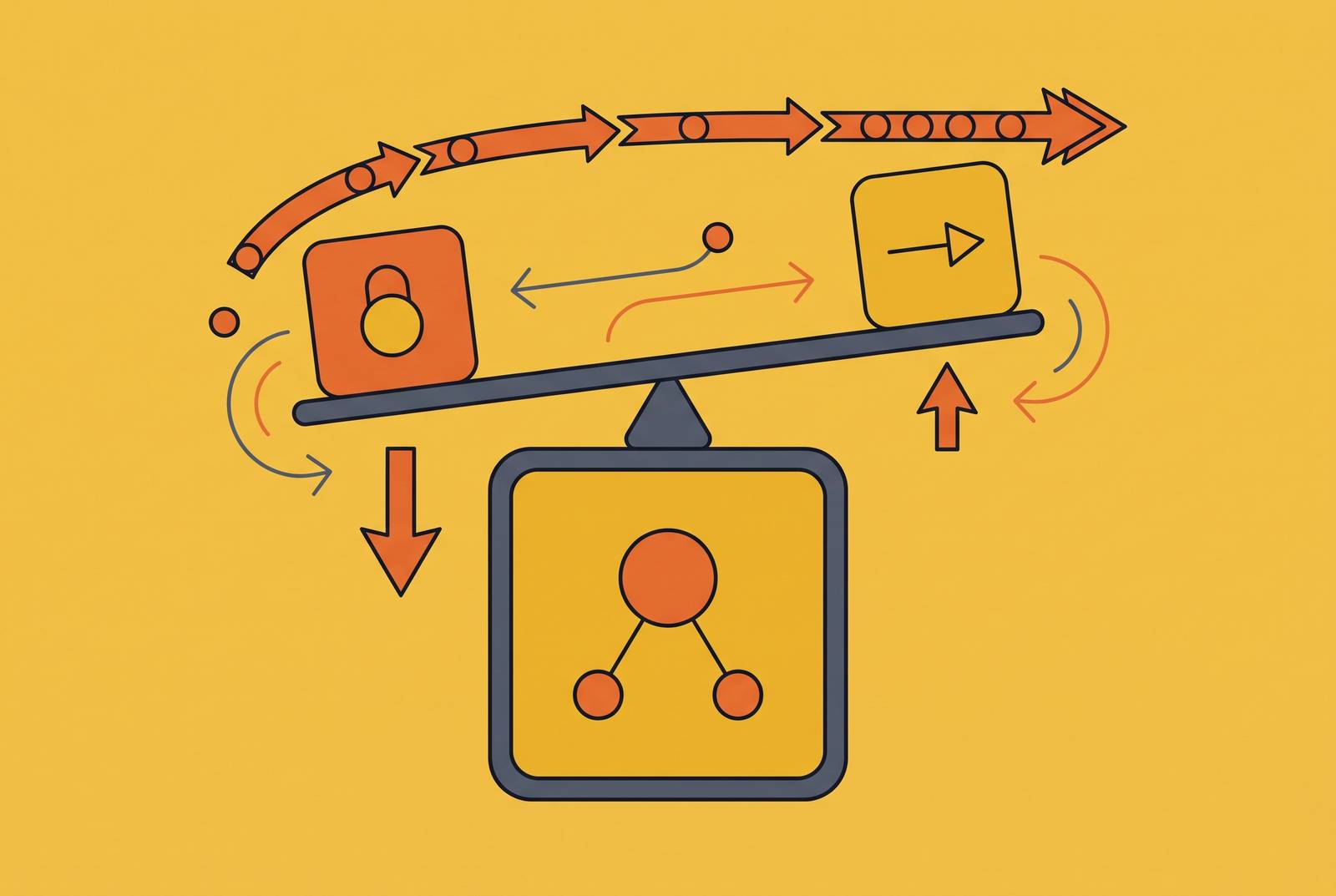
Every AI agent that calls a tool, runs code, or spins up a fresh environment asks its sandbox to do two things that fight each other: start instantly, and isolate perfectly. None of the four dominant approaches, microVMs, containers, browser isolates, or user-space kernels, wins on both counts at once, and the platforms winning the agent infrastructure fight right now are the ones that stopped pretending otherwise.
Why does this matter now, specifically? Agent workloads multiply sandbox invocations in a way ordinary web apps never did. Every tool call in a chain, every code execution step, can mean spinning up a fresh environment or resuming an old one. Jakob Nielsen's research on response times puts 100 milliseconds as the ceiling below which a system feels instant to a human, and stack five or six tool calls together, each adding its own delay, and that budget is gone before the agent has done anything useful.
The adoption numbers show the gap this causes. Enterprise pilots of AI agents nearly doubled between Q4 2024 and Q1 2025, climbing from 37% to 65%. Full production deployment stalled at just 11%. That's a wide canyon between "we tried it" and "it runs in production," and infrastructure friction, sandboxes too slow, too leaky, or too costly to run at scale, is one of the named reasons pilots don't convert.
Isolation failures aren't hypothetical either. An AI coding agent deleted a production database during what was supposed to be a test project on Replit. That's a sandbox boundary that didn't hold when it needed to, and it's why this conversation feels urgent instead of academic. What follows is fast versus safe in code running at scale right now, not fast versus safe in theory.
What agent workloads demand that generic serverless infrastructure was never designed to provide
Generic serverless platforms, built for stateless web functions, were never built with agents in mind. Agent workloads make four demands that stretch that infrastructure past its design intent, and most teams find this out mid-migration, not up front.
Startup latency has to stay low enough that an agent doesn't stall between tool calls. Tenant isolation has to hold up against untrusted, AI-generated code, since agents routinely write and run their own code, without state leaking between workloads. State has to carry over between invocations, so an agent isn't re-cloning a repository or reloading a dataset every time it picks up where it left off. And scaling has to happen on its own, absorbing bursts without someone on call tuning capacity by hand.
The scale involved is worth sitting with. Sandbox usage is projected to hit at least 164 trillion invocations annually within three years. Infrastructure assumptions that hold fine at a few thousand invocations a day start breaking well before volume gets anywhere close to that number.
Cost is already showing the strain, not as a future projection but as something happening now. One mid-sized firm saw its infrastructure bill jump from $5,000 a month during prototyping to $50,000 a month once it moved to staging, a tenfold jump traced back to unoptimized RAG queries pulling in far more context than the task needed. That's not a hypothetical failure mode. That's a line item someone had to explain in a budget meeting.
There's also the matter of how agents spend their time once running. Tool-augmented agents sit idle for a surprising chunk of their execution window (GPU idle periods can run as high as 54.5% of total run time) because agents spend real time waiting on an API response, a database query, or a slow tool call to return. Billing models built around wall-clock time punish exactly the usage pattern agents produce by default. Most teams are still paying for idle GPU seconds as if they were compute, because the billing model was written for workloads that don't wait around this much.
OpenAI's framing at the 2025 AI Engineer Summit in New York City captured the shift well: agents need something closer to an "OS for agents," a runtime built around a dynamic lifecycle, rather than a container borrowed wholesale from a standard web deployment pipeline. That's the tension the rest of this piece works through. The techniques that deliver the strongest isolation guarantees tend to be exactly the techniques that add the most latency at startup, and nothing on the market today escapes that pull in both directions.
The isolation-latency spectrum: four architectural approaches and where each sits
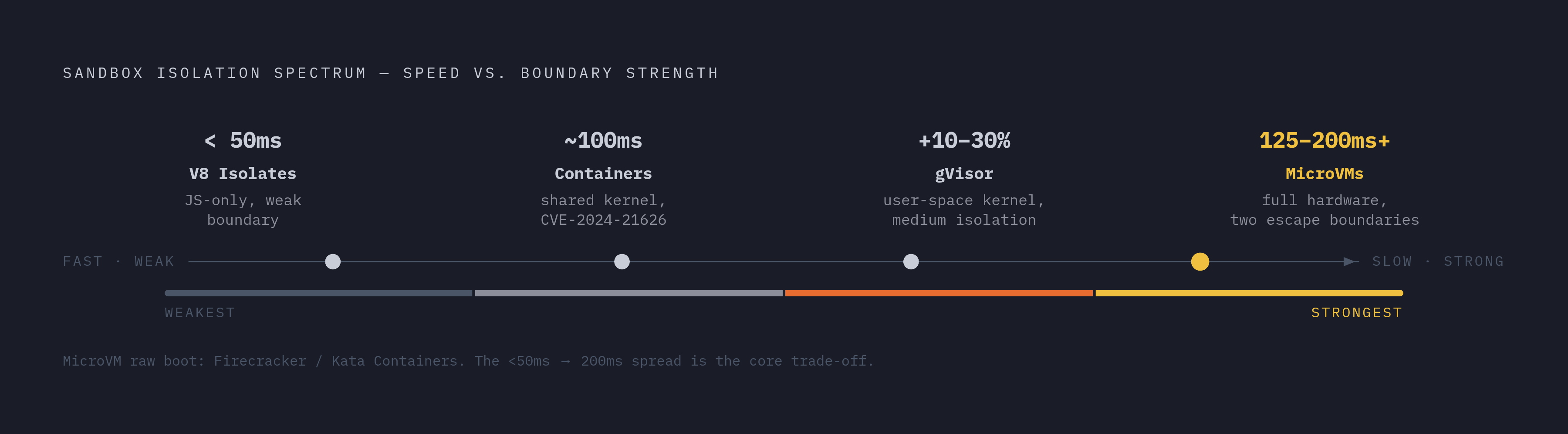
Every sandbox architecture on the market sits somewhere on a single line running from fastest-but-weakest to strongest-but-slowest. Nothing lives at both ends. Knowing where an approach lands, and why, is what lets a team choose on purpose instead of by default, or worse, by whatever the last vendor demo happened to emphasize.
V8 isolates, the model behind Cloudflare Workers, sit at the fast end. They virtualize the JavaScript runtime itself rather than a full OS or kernel, so there's no boot sequence to wait through, just a V8 context to spin up. That gets a cold start under 50 milliseconds, with each isolate getting its own heap and its own global scope. The isolation boundary here is the language runtime itself: strong within JavaScript's execution model, but that model is also the ceiling. Native binaries, arbitrary Linux environments, multi-language workloads, none of that runs inside a V8 isolate. Session length caps out fast too, with short execution windows being a known constraint of this model. This is the right call when the workload is JavaScript-native, latency matters more than almost anything else, and execution windows are short.
Standard containers, Docker and similar shared-kernel runtimes, are fast to start but weak on isolation, and this is where a lot of teams get burned without realizing it until something breaks. Containers use namespace isolation without a separate kernel underneath, so kernel vulnerabilities and container escapes sit there as a live, ongoing attack surface, not a footnote in a security review. CVE-2024-21626, nicknamed "Leaky Vessels," is a concrete recent example of a container escape via a kernel or runtime flaw, not a theoretical scenario cooked up for a conference talk. NIST SP 800-190 documents the shared-kernel risk formally as a known category of concern. Containers make sense for trusted workloads or internal tooling where the code source is controlled. Treating them as a safe default for running AI-generated code from untrusted or semi-trusted sources across multiple tenants is probably the single most common mistake in this whole space, and it's worth stating plainly: if the code came from a model and the tenant isn't fully trusted, a shared kernel is the wrong answer, no matter how convenient the tooling around it feels.
gVisor sits in the middle. It runs as a user-space "application kernel" that intercepts system calls before they reach the host kernel, cutting the host's attack surface substantially without paying the full cost of hardware-level virtualization. The tradeoff shows up as 10 to 30% overhead compared to a native container, with cold starts landing somewhere between containers and microVMs. gVisor also supports a broad range of languages and runtimes, unlike the V8 isolate model, which locks a workload into JavaScript. This is the right call for teams that need isolation stronger than a container but can tolerate the overhead, particularly for compute-heavy workloads.
MicroVMs, Firecracker and Kata Containers being the two production examples worth naming, sit at the strongest end of isolation, and historically the slowest end of cold start before any optimization gets applied. Each workload runs its own Linux kernel inside KVM, so an attacker has to escape both the guest kernel and the hypervisor, two separate boundaries instead of one. Firecracker itself boots in around 125 milliseconds, adds less than 5 MiB of overhead per VM, and can support up to 150 VMs per second on a single host. Kata Containers takes a different architectural path: it orchestrates multiple VMMs, including Firecracker, Cloud Hypervisor, and QEMU, through standard container APIs, so Kubernetes sees what looks like an ordinary container while underneath it's a full VM with hardware-level isolation. Kata boots in around 200 milliseconds. Without snapshot optimization (more on that below), microVM cold starts run anywhere from 150 milliseconds to 2 seconds, and that range is the raw cost of hardware isolation before anyone tries to shrink it. For agent workloads running arbitrary generated code across multiple tenants, this should be the default assumption, not the exception argued for case by case: the isolation strength justifies whatever startup cost comes with it.
Laid end to end, the order runs V8 isolates, then containers, then gVisor, then microVMs, moving from fastest-to-start toward strongest-isolation. Every platform on the market sits at one of these four positions, or in some cases lets an engineering team pick per workload.
How snapshots collapse microVM cold-start latency without giving up isolation
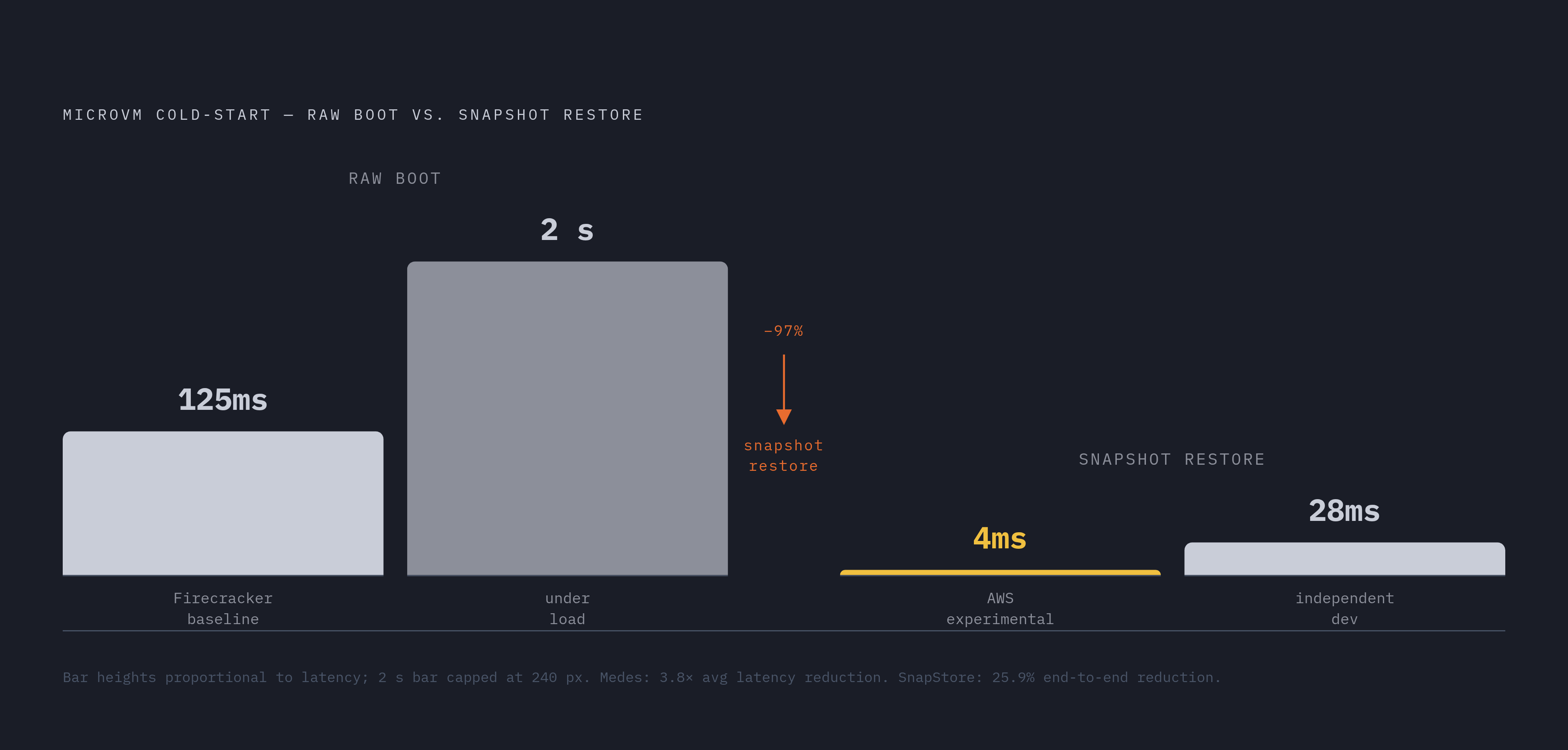
The obvious objection to microVMs is the boot time. If hardware isolation costs 125 to 200 milliseconds, or worse, up to 2 seconds under load, every single time a workload starts, that seems to rule microVMs out for anything latency-sensitive. Snapshotting is the technique that breaks that assumption apart, and it's the reason the "microVMs are too slow" argument is now mostly outdated.
A snapshot captures the state of a running VM, its VMM state plus the guest's physical memory, and writes it to disk as a file. Restoring from that file skips the entire boot sequence: no kernel boot, no init process, no agent startup routine. The VM just resumes from the exact point it was frozen at.
AWS Lambda SnapStart is the clearest production example of this working at scale. Lambda initializes a function once, at publish time, takes a Firecracker microVM snapshot of its memory and disk state and intelligently caches it to optimize retrieval latency on later invocations. Cold-boot latency is substantially reduced out of the request path. AWS's own experimental results show Firecracker snapshot restores completing in as little as 4 milliseconds, a striking contrast against the 125 to 200 millisecond raw boot numbers from the previous section. One independent developer reported getting Firecracker snapshot boots down to 28 milliseconds, against a raw boot baseline that otherwise runs into the hundreds of milliseconds.
Academic work has pushed this further. Medes, a memory-deduplication approach for serverless snapshots, uses delta compression across snapshots stored on the same cluster and managed to raise the number of instances cached per node by 42.98%, while cutting average startup latency by 3.8 times. SnapStore, focused on the storage and retrieval layer rather than compute, cut deduplication time by 46%, retrieval time by 82.6%, storage overhead by 2.4 times, and end-to-end latency by 25.9%. These aren't marginal tuning gains. They mark a real shift in what "cold start" even means once snapshotting enters the picture.
Snapshots don't solve everything on their own, though, and this is where engineering discipline still matters more than any marketing slide suggests. Captured memory can include cryptographic secrets sitting in RAM at the moment of the snapshot, so a snapshot pipeline needs explicit handling for high-value memory rather than treating every snapshot as safe to cache indefinitely. Cloning multiple instances from the same snapshot also means restoring uniqueness across those clones: UUIDs, secrets, nonces, all of it has to be re-seeded after restore, or two supposedly "different" cloned VMs end up sharing values they should never share. And running a snapshot pipeline at all takes real engineering investment in storage management, per-image validation, and freshness discipline across every image variant in a fleet.
That last point matters for anyone reading vendor latency claims with a skeptical eye, which is the only sensible way to read them. When a platform advertises a cold-start number, ask whether it's measuring a raw boot or a snapshot restore. Those are two different measurements, and comparing a raw-boot figure from one vendor against a snapshot-restore figure from another is comparing two different things dressed up as one number.
State persistence as a separate axis: what happens between invocations matters as much as startup speed
Startup speed answers one question: how fast can a sandbox get running? It says nothing about a second question that matters just as much for agents: what does the sandbox remember once it stops?
That gap, a sandbox that runs code versus one that remembers what it did last week, is where a lot of working demos quietly turn into broken production deployments. An agent builds up real state over a session: crawled datasets, conversation history, installed packages, fine-tuned parameters. Losing all of that on every invocation isn't just an inconvenience. Rebuilding conversational context from scratch runs around 26,000 tokens per conversation on standard benchmarks, which is both direct cost and added latency stacked right on top of whatever the cold start already cost.
Platforms answer this differently, and the differences are bigger than they first appear. Fly.io runs persistent Firecracker microVMs and stops billing for idle compute when an environment sits unused, though there's no automatic deletion of paused environments. Blaxel takes a more aggressive stance: standby resumption in under 25 milliseconds that brings back full filesystem and memory state intact.
This unlocks a workflow pattern that throwaway environments simply can't support: snapshot-as-fork. An agent branches its own execution, runs two different approaches to a problem in parallel from the same starting snapshot, and keeps whichever one succeeds while discarding the other. That's a meaningfully different capability than "restart quickly," and it only exists because the underlying infrastructure treats state as something to preserve and branch from, not something to rebuild from scratch every time.
The isolation model chosen earlier in the stack quietly decides what "resume" even means here, and this is worth being precise about. A microVM-based standby preserves full kernel state, memory included. A container-based standby, by contrast, generally preserves only the filesystem. Two platforms can both claim to support "persistence" and mean genuinely different things by it, depending on which isolation approach sits underneath, so the word alone tells you almost nothing without asking what's actually being restored.
How the major platforms position on the tradeoff spectrum in practice
None of this is a ranking exercise, and any comparison chart that tries to crown one winner misses the point of the whole spectrum described above. Each platform below is a coherent, deliberate answer to a specific spot on that tradeoff space, built for a particular kind of workload rather than built to win every column.
Northflank supports Firecracker, Kata Containers (with Cloud Hypervisor as its primary VMM backend), and gVisor, letting a team pick isolation strength per workload rather than committing to one model platform-wide. Cold starts run around 2 seconds without snapshot optimization, but session duration is unlimited. It supports bring-your-own-cloud deployment across AWS, GCP, Azure, Oracle, CoreWeave, Civo, and others, and handles over 2 million isolated workloads a month. This fits teams that need enterprise-grade infrastructure with full deployment control and can absorb the cold-start cost in exchange for that flexibility.
Some platforms in this category skip GPU support entirely and run managed-infrastructure-only, with no bring-your-own-cloud option, which fits agent developers who want a purpose-built product without owning the infrastructure layer, and several open-source options in this space have seen wide adoption on exactly that basis. Others keep memory snapshots for 7 days in alpha and filesystem snapshots for 30 days by default (configurable, including indefinite retention), without BYOC support, which suits teams running compute-heavy agent workloads.
Vercel Sandbox runs on Firecracker microVMs with roughly a 1-second cold start, and tiers session length by plan: 45 minutes on Hobby, up to 24 hours on Pro and Enterprise. Its main advantage is tight integration with the rest of the Vercel platform, a natural fit for frontend and codegen teams already building there.
Cloudflare Sandboxes uses V8 isolates and per-sandbox VMs running on Cloudflare Containers, with cold starts under 50 milliseconds, but a session limit of 30 minutes, and state gets wiped on sleep. That combination fits Workers-native teams running short, JavaScript-based agent tasks where edge latency is the priority and long-lived state isn't the goal.
Blaxel runs on Firecracker-based microVMs with sub-25-millisecond resume from standby and indefinite standby at zero compute cost, backed by SOC 2 Type II, ISO 27001, and HIPAA BAA compliance. This is built for production agents that need persistent state and near-instant resume, particularly in compliance-sensitive environments where the audit trail matters as much as the latency number. It suits developer teams that want fast iteration, multi-language support, and room to scale into stronger isolation as a workload's requirements grow, without re-architecting the whole stack to get there.
Fly.io runs Firecracker microVMs through its Machines API, with up to 500GB of NVMe storage available. CPU and RAM billing stops when a machine sits idle, though rootfs and volume storage keep billing regardless, and there's no auto-deletion, which makes orchestration a DIY responsibility. That fits teams comfortable managing their own agent infrastructure down at the infrastructure layer, in exchange for the control that comes with owning it.
Laid side by side, the pattern holds across every platform: none of them escape the spectrum described at the start of this piece. Each made a deliberate trade, faster starts against weaker isolation, or stronger isolation against a slower boot, and layered snapshotting and persistence choices on top of that base decision. The real mistake isn't picking the wrong platform outright, it's picking any platform before asking which point on the spectrum the workload actually needs: fast at what, forgetting what, isolated from what. Answer that first, and the platform choice mostly falls out on its own instead of getting reverse-engineered from a vendor's homepage.