GSM8K Benchmark Design and Agent Math Reasoning
A benchmark's design choices shape what its scores actually reveal about model reasoning.

GSM8K is a set of 8,792 grade-school math word problems (7,473 for training, 1,319 held out for testing), and it became one of the most cited benchmarks in AI reasoning research since Cobbe et al. introduced it in 2021. A high score on it tells you far less than most people assume. The design choices behind it, the human-written solutions, the hidden test set, the answer-checking grading, shape what the number can and can't reveal about whether a model actually reasons, and most coverage of GSM8K scores skips past that entirely.
The problem structure that makes superficial pattern-matching insufficient
Each problem takes between 2 and 11 steps to solve, and the dataset is designed to require between 2 and 11 computational steps, creating a graded slope of difficulty built that way on purpose.
The operations themselves stay simple on paper: addition, subtraction, multiplication, division, fractions, decimals, percents, ratios, a bit of basic algebra, all spelled out in plain English sentences. The benchmark was calibrated against a non-expert adult solving roughly four questions in 15 minutes, which sets a ceiling the dataset tries to approach without asking more of a model than a reasonably sharp person could deliver.
Here's the trap for a model working through these step by step. Get an early step wrong, and everything downstream is compromised, because autoregressive generation has no built-in way to go back and fix a mistake once it's committed to text. An arithmetic slip at step two poisons steps three through seven even when those later steps run flawlessly. And the phrasing shifts constantly by design: names, objects, dollar amounts, scenarios, all swapped from problem to problem, so a model can't memorize a surface template and pattern-match its way to an answer. It has to parse what's actually being asked and work out which operations apply in which order. That's what gives GSM8K its diagnostic teeth: it isolates multi-step procedural reasoning from the kind of retrieval or completion a large language model does well by default.
What baseline model performance revealed about reasoning versus scale
When GSM8K launched, GPT-3 baseline models scored only in the 45 to 50% range, well below the pace a non-expert adult manages on the same problems. That's a rough showing for a model that size, and it's the number that made the field pay attention.
Scaling up parameter count or training data didn't close the gap in proportion to the size increase. Naive upscaling buys fluency and general knowledge. It doesn't reliably buy multi-step arithmetic. Standard supervised fine-tuning ran into a related problem: models grew overconfident and poorly calibrated, a pattern that showed up clearly once researchers sampled multiple candidate completions for the same problem and looked at how inconsistent the answers were across samples.
What made GSM8K useful here was its annotated, step-by-step solutions. Because every problem ships with a full written-out solution rather than a bare final number, researchers could see exactly where reasoning broke down. Three failure types kept recurring: misreading what the problem asks (semantic misunderstanding), getting the arithmetic wrong (calculation errors), and skipping a required step (step-missing). A benchmark that only checked the last digit would hide all three behind one "wrong" label. That gap between scale and accuracy is what pushed the field toward architectures that split the job of generating an answer from the job of checking one.
The generator-plus-verifier paradigm GSM8K introduced
Cobbe et al.'s core move in the 2021 paper was to stop asking one model to both generate and grade its own work. Autoregressive models don't self-correct well across long chains of steps, so the paper splits the job: a generator produces candidate solutions, and a separate verifier scores how likely each candidate is to be right.
The pipeline runs like this. Fine-tune a generator on GSM8K's training problems, sample a large batch of candidates per problem, then feed each problem-and-candidate pair into a verifier trained with both a verification loss and the usual language-modeling loss. At inference time, pick whichever candidate the verifier ranks highest, or run a voting scheme across the top few.
One detail worth sitting with: the verifier's design choices around granularity shape how well it generalizes across candidate solutions.
The payoff was substantial. A 6-billion-parameter generator paired with a verifier matched or slightly beat a fine-tuned 175-billion-parameter baseline working alone, an effective capacity gain on the order of 30 times. That result should change how anyone reads a GSM8K number going forward. The score was never a pure read on "the model." It measures the generator-verifier system, sampling strategy included, and treating it as a single-model number misses the architecture doing the actual work.
How prompting strategies changed what GSM8K scores measure
Chain-of-thought prompting, just asking a model to write out its reasoning before answering, produced a real jump over asking for a bare number. But it didn't eliminate any of the three error modes. It only cut down how often they showed up.
Zhong et al.'s 2024 Deeply Understanding the Problems (DUP) method took a more surgical route, structuring the reasoning process to target semantic misunderstanding directly, before any computation starts. With GPT-4 in a zero-shot setting, DUP reached 97.1% accuracy against 94.6% for standard chain-of-thought.
The gap on paper, about two and a half points, looks modest. What moved underneath it is the interesting part. DUP cut semantic misunderstanding errors from roughly 35% down to 20%, calculation errors from about 32% down to 22%, and step-missing errors from around 24% down to 11%. The headline number barely budged. The error composition shifted hard, and that's only visible because GSM8K's annotated solutions let researchers sort failures into categories in the first place.
A different strategy skips the arithmetic problem entirely. A Prolog-generation approach hands the actual computation to an external interpreter, scoring 70.2% on GSM8K with Mistral-7B against 58.9% for chain-of-thought without that offload. Remove calculation from the model's job, and one whole error mode disappears by construction. So when a score climbs, is it because the model got better at reading language, better at arithmetic, better at not skipping steps, or some blend of the three? Without the annotated chains underneath, there's no way to answer that question at all, and that's worth sitting with before trusting any single leaderboard jump.
Synthetic data and small-model pairings that challenge size assumptions
Liu et al.'s TinyGSM project generated 12.3 million synthetic GSM8K-style problems, each paired with a Python solution instead of a natural-language one, using the original benchmark's structure as a template for scale. A small-parameter generator paired with a verifier ended up competitive with much larger models on GSM8K. Two small models working together outscored a model many times their combined size. That result alone should put to rest the assumption that parameter count is the main lever here, and yet plenty of teams still reach for a bigger base model before they touch their data pipeline.
Li et al.'s work found a log-linear scaling relationship for LLaMA-7B: accuracy improvement tracked roughly 10.7 times the log of the number of augmented samples, plus a constant. Not linear. Doubling the synthetic data doesn't double the gain, the returns taper, though they don't vanish either.
The augmentation methods themselves stayed fairly plain, working within GSM8K's original difficulty envelope rather than extending beyond it. None of it pushes past GSM8K's original difficulty envelope. It just fills in more of the space already inside that envelope. Data quality and the generator-verifier split matter as much as raw parameter count here, and in some of these results, more.
Near-saturation on single problems and what happens when problems are chained
Frontier models now clear 94% or higher on canonical GSM8K, which means the benchmark, in its original single-problem form, has stopped being able to tell the best systems apart. Everyone's bunched up near the ceiling, which is exactly the kind of result that should make you suspicious of the benchmark rather than impressed by the models.
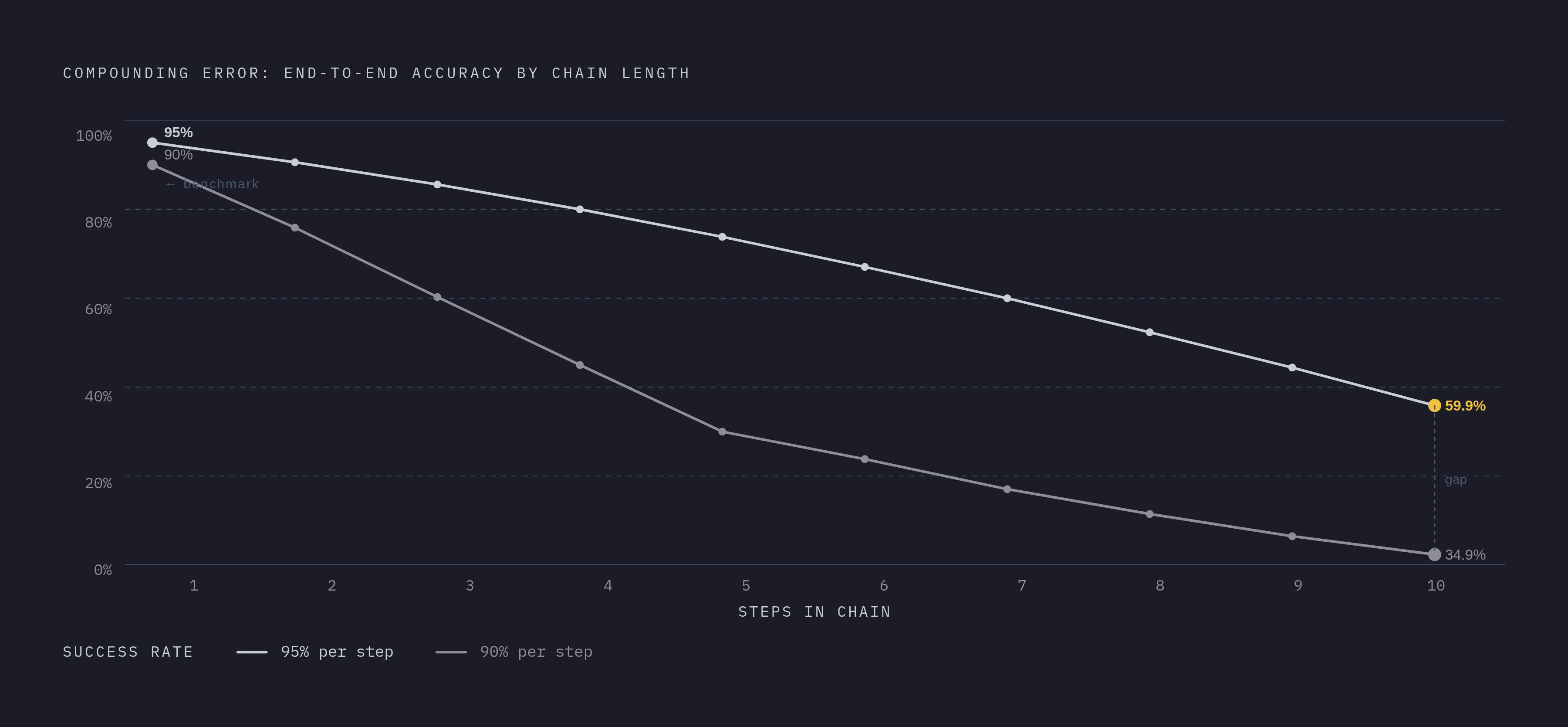
Chain a few GSM8K-style problems together, though, either in sequence or through conditional dependencies where one answer feeds the next problem, and the picture falls apart fast. Compositional variants like Scheherazade show accuracy dropping sharply as chain length grows, across nearly every frontier model tested. Near-perfect accuracy on one problem tells you almost nothing about accuracy on a ten-problem chain.
The math behind why is worth sitting with. A system right 95% of the time on each individual step has only about a 60% chance of clearing ten steps cleanly (0.95 to the tenth lands around 0.599). Drop per-step accuracy to 90%, and a ten-step workflow only succeeds about 35% of the time. String enough near-certain steps together, and the certainty just evaporates.
For anything built to act as an agent, running multi-step plans with no human checking each intermediate result, that gap between single-problem accuracy and chained accuracy is not an academic curiosity. It's the difference between a benchmark headline and an actual production reliability number. Omni-MATH, spanning Olympiad-level problems across multiple domains and difficulty tiers, is one answer to the saturation problem, giving researchers more room to tell frontier models apart once GSM8K and MATH stop doing that job.
Extensions that exposed what GSM8K's design cannot see
GSM8K was built and validated inside a particular linguistic and cultural frame, and later work went looking for what that leaves out. Later work re-templated GSM8K problems for different cultural and regional contexts, changing names, currencies, and everyday scenarios while leaving the underlying math untouched, and found that model accuracy varied across those variants, suggesting some sensitivity to those contextual differences. That's a signal that part of what GSM8K measures is sensitivity to training-data cultural cues, not pure reasoning ability. That pattern suggests the bias sits in the model's underlying priors, not just in how it phrases the final answer.
Yuan et al.'s GSM8K-V (2025) took a different cut at the same question, rendering the same problems as pure images through image-generation pipelines with no text version given at all. Best vision-language models managed only 46.93% on GSM8K-V, a stark contrast against near-saturation on the original text version. The failure modes here differ too: grounding symbols correctly inside an image and aggregating visual facts across a sequence, rather than the semantic-calculation-step-missing triad that shows up in text.
Liang et al.'s MathClean (2025) uses GSM8K and MATH as seed material to evaluate something else entirely: the quality of data-cleaning pipelines for math datasets. The benchmark has become a tool for judging training data, not only for judging models.
Cheng et al. (2025) proposed splitting the final-answer score into separate abstraction-accuracy and computation-accuracy metrics rather than collapsing both into one pass-fail number. That's a direct answer to the diagnostic gap running through this whole piece: a single score can't say where a failure started, but two scores, one for understanding the problem and one for executing the math, start to.
Li et al.'s 2023 work on augmented GSM8K training found that gains made on GSM8K transferred weakly to MATH, the harder benchmark covering geometry, combinatorics, and higher algebra. GSM8K's elementary scope is also its ceiling. Getting very good at grade-school word problems doesn't make a model good at olympiad-level math, and anyone reading a strong GSM8K number as proof of general mathematical ability is reading past what the dataset was built to test. That's arguably the single most common misread of this benchmark in the wild.
What reinforcement learning with verifiable rewards adds to the picture
Reinforcement learning with verifiable rewards (RLVR) checks whether a math answer is right automatically, with no human judgment in the loop. GSM8K's exact-match grading is exactly the property that makes this workable at scale: the ground truth is a number, and a number is either right or it isn't.
That's a real contrast with RLHF, which depends on extrapolating from human preference judgments, an inherently fuzzier signal to train against. RLVR skips that step entirely. Models trained this way on GSM8K-style environments develop multi-step strategies on their own, which suggests the benchmark's structure doesn't just measure the behavior researchers want. It actively produces that behavior during training.
A related thread uses GSM8K's annotated solution chains for outcome-supervised methods like DPO, building step-level preference data without running a full RL loop. Frontier reasoning models (OpenAI's o3 from April 2025 and o3-Pro from June 2025, Anthropic's Claude 3.7 Sonnet with extended thinking from February 2025) get trained and evaluated against benchmarks in this family. The cost shows up directly in resource use: these models can burn 3 to 30 times more tokens per response and add anywhere from seconds to minutes of latency, and that overhead doesn't pay off on tasks that don't actually reward extended deliberation in the first place.
Huang et al.'s 2025 PEAR (Phase Entropy Aware Reward) method tries to manage that overhead directly, penalizing excessive entropy during a model's thinking phase while still allowing some exploration at the answer phase. Applied across GSM8K and related benchmarks, it cuts redundant reasoning steps without giving up accuracy. None of this training machinery would even be computable without GSM8K's verifiable structure sitting underneath it.
What high GSM8K scores actually tell you about an agent's math reasoning
A GSM8K score is never a measurement of a model in isolation, and treating it that way is the most common misreading of this whole benchmark. It reflects the generator, whatever verifier or sampling strategy sits alongside it, the prompting protocol, and the training data behind all of it. Reading it as a single clean number about "the model's math ability" misses most of what's actually feeding into that number.
High single-problem accuracy, the 94%-plus territory where frontier models now sit, is necessary for calling a system good at math, but it's nowhere near sufficient for trusting it in deployment. Necessary is not the same as sufficient, and the chained-problem collapse covered earlier shows exactly why: a score on isolated problems doesn't predict how the same system holds up across a multi-step workflow, where one early error ruins everything downstream. Anyone treating a single GSM8K number as a green light for an autonomous, multi-step agent is skipping the one section of this piece that matters most.
The three error-mode categories that GSM8K's annotated chains expose, semantic misunderstanding, calculation errors, step-missing, do more diagnostic work than the aggregate accuracy figure by itself. The cultural re-templating research backs that up from another angle: a high score built on one language's corpus can overstate how well a system reasons for users outside that linguistic frame. The visual-modality gap tells a similar story. Best-in-class vision-language models landing at 46.93% on GSM8K-V, against near-saturation on the text version, is a clear warning against assuming a strong text-based math score carries over to a multimodal agent.
For anything built to operate as an agent, the structural gap between per-step accuracy and end-to-end workflow success has to be handled architecturally, not solved by picking a slightly better model off a leaderboard. Stateful execution, checkpointing at each step, isolated environments where a multi-step reasoning chain can actually run to completion: these are the infrastructure choices that turn a benchmark number into something closer to a production reliability number. Cheng et al.'s disentangled metrics, separating abstraction accuracy from computation accuracy, point toward where benchmark reporting needs to go: showing exactly where in a chain a failure starts, instead of flattening everything into one pass-fail digit.
The rule that falls out of all this is plain enough. Treat a benchmark score as a lower bound on what a system can do under ideal, single-problem, single-language, text-only conditions, and nothing more than that. Chained performance, cross-cultural performance, and multimodal performance will each come in lower until measured separately, and right now the evidence says they do. No amount of leaderboard-topping on the original 1,319 test problems changes that.