LLM Benchmarks for Infrastructure Developers
Benchmarks built for chatbots don't measure what infrastructure agents actually fail at.

Most LLM benchmarks measure how well a model reasons, writes, or recalls facts. Infrastructure developers building agents that execute code, call tools, and run unattended for days need something else entirely: signals about execution reliability, tool-calling accuracy, memory persistence, and behavior under real production load. This piece maps out which benchmarks actually speak to those failure modes, and which ones just look relevant from a distance.
The timing matters. Gartner projects that 40% of enterprise applications will embed task-specific AI agents by the end of 2026, up from less than 5% in 2025. The shift drops off like a cliff rather than tapering gradually. Teams are choosing models right now, under deadline pressure, often reading benchmark leaderboards built for a different audience entirely. KPMG's Q4 2025 AI Pulse Survey found that 65% of leaders cite agentic system complexity as their top barrier, for two quarters running. Picking the wrong model based on a misread benchmark doesn't reduce that complexity. It compounds it.
Compounding the problem: nobody's grading their homework. An AI Agent Index review of 30 deployed agent systems found only 4 with agent-specific system cards, and only 9 that report capability benchmarks at all. Most infrastructure developers are choosing models with almost no visibility into how those models actually behave in agentic, tool-calling contexts. This article aims to explore the landscape rather than crown a winner. It's trying to build the lens: which benchmark categories map to which real failure modes, and where the published numbers quietly stop telling the truth.
What infrastructure agents actually do that generic benchmarks don't test
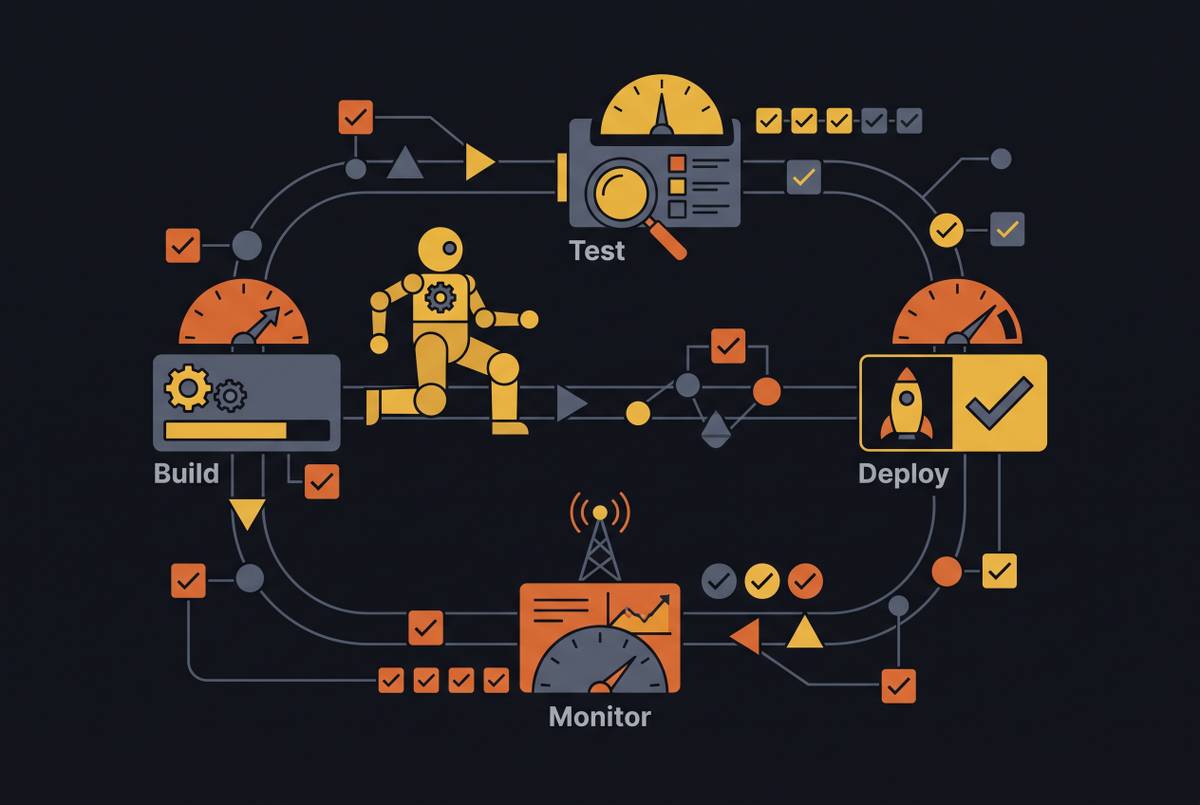
An infrastructure agent doesn't answer a question and stop. It reads a task, calls a tool, checks the result, decides what to do next, and loops, sometimes for hours, sometimes for days, until the job is done or it fails somewhere along the way. That loop is the entire unit of work, and almost nothing about a standard language benchmark tests it.
Four things separate this from a chat interface. The model has to call external tools with the right schema, not just generate plausible-sounding text. It has to hold state across steps and across sessions, because an agent that forgets what it did three tool calls ago isn't buggy, it's dangerous. It has to run generated code inside a properly isolated sandbox, since a lot of what it produces is untrusted by definition. And it has to keep its latency and accuracy intact under sustained load, because a workflow with fifteen sequential steps doesn't forgive a slow model the way a single chat response does.
Long-horizon behavior is where this gets genuinely strange. There are documented cases of agents running autonomously for close to a week straight, producing over a million lines of code across a thousand files. No standard reasoning benchmark, built around single-turn question-and-answer pairs, has anything to say about whether a model can sustain coherent behavior over that kind of timescale.
Cost behaves the same way, and it sneaks up on teams that aren't watching for it. One mid-sized e-commerce firm's agentic supply chain optimizer ran at $5,000 a month in prototyping. In staging, it hit $50,000 a month, a tenfold jump, driven by unoptimized retrieval pulling in roughly ten times more context than the task actually needed. A benchmark would not catch this kind of quality problem. It's a token-consumption problem, and it's every bit as much an infrastructure decision as picking the model in the first place.
So the framework that follows breaks into four buckets: code execution reliability, tool use and function calling, latency and throughput under real load, and multi-step coherence over time. Each has its own benchmarks, and each has its own way of lying to you if you read it wrong.
Code execution benchmarks: what SWE-bench measures and where it breaks down
SWE-bench is the benchmark everyone cites first, and for good reason. It tests code generation against real GitHub issues pulled from a dozen popular Python repositories, each one paired with a gold patch and human-written unit tests. It looks like exactly what an infrastructure team wants: real code, real bugs, real pass/fail criteria.
Except the top of the leaderboard has gotten crowded. Frontier models now clear 70% or more on SWE-bench Verified, a ceiling so compressed that OpenAI itself published a piece explaining why SWE-bench Verified no longer measures frontier coding capability. When the benchmark stops discriminating between models, it stops being useful for procurement decisions, however good it still looks in a press release.
The inflation is measurable. Under the SWE-ABS adversarial framework, which strengthens test suites specifically to catch models that are pattern-matching rather than problem-solving, the leading model as of November 2025, Claude 4.5 Opus (medium), scored 74.40% on the original SWE-ABS evaluation but fell to 58.00% under SWE-ABS augmentation. That's a 16.4 point drop, and the pattern holds across other models too. What that gap suggests is memorization: models recognizing training data they've seen before rather than reasoning through a genuinely novel problem. A procurement decision made on the headline SWE-bench Verified number alone is a decision made on evidence that may be substantially inflated.
There are structural issues underneath the inflation, too. SWE-bench issue descriptions tend to be unusually detailed, more scaffolding than a real infrastructure ticket would ever include, which flatters resolution rates. The benchmark is limited to a single programming language, so it says little about a polyglot infrastructure codebase running multiple other programming languages side by side. And because SWE-bench scores blend the agent scaffold with the underlying model, it's genuinely hard to tell whether a high score reflects a better model or just a better harness wrapped around a mediocre one.
Two newer benchmarks try to correct this. SWE-bench Pro, introduced in September 2025, expands to 1,865 problems across 41 repositories with anti-contamination design meant to defeat memorization. Top models score around 23% on it, a number that looks discouraging next to SWE-bench Verified's 70-plus but is probably closer to the truth. Frontier-SWE, introduced in 2026, targets long-horizon software engineering specifically, which makes it the more relevant successor for teams running agents across multi-day autonomous stretches rather than single-turn fixes.
The takeaway for an infrastructure team: treat SWE-bench Verified as a floor, not a ceiling. Check the SWE-bench Pro number before signing off on a model, and watch for SWE-ABS results wherever they're published.
Security quality of generated code as a benchmark dimension infra teams can't skip
Veracode ran a 2025 benchmark across more than 100 LLMs and 80 coding tasks and found that 45% of generated code samples failed security tests tied to the OWASP Top 10. Nearly half. The margin is wide enough that whether the code an agent just wrote is safe to run comes down to a coin flip.
This isn't theoretical. Reported incidents include AI coding agents deleting local user files and home-directory contents, and separate cases where agents deleted production databases outright. Standard coding benchmarks check whether code runs and passes its tests. They say nothing about whether that same code opens an injection vulnerability, leaks a secret into a log, or finds a way to escape the container it was supposed to stay inside.
Three things worth checking before choosing a model for infrastructure work. First, security-specific benchmark results, Veracode's numbers or CyberSecEval's, read alongside whatever SWE-bench score gets quoted. Second, whether the model actually respects the tool boundaries it's given, or whether it tries to reach past them when a task gets ambiguous. Third, resistance to prompt injection arriving through tool outputs rather than the initial prompt, since that's the attack surface infrastructure agents are actually exposed to in production, not the chat-window version most people picture.
None of this substitutes for the environment the code runs in. Running AI-generated code directly on an application server, with no dedicated execution sandbox between the model's output and production, creates exposure that no benchmark score can retroactively fix: secrets leaking out, resources getting exhausted, containers getting escaped, and outright malicious behavior triggered by a hallucination or a successful injection. A model that scores well on every security benchmark available still needs somewhere safe to actually execute, which is the thread the later section on execution environments picks back up.
Tool use and function calling benchmarks: where agent reliability is actually measured
Strip an infrastructure agent down to its core behavior and it's this: read a task, call a tool, check what came back, act again. A model can write beautiful prose and still fail this loop completely if it can't call a tool correctly or recover gracefully when a call errors out. Language quality scores don't predict that at all.
A handful of benchmarks measure it directly. Tau-bench simulates multi-step customer-service workflows, retail and airline support scenarios, complete with a user simulator, and checks whether a model can carry a tool-dependent task through to completion. It's useful, but narrow: strong tau-bench performance in a customer-service context doesn't necessarily transfer to an arbitrary infrastructure pipeline.
BFCL, the Berkeley Function-Calling Leaderboard, is more directly on point. It evaluates function-calling accuracy across a wide range of schema types and edge cases, and it's one of the few benchmarks built specifically around the question infrastructure teams are actually asking: can this model call tools correctly and consistently? ComplexFuncBench pushes further, layering in real API responses, user-specified constraints, and multi-step parameter reasoning across long-context scenarios, which makes it a harder and arguably more honest test than BFCL alone. MCP-Atlas evaluates behavior specifically over the Model Context Protocol, increasingly relevant as MCP becomes the default layer for wiring models into tools. GAIA rounds this out as a broader test of general-purpose assistant behavior across multi-step, real-tool tasks.
Averages hide a lot, though. A model can post a strong mean score on a benchmark and still fail one task in five when it actually matters. That's where pass^k metrics earn their keep: they expose models that are capable in principle but unreliable in practice, which is a distinction that matters enormously once an agent is running unattended in a pipeline that can't tolerate intermittent failure.
Scaffolding matters more than most teams expect going in. Terminal-Bench, which tests autonomous terminal work in sandboxed shells, showed a harness-dependent spread of roughly 16.7 points in version 2.0, meaning the agent framework wrapped around the model could swing results almost as much as the model itself. Version 2.1 narrowed that gap to somewhere between 0.2 and 8.1 points, better, but still a reminder to replicate the actual deployment stack as closely as possible before trusting a published number.
One more data point worth sitting with is InnoGym, a benchmark out of Zhejiang University, Ant Group, and the National University of Singapore, which found that current agents perform well below human state-of-the-art on complex real-world engineering and scientific tasks. Novelty of approach didn't translate into reliable gains. For infrastructure teams evaluating agents on genuinely complex multi-step engineering work, that's a useful check against the assumption that a clever new method automatically means a more dependable one.
Memory and state benchmarks: why coherence across sessions is a first-class infrastructure metric
An agent that can't hold onto context across steps, or across sessions entirely, suffers a fundamental limitation. It's unusable for real infrastructure work: it repeats tool calls it already made, drops intermediate results it needed later, and never accumulates the state a multi-day autonomous task actually depends on.
Three benchmarks now anchor this space, according to Mem0's State of AI Agent Memory 2026 report. LoCoMo runs 1,540 questions across four categories (single-hop, multi-hop, open-domain, and temporal reasoning) over multi-session conversation data. LongMemEval covers 500 questions across six categories, including knowledge updates and multi-session reasoning, and leans hard on cross-session coherence specifically. BEAM operates at a different scale entirely, 1 million and 10 million tokens, spanning ten categories including contradiction resolution and temporal reasoning. BEAM's scale matters because it can't be gamed by simply widening the context window, which makes it the closest thing to a production-scale test in this category.
What a strong score actually looks like: Mem0's 2026 algorithm hit 92.5 on LoCoMo and 94.4 on LongMemEval, using around 6,900 tokens per query. That token figure is not a footnote, it's half the result. A memory system that scores well but burns far more tokens per query to get there isn't viable at infrastructure scale, no matter how good the accuracy number looks in isolation.
Two categories remain the hardest by a wide margin. Temporal reasoning improved by 29.6 points in Mem0's newer algorithm over its predecessor, and multi-hop reasoning by 23.1 points, both large jumps that still say something about how far these categories had to climb. They're also the categories that most directly test whether an agent can handle a real history, where facts accumulate, get revised, and relate to each other over time, rather than a clean single-session conversation.
The practical implication: pair a model's raw benchmark scores with whatever memory benchmark data exists for the architecture it's paired with. A capable model bolted to a memory system that loses state under real workload patterns is still going to fail in production, and the failure will look like a model problem when it's actually an infrastructure problem. The Mem0 report flags three issues in this space as still unresolved: cross-session identity, temporal abstraction at scale, and memory staleness. None of them go away just because a team picked a better model.
Latency and throughput behavior under agentic load: the benchmark gap most teams discover too late
No published benchmark currently measures model latency under sustained, concurrent, multi-step agentic load. Teams find this gap the hard way, usually right around the point they move from prototype to staging.
The math is unforgiving once it compounds. Across a workflow of fifteen sequential tool calls, a 2-second cold start on each call adds up to 30 seconds of pure waiting before any real work gets done. Get that down to sub-100ms and the same workflow finishes in under 2 seconds. Both model inference latency and sandbox startup latency stack inside the same workflow, and neither one shows up cleanly in a benchmark built around single-query response time.
That $5,000-to-$50,000 monthly jump mentioned earlier traces to exactly this kind of gap: unoptimized context retrieval driving token consumption per call far higher than the task needed. Standard benchmarks report per-query averages. They don't report per-workflow accumulation, which is the number that actually determines the bill.
What infrastructure teams end up measuring on their own, because nobody publishes it for them: time-to-first-token under concurrent load rather than isolated average latency, token consumption per tool call across a full representative workflow rather than a single query, how accuracy and latency degrade as context grows toward the model's limit, and what the model actually does when it's under pressure, whether it truncates cleanly, hallucinates a tool call that doesn't exist, or silently drops context it needed.
Harbor, built by the team behind Terminal-Bench, gives teams a structured way to run these evaluations themselves, generating rollouts inside container environments with cloud deployment options rather than relying entirely on someone else's published leaderboard. It doesn't replace the published benchmarks. It fills the gap they leave open, which is workload-specific reliability under conditions that actually resemble production.
Latency at the model layer is only one half of the story, though. The other half lives in whatever environment the model's generated code actually runs inside, and that environment has its own latency budget that stacks directly on top of the model's.
How the execution environment interacts with benchmark-derived model choices
A model that clears SWE-bench Pro and posts a strong ComplexFuncBench score still has to hand its output to something: a sandbox that starts up fast enough, holds state correctly, and isolates the code enough to be trusted. Get that part wrong and the benchmark scores stop mattering, because the tool calls never complete cleanly in the first place.
Isolation isn't optional here. With 45% of AI-generated code failing OWASP security tests in Veracode's benchmark, every tool call that executes code needs to run inside a properly isolated runtime, not a developer container repurposed for production because it was already sitting around.
A few dimensions of the execution environment interact directly with whatever benchmark numbers led to the model choice in the first place. Cold start latency varies a lot by isolation technology: Firecracker microVMs give kernel-level isolation but add somewhere between 150 milliseconds and 2 seconds to every cold start, browser isolates start in under 50 milliseconds but support fewer languages, and gVisor sits in between with user-space kernel protection. State persistence matters just as much: a model that scores 94.4 on LongMemEval still fails in production if the sandbox underneath it drops filesystem state between tool calls, which means the environment needs to be stateful by design rather than ephemeral with persistence patched on afterward. And startup time compounds across an agentic workflow exactly the way model latency does, which is why sub-90ms sandbox provisioning is often the difference between a workflow that stays inside its latency budget and one that doesn't.
Reading benchmark scores in isolation, without asking what execution environment the model will actually run inside, answers only half the question an infrastructure team is asking. The other half, cold start time, state persistence, isolation guarantees, doesn't show up on any leaderboard. It shows up in staging, usually around the same time the cost curve does.