What Data Residency Requirements Mean for Agent Compute Placement
Agents move regulated data through prompts, logs, and delegation—not just storage.
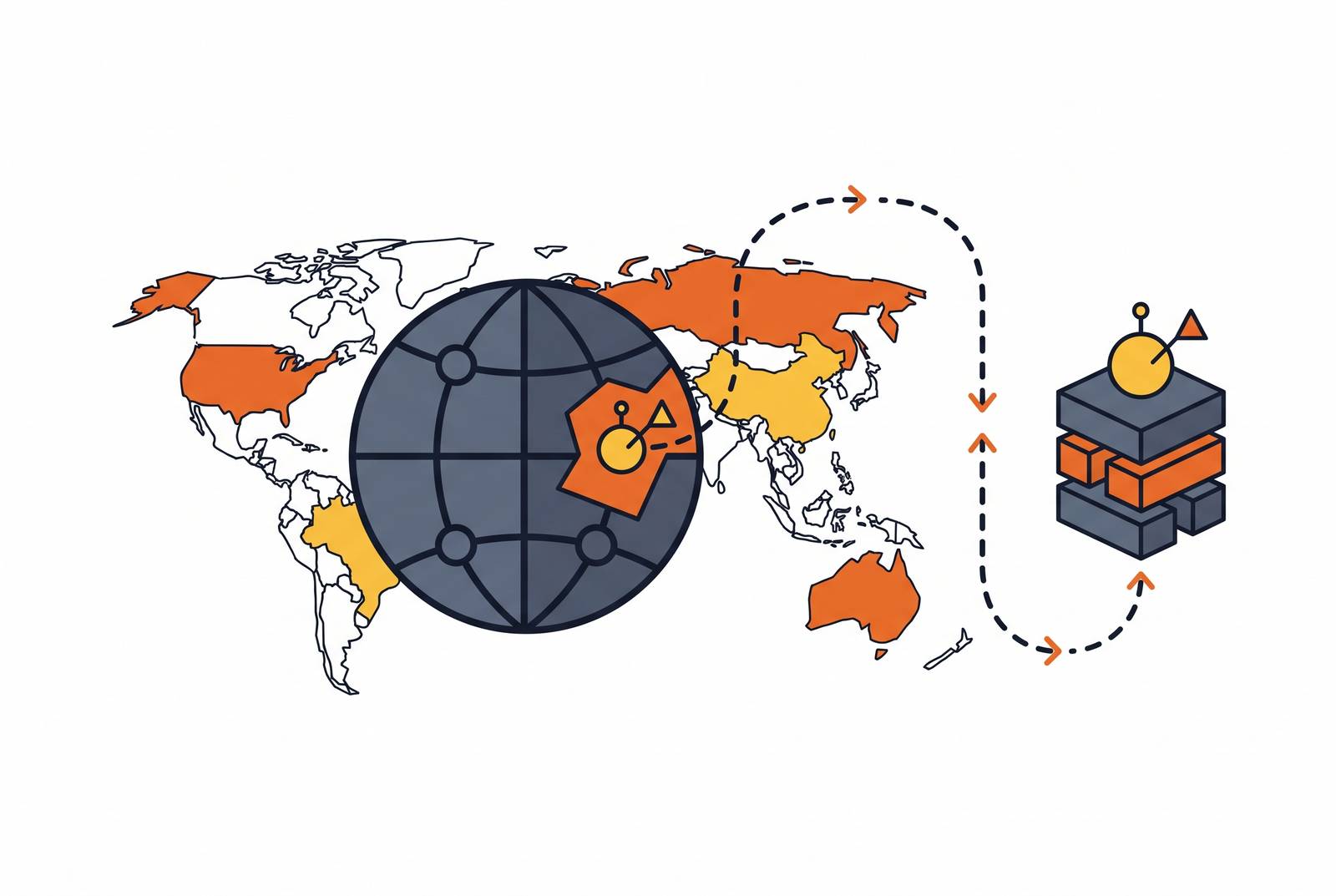
Data residency requirements make agent compute placement both a compliance decision and an infrastructure choice. An agent can move regulated data through prompts, tool calls, memory, and logs even when its primary database stays in the approved region. A defensible placement decision therefore accounts for the full execution path, including the state and records left behind.
Why compute placement has become a compliance question for AI agents
A team selects the EU-region box, deploys its agent, and sends the architecture for legal review. The selected region describes where the workload executes, but not where every artifact goes. If those logs contain data subject to an EU-only requirement, the compute setting has not enforced that requirement. The failure is a mismatch between the scope of the setting and the scope of the obligation.
That mismatch exposes a deeper problem with applying a storage-centric residency model to agents. The inherited model assumes data flows that can be enumerated before deployment, while agent execution can choose its next destination at inference. A tool call can resolve to an endpoint absent from the DPIA. A retrieval can reach a replica in another jurisdiction, while sub-agent delegation can cross a cluster boundary that carries no region signal.
The question changes from where data lives to where data travels during execution. This makes regional deployment the beginning of the analysis. The architectural category error is treating the location of one component as proof about the behavior of the whole system.
What the regulations actually require across GDPR, HIPAA, and sector-specific localization rules
GDPR Chapter V governs transfers of personal data to non-EEA destinations, including transfers made through tool APIs or sub-agent clusters. Each hop covered by these rules needs a lawful basis for processing and a transfer mechanism that applies to it. HIPAA, by contrast, does not mandate a geographic storage location. Its Business Associate Agreement requirements must cover the entities that handle protected health information at the model endpoint and across the runtime, logging layer, and delegated processing.
Logging creates a separate obligation. The EU AI Act's Article 12 requires high-risk systems to support automatic recording of logs over the system's lifetime, with retention requirements also applying. The Act does not itself specify a storage region for those logs. Their location is consequently a contractual and architectural decision that deployers cannot leave to the default observability stack. Rules for EU financial entities and limits under India's DPDP Act and China's PIPL add duties that having cloud services in a region alone cannot meet.
Three concepts help separate the decisions, namely data residency, data sovereignty, and data localization. Data residency is where the data is physically kept, data sovereignty is whose laws govern it, and data localization is a legal mandate to keep it within a jurisdiction. The US CLOUD Act illustrates why these are not interchangeable. A US-headquartered provider's EU data center can keep data physically in the EU while leaving it legally accessible to US authorities. Evidence of placement must therefore show where execution artifacts land and whether that location, provider, and legal arrangement meet the rule that applies.
The four data surfaces an agent produces and why each carries an independent residency posture
The execution surface divides into four categories, namely input and prompts, inference compute, storage at rest, and observability. Their locations can differ, so each needs its own residency assessment. Input begins the chain because a query can carry personal information, business-sensitive context, or other regulated data. A global load balancer that routes the prompt through servers outside the mandated region can create a breach of the location restriction before inference begins. A regional model does not resolve an out-of-region entry path.
Inference adds both the model endpoint and the agents to which work is delegated. Regional model endpoints must be supported architecturally and contractually where the workload requires them. In LangGraph, CrewAI, and AutoGen orchestration, delegation can carry payload, instructions, and retrieved context across cluster boundaries. Framework telemetry in developer dashboards may leave that transfer outside the security and privacy tools meant to detect it.
Storage includes source documents, embeddings and vector indexes. Deriving an index from regulated data does not, by itself, remove the source data's residency obligations. A vector database with an out-of-region read replica creates movement during provisioning and index rebuilds, while retrieval can introduce another cross-border path. Observability is independent again because platforms including LangSmith and Langfuse may record full prompts and completions on their servers. Before an audit, a map of these four surfaces with clear region boundaries helps show where each crossing could break a compliance rule.
How stateful execution and long-running agent workflows multiply the residency surface
Short-term memory in Redis or a similar store holds the context of the current conversation and recent tool outputs. Long-term memory in a vector database can keep summaries of past interactions with no time limit. A durable record in SQL or object storage holds audit logs and compliance records immutably for legal retention. These layers can occupy different locations and follow different retention requirements, so reviewing the primary database leaves much of the state unexamined.
Sandbox persistence adds less obvious copies. Fresh-ephemeral execution destroys the sandbox after each run, avoiding persistent sandbox state but paying the cold-start cost again. Persistent-paused execution retains filesystem and memory snapshots between runs, making the snapshot another regulated artifact. Snapshot-or-fork execution branches a copy-on-write image from a parent with cached dependencies, bringing both the parent and branches into scope when they contain regulated data. The branching operation itself and the resulting storage each have a location.
Memory captures can write all of RAM to storage during standby, including credentials and plaintext data that are in active use. Protection is not automatic across every configuration. AWS requires an encrypted EBS root volume for memory capture protection, while GCP's customer-managed encryption keys require configuration at resource creation and cannot be applied retroactively.
Durable workflow engines add another dependency by checkpointing steps so an agent can survive a pod restart without repeating completed work. Their event-history backend, whether Cassandra, MySQL, PostgreSQL, or SQLite, also needs region pinning. When sensitive state must stay on-premises while non-sensitive processing runs in the public cloud, federated state management needs to be designed with care.
Why region-pinning alone is not enough and what enforcement actually requires
The decisive distinction is between a preferred region and an enforced boundary. Best-effort selection puts work in the chosen region while there is capacity, but can send it elsewhere under load or during failover. With policy-enforced pinning, the control plane rejects any placement outside the boundary. If the designated region is full, the workload fails. Asking whether work fails or spills reveals more about residency enforcement than asking whether a region is available.
Auto-scaling and regional failover test this distinction in different ways. Scaling follows capacity signals unless a deny policy constrains placement. Failover can move execution across a border unless the policy blocks that move until an operator acts. State artifact drift tests what the policy covers beyond how it schedules work. A deny rule limited to compute can still leave snapshots, volumes, logs, and telemetry free to move elsewhere.
Encryption complements this boundary but does not replace it. Block storage encryption does not establish that every sandbox snapshot or memory capture has equivalent coverage. Snapshot encryption can inherit the source volume's configuration, but that inheritance is not universal across sandbox architectures. Customer-managed keys add the ability to revoke access by deleting a key, provided coverage extends to the relevant artifacts.
The contract must describe the same boundary as the architecture. To support a residency claim, the Master Service Agreement, the Data Processing Addendum with region-specific clauses, and sub-processor disclosures must all agree. Those disclosures must name the logging vendor and other third parties that touch execution data. Even with an EU-only clause, an observability pipeline can still send data elsewhere.
Architecture patterns that enforce residency across the full agent execution surface
The first pattern is region-pinned execution backed by a control-plane deny policy. It constrains the primary sandbox, inference endpoints, tool APIs, and sub-agent clusters. Cross-region failover becomes a compliance event that needs an operator to act before recovery can proceed. Where an external API or LLM endpoint must be called outside the mandated region, edge redaction provides a second pattern. Personal information is redacted or tokenized before the call and re-identified only after the response returns inside the compliant perimeter, subject to the applicable transfer restrictions.
Federated observability applies the boundary to execution records. Each region runs its own observability stack without replicating logs out of jurisdiction. This covers application logs as well as telemetry from the embedding pipeline and traces of agent execution. This keeps the record of processing within the same location constraints as the processing it describes.
A runtime-derived AI-BOM with a delegation graph provides evidence about paths that deployment manifests cannot fully predict. The inventory continuously records external endpoints and joins them against the active processor registry. Each delegation edge shows its source jurisdiction, destination jurisdiction, who the processor is, and what personal data it covers. Capturing that behavior at runtime turns tool calls and sub-agent transfers into evidence relevant to Article 28 and Article 30.
Sandbox isolation addresses a different but related boundary. Standard containers share the host kernel, while microVMs using technologies such as Firecracker or Kata Containers provide dedicated kernels per workload. Hardware-enforced isolation supports separation when agents execute generated or user-supplied code in multi-tenant regulated environments, but regional controls must still govern placement. With customer-managed compute, the deny policies, encryption keys, and audit logs are in the organization's own cloud account. With a non-US-headquartered runtime provider, the jurisdiction assessment then rests on the customer's cloud agreement.
What to verify before trusting a vendor's residency claims for agent workloads
Ask whether workloads fail or spill when the designated region reaches capacity, and whether that behavior is logged and auditable. Then establish where the observability stack sends data by default and whether its destination can change without losing platform functionality. The scope should cover compute, state, logs, telemetry, crash dumps, and standby snapshots. A residency claim is only as useful as the artifacts it includes.
Persistence needs its own evidence. Verify that standby snapshots and memory captures stay in the sandbox's mandated region, with encryption coverage established for those artifacts through artifact-specific verification. Ask whether customer-managed keys cover all sandbox state and whether deleting a key renders that data inaccessible. Check whether the keys must be configured when the resource is created.
Delegation and contracts need the same scrutiny. The DPA should identify every third-party service touching execution data, including logging, embedding, and observability providers, with their jurisdictions. Runtime telemetry should expose primary workload execution, cross-border tool calls and sub-agent delegation. For HIPAA workloads, verify BAA coverage across that processing chain. For EU AI Act Article 12 obligations, check where logs are kept, how long they must be kept, and which contractual entity governs those records without global replication.
SOC 2 Type II is a meaningful baseline for independently audited internal controls over a defined period, but it does not prove that a configured agent's actions are compliant. Transparent, open-source infrastructure lets the customer's security team check how isolation, placement, and logging work, so the team has more than an attestation to rely on. Combined with customer-managed compute, it can put the evidence in the customer's own control plane. The final test is whether the organization can account for where execution data went, show what prevented prohibited movement, and connect that evidence to the applicable legal obligation.