What No-Code Agent Builders Actually Execute Under the Hood
Understanding what runs beneath the visual interface determines production reliability.
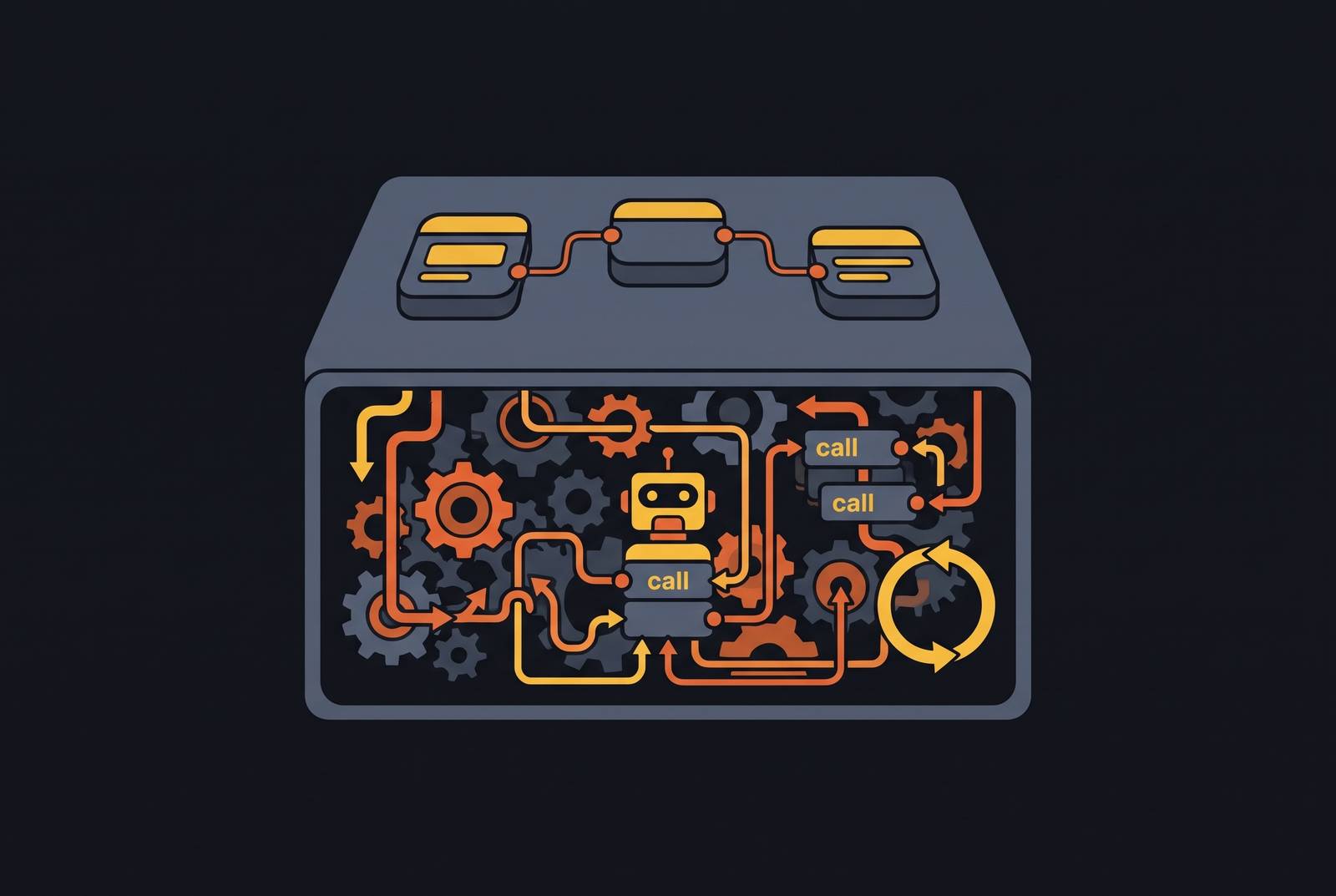
No-code agent builders hide a complex execution system behind a visual canvas. This article examines the runtimes, isolation boundaries, deployment choices, and persistent state beneath that surface. Its central argument is that production reliability depends on what the platform executes and controls.
What no-code agent builders actually do when a workflow runs
A drag-and-drop editor shows connected steps, but the running workflow consists of instructions and knowledge, tools the agent can call, and a runtime. That runtime starts execution on a trigger, a schedule, or a call from another workflow. The canvas conceals much of the coordination work. Integrations, conditional logic, state management, retries, and error handling become visual components rather than orchestration code that the builder’s user must write.
Yet hiding code does not make every workflow an agent. The distinction is whether the model can interpret context, choose among allowed actions, and change its approach during execution. Consider the request “my package didn't arrive, ship a replacement to a new address”. Handling it requires checking order records and inventory, initiating a return, updating the address, and confirming a new delivery window. Those actions require coordination when the next step depends on what the previous one reveals.
Agent-first builders focus on trigger-based assistants for people and teams, while business agent platforms have multiple agents work together across broader processes. Automation-first platforms start with structured workflows and add AI reasoning where it is needed. These categories describe emphasis across different execution engines. The same visual connection between two steps can therefore hide very different rules for who decides what happens next.
How the leading platforms differ in their underlying execution architecture
CrewAI makes the distinction between autonomous behavior and deterministic control explicit. Its Crews let agents work together, while its Flows run event-driven production workflows. Those are separate orchestration models. Google Vertex AI Agent Builder instead provides fully managed runtime deployment and agent evaluation, with full integration for LangChain and LangGraph and support for CrewAI through a custom template.
Other platforms put different controls around execution. n8n’s self-hosted model supports RBAC, SSO/SAML/LDAP, external secret stores, and audit logging, while its agents support versioning, session memory, tool scoping, and human approval gates. Rasa uses an Orchestrator to combine reusable skills encoding business logic with memory that retains context across interactions. It applies LLMs selectively to interpretation and response generation.
These differences complicate any claim about what “no-code” supports. Does the platform manage the runtime, constrain an agent’s choices, or preserve context between interactions? Those are separate questions, even when the interfaces look similar. Governance also varies by platform and often by pricing tier. A prototype can demonstrate a successful sequence without establishing which controls will be available when that sequence handles production work.
Why code steps inside visual builders create an execution boundary most teams don't see
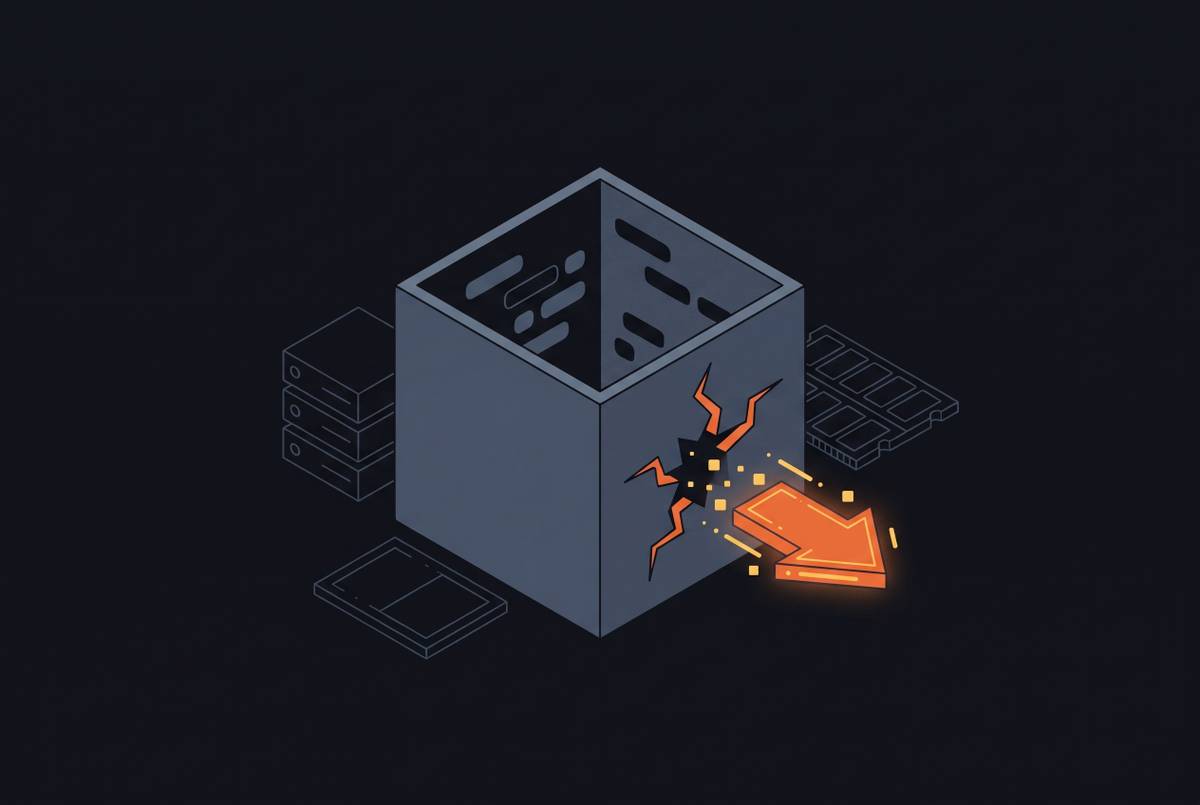
A Python or JavaScript step extends the builder beyond its predefined components. It also changes the nature of execution. The code escape hatch is especially useful when behavior cannot be specified in advance, which is also where an agent may generate or modify code at runtime. The instructions that the machine writes then run with whatever permissions the execution environment gives them.
At that point, the visual abstraction stops protecting the reader’s understanding of the system. The platform may still coordinate sequence and tool calls, but the code’s reach depends on the runtime. A hidden prompt injection in a document could instruct an agent to read SSH keys and include them in its response. If the code step can access the host filesystem, that request has a route to sensitive data.
The emerging Agent-OS primitive addresses this boundary through transactional filesystem sandboxing with copy-on-write. It stages agent-generated code in a shadow copy for review before committing changes. That makes isolation part of the execution design from the outset. Yet many builders advertise a code step without showing where it runs, what it can reach, or what stops it from escaping. What, exactly, separates the generated code from the systems beneath it?
What actually isolates agent-generated code from the systems it runs on
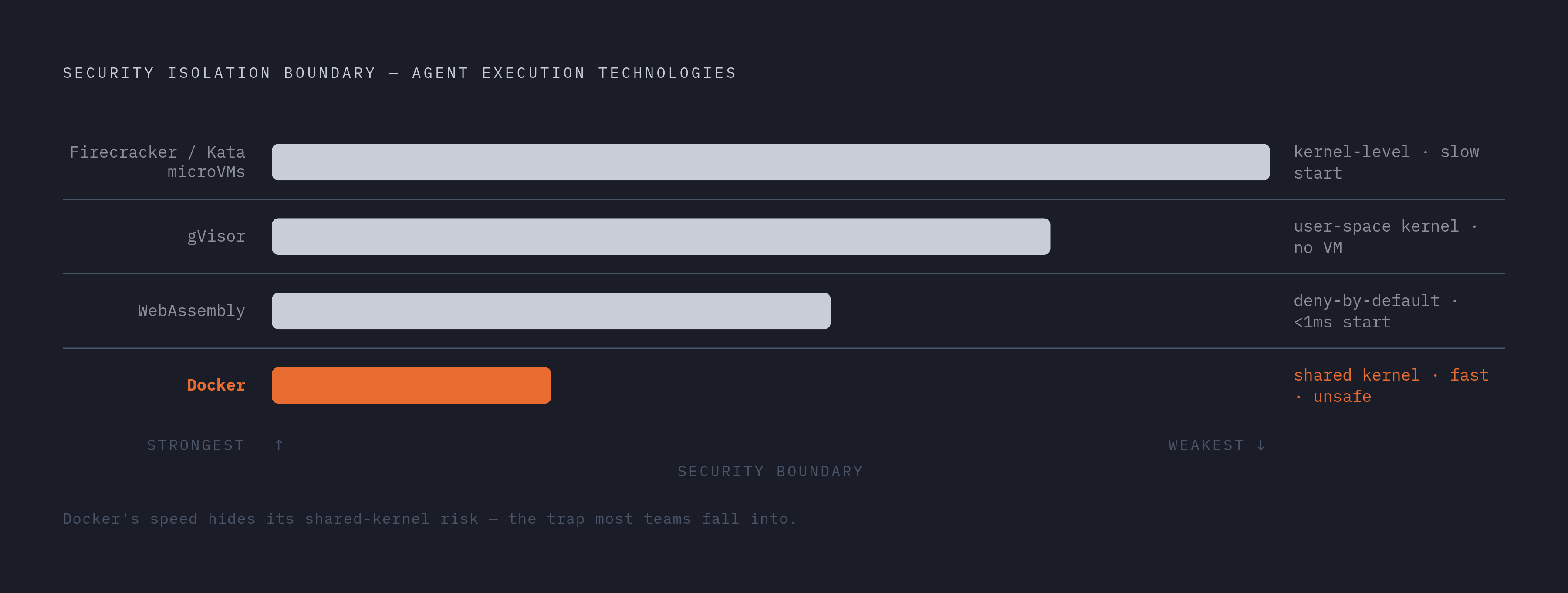
Standard containers share the host kernel, which makes them an insufficient boundary for potentially malicious agent-generated code. Speed of provisioning does not resolve that exposure. The security model has to treat generated code as untrusted and explicitly permit only what it needs. This applies zero trust at the point of execution.
The concern is broader than a model occasionally making a mistake. AI-generated code has higher rates of vulnerability classes that include browser-based script injection and log injection, and these patterns occur in code generated across model families without reliably going away as models get larger. The peer-reviewed USENIX Security 2025 study also found that models recommend hallucinated package names and repeatedly generate some of the same names. That repetition creates an opening for package squatting. An attacker can publish a package under a name the model predictably invents.
Firecracker/Kata microVMs provide kernel-level isolation and the strongest security boundary among the options described here, while gVisor provides user-space kernel protection without full VM overhead. Chrome-based browser isolates suit workloads that fit a browser context. Docker containers are quick to set up but still have the shared-kernel boundary. WebAssembly takes another approach, combining deny-by-default capabilities with per-invocation isolation and sub-millisecond startup.
For “sandboxed” execution, the resources the sandbox exposes and the boundary that enforces those limits therefore matter. Open-source, transparent infrastructure makes those guarantees available for inspection. With a black-box execution service, the team instead has to trust protections it cannot check. For production agents running untrusted code, inspectability belongs in the security argument.
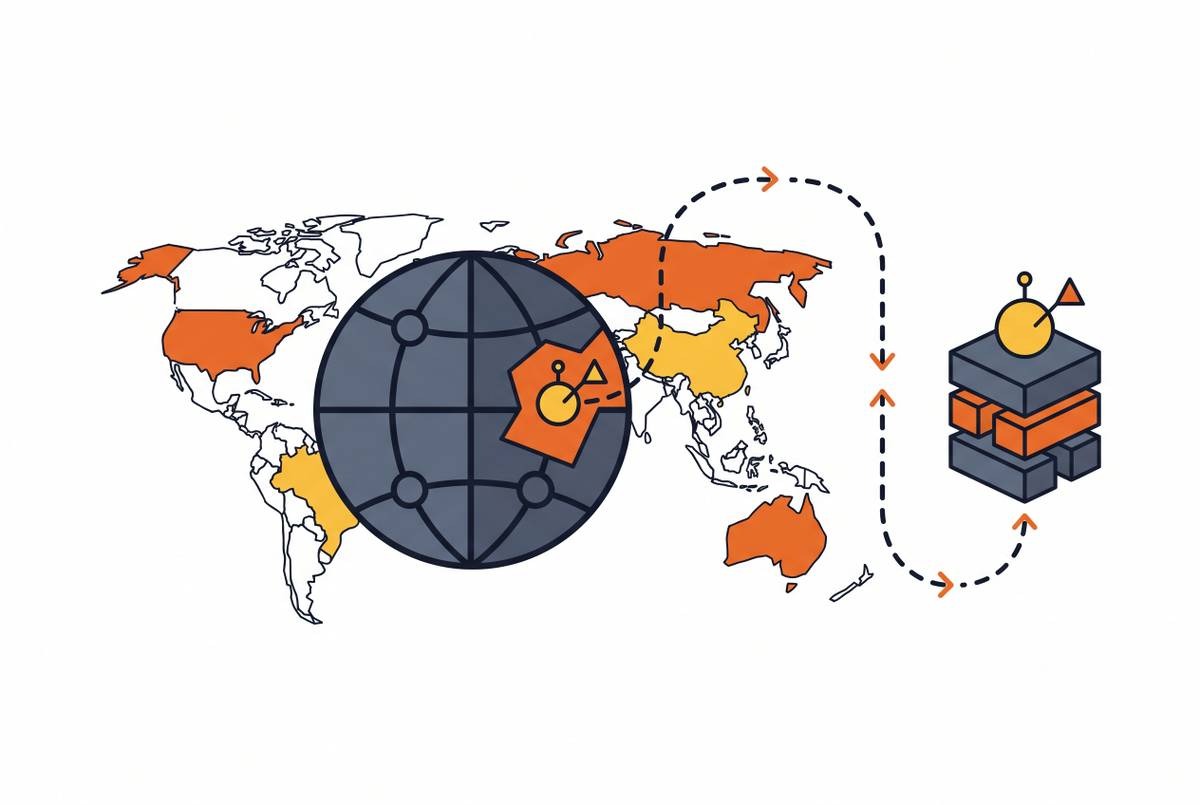
How platforms that support on-premises and self-hosted deployment handle the data boundary
A sandbox constrains what running code can reach, while deployment determines where the runtime lives and whose infrastructure contains it. Cloud-hosted, self-hosted, and on-premises execution therefore differ in where data stays and how it can be audited. A strong sandbox outside an organization’s infrastructure does not, by itself, move the data boundary inside it.
The deployment options described for late 2026 span several models. Dify offers a self-hosted Community edition and Dify Enterprise, with air-gapped deployment supported on the Enterprise edition. Stack AI offers on-premises and VPC deployment on its Enterprise tier, while Lyzr supports on-premises deployment inside a VPC or a hybrid model. These are distinct deployment commitments. Their availability cannot be inferred from the presence of a visual builder.
VDF AI supports on-premises, private-cloud, or air-gapped deployment, while Langflow offers a free self-hosted option as well as DataStax managed cloud. By contrast, cloud-only platforms including Microsoft Copilot Studio and Vertex AI Agent Builder place execution outside the organization’s infrastructure. Internal policy alone cannot change that location.
Teams need to decide the data governance boundary before building the agent, giving it priority over deployment cost or convenience. Location, however, is only part of accountability. Each agent also needs its own identity so actions remain individually attributable. Shared service accounts break that distinction and undermine the audit trail needed for SOC 2, HIPAA, and GDPR controls.
What stateful execution actually requires and why ephemeral runtimes break long-running agents
Even a well-isolated runtime in the right location can lose the continuity a task requires. Enterprise agents may need to work across many sessions and sandboxes over days or weeks, survive failures, and pause for human review. Each session needs to pick up where the last left off. That requires keeping execution state and leaving the workspace in a state that lets work resume.
What must survive a pause is more than the latest answer. A long-running runtime can keep the reasoning chain, working memory, tool history, and pending action while human review takes hours. It can suspend without consuming compute and resume with sub-second latency. These are runtime capabilities.
LangGraph models agent behavior as stateful graphs with checkpoint-based persistence, supporting resumption, human inspection, memory, time travel, and fault tolerance. Azure Durable Functions uses a different durable pattern that checkpoints each activity when it is done. A replacement worker can replay the history and continue from the interruption, alongside Azure AI Foundry’s model and agent execution layer. In both cases, continuity has an explicit mechanism.
An ephemeral runtime that terminates between steps cannot preserve a pending human decision without a durable layer outside it. n8n’s approval gates for sensitive actions make that requirement concrete. The workflow must keep enough state to link the response, when it comes, to the action waiting for approval.
Computer-use agents and what running a virtual desktop inside a sandbox demands
Computer-use agents expand the execution environment from code and tools to a graphical workspace. They sign into accounts, navigate dashboards, complete forms, download files, and operate applications through simulated mouse and keyboard actions. The runtime now has a desktop to maintain. Provisioning, isolation, and persistence become visible parts of whether the agent can complete its task.
The cloud-sandboxed approach separates that workspace from the user’s computer. ChatGPT’s Agent Mode gave the agent a secure cloud-based virtual computer with a visual browser, terminal, and filesystem, while keeping direct control of the local desktop out of its hands. OpenAI removed Agent Mode in August 2026 and replaced it with ChatGPT Work. The agent’s working computer was a separate execution environment.
Vercel Labs took a different path with agent-desktop, which was released on October 31, 2026. The free, open-source tool supports macOS, Windows, and Linux by reading the OS accessibility tree rather than inferring button locations from screenshots. It uses AX API, UI Automation, and AT-SPI respectively. Each agent gets its own on-screen cursor and operates native applications in the background while the user continues working.
Bytebot provides a complete Ubuntu 22.04 desktop with XFCE, Firefox, and VS Code inside Docker containers, accessible through a web interface. It supports Docker Compose or one-click Railway deployment. ByteDance’s UI-TARS Desktop instead provides an Apache 2.0 open-source native GUI agent for Windows, macOS, and browsers, with fully local processing through the UI-TARS and Seed-1.5-VL/1.6 vision-language model series.
For sandboxed desktops, the earlier requirements now compound. The environment must be quick to set up, keep desktop state from one interaction to the next, and block access beyond the allowed filesystem and network boundary. Millisecond provisioning and indefinite stateful execution make extended computer-use work practical. A desktop that appears quickly but disappears before the next interaction solves only the first part.
The compliance layer that sits on top of the runtime and why it cannot be retrofitted
Compliance makes these architectural choices procurement questions as well as engineering questions. SOC 2 Type II, ISO 27001, HIPAA, GDPR, and NIST AI RMF bring different trust, information-security, healthcare, privacy, and AI-risk requirements into the evaluation. They are not interchangeable labels. The runtime must support the controls relevant to the work it performs, rather than merely sit beneath a policy promising them.
Healthcare makes the connection concrete. An agent that processes, transmits, or stores Protected Health Information requires a signed Business Associate Agreement with the AI model provider. This includes agents that query medical databases, write clinical notes, or route patient records. Its PHI-related actions must also appear as individually attributable audit events. The per-agent identity boundary described earlier is therefore a prerequisite for a meaningful record.
Deployment options and persistent execution become equally consequential when controls must operate throughout a workflow. Self-hosting does not by itself establish compliance, just as a cloud-hosted canvas does not establish that the necessary controls are absent. The chosen architecture must support the workload’s obligations. Discovering that it does not is not a configuration problem. Teams that establish those requirements before building can choose a suitable foundation, while teams that discover the mismatch after a successful prototype may have to rebuild it.