How Deliberative and Reactive Agents Differ at Runtime
Reactive agents act instantly; deliberative agents plan first.
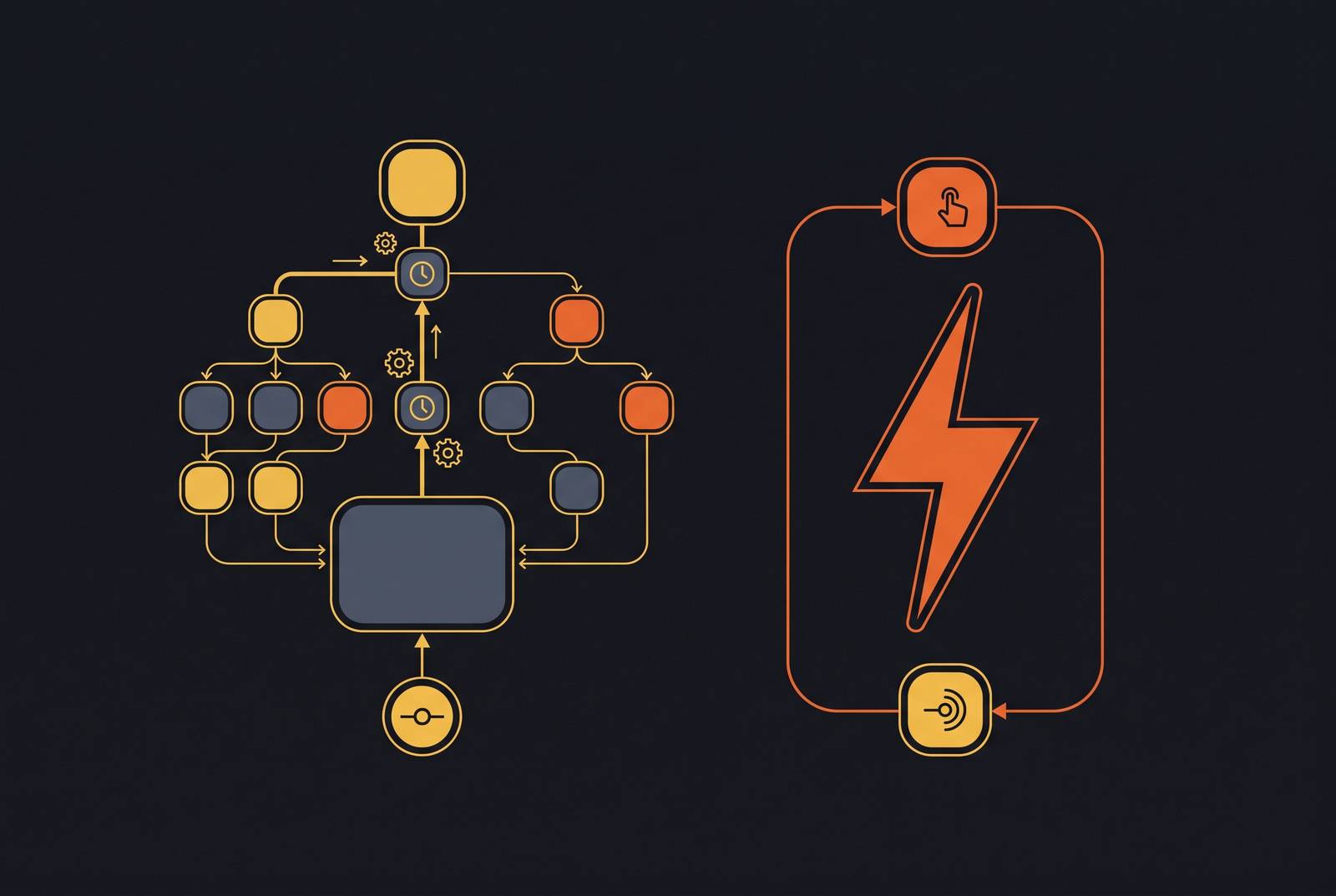
Reactive and deliberative agents differ most at runtime, in the work they do before acting and the resources that work requires. Those differences determine how builders should provision compute, preserve state, enforce isolation, and support compliance.
The fundamental runtime difference between reactive and deliberative agents
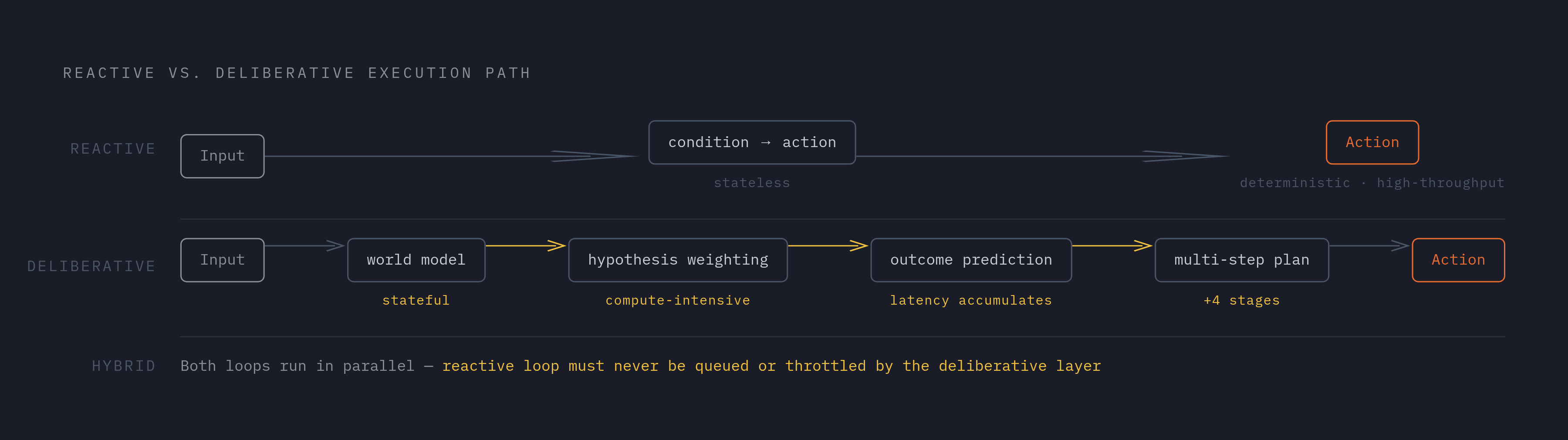
The architectures differ in what happens between an input and an action. A reactive agent applies a condition-action mapping immediately, without retaining a world model or looking ahead. A fraud-detection system flagging a velocity threshold illustrates this direct path. A deliberative agent keeps an explicit world model, weighs hypotheses, predicts outcomes, and thinks through a multi-step plan before it acts. Supply chain scheduling, clinical decision support, and portfolio rebalancing are common uses of that planning layer.
The distinction is therefore between a tight, predictable control loop and a process that spends time evaluating what to do. Both patterns are needed because a fast response and a well-considered decision serve different needs. The hybrid reactive-deliberative pattern combines them by running a fast reactive loop in parallel with a slower deliberative layer. As that pattern is the production norm, runtime infrastructure must serve both loops simultaneously.
How each architecture consumes compute and generates latency
Each decision requires little compute, timing is deterministic, and workloads can scale horizontally. High decision throughput is achievable precisely because no planning cycle intervenes between a matching condition and its action. Infrastructure must principally serve many short executions.
Deliberative agents impose a different load because planning adds meaningful latency and significant compute overhead to each decision. That cost is structural because an agent that compares possible outcomes must do work that a direct condition-action mapping skips. The operational deadline therefore limits how much planning can be accommodated. No single timing figure in the notes establishes a universal budget for that work.
Timeout thresholds and fallback mechanisms are needed so that planning failures degrade gracefully and downstream operations can continue. Caching repeated decision patterns can also reduce latency without sacrificing planning depth. In a hybrid system, however, these measures do not replace separation between the two execution paths. The deliberative loop must run asynchronously without queuing or throttling the reactive loop in a way that breaks its response guarantee. Consequently, high-throughput stateless compute fits the reactive side, while the deliberative side needs a durable, longer-running environment that holds state throughout planning.
Why deliberative agents make state persistence a first-class infrastructure requirement
That need to hold state is a requirement for correctness. A reactive agent that loses local state between invocations loses no retained world model, because its architecture does not depend on one. A deliberative agent that loses state mid-plan can lose the plan itself and the compute already spent developing it. Its runtime must keep the task going as well as keep an individual process available.
The Model-Native Computing Architecture paper frames the agent runtime as analogous to an operating system, responsible for scheduling, permissions, and resource management across the agent lifecycle. The same paper describes an engineer at Rakuten running Claude Code autonomously for hours over a 12.5-million-line codebase. It also describes an Augment Code enterprise customer delivering in two weeks what a CTO had estimated at four to eight months. These examples establish that long-horizon execution is already a production reality, rather than only a demonstration scenario. They make session continuity a practical infrastructure concern.
Persistence does not, by itself, make a plan sound. Deliberative systems still face stale plans as environments change, model incompleteness when reality violates planner assumptions, and computational overrun when planning exceeds operational deadlines. Losing state mid-execution makes each problem worse because the agent loses what it needs to carry on with the task. Durable execution provides crash recovery, session-level persistence, and checkpoint-based resumption. A coding agent debugging a complex test failure can run for more than 30 minutes, so resuming can save substantial work compared with restarting. Infrastructure sized only for short, stateless invocations misses that requirement.
What isolation actually means for each agent type, and why shared-kernel containers fall short for deliberative workloads
Preserving a task across time also raises the question of what that task is allowed to affect. Reactive agents execute predefined logic in short-lived, stateless runs, so their behavior has a bounded blast radius. Deliberative agents may call external tools and run LLM-generated code as they work through multi-step plans. That code introduces novel, untrusted behavior rather than merely another invocation of an established rule. The isolation boundary must account for that difference.
The Hugging Face paper on autonomous AI agents identifies a particular danger in systems that write and execute their own code beyond predefined constraints. Such systems create the potential to override human control, making isolation more important as autonomy increases. Standard containers share the host kernel, which is adequate for the trusted, predefined code in the reactive case described here. It is not the required boundary for AI-generated code that must be treated as hostile. A runtime cannot substitute confidence in the agent’s intended task for containment of the code it actually executes.
The relevant options differ in where they enforce that boundary. Hardened containers suit trusted code, while gVisor provides an intermediate approach through a user-space kernel and syscall interception. MicroVM approaches, including Firecracker and Kata Containers, provide hardware-enforced isolation with dedicated kernels per workload. For deliberative agents running untrusted generated code, this stronger separation is an architectural requirement. Purpose-built agent runtimes offer isolated execution environments for tasks whose security needs go beyond what developer containers can provide.
How the autonomy spectrum changes the compliance burden at runtime
Isolation addresses what an agent can reach, but enterprise governance must also account for the data and decisions inside that boundary. Deliberative agents keep state over time, call external systems, and may work with regulated data throughout long tasks. These traits leave more to audit than short runs of predefined reactive logic. The Hugging Face paper links increasing autonomy to increasing risks to people, including hijacking, data exfiltration, and privacy compromise. Enterprise governance must assess how much control has been ceded and what that control exposes.
The EU AI Act adds obligations based on the use case. Most B2B agents are in minimal-risk or limited-risk categories, and limited-risk uses must meet transparency obligations. Agents used in HR/recruitment, credit scoring, healthcare, critical infrastructure, or law enforcement fall into high-risk categories that trigger conformity assessment, post-market monitoring, and human oversight requirements. Deliberative agents are more likely to encounter these burdens because they make multi-step decisions autonomously. Their planning architecture does not itself replace an assessment of the application.
HIPAA imposes a separate constraint regardless of architecture, because an organization cannot legally share PHI with a vendor without a signed Business Associate Agreement. Deliberative agents are especially likely to come across that data in long healthcare sessions. When enterprises buy infrastructure, they also require SOC 2 Type II and ISO 27001, with HIPAA for healthcare and FedRAMP for the US public sector. These requirements reach the runtime because regulated data lives there during execution.
OWASP’s Top 10 for Agentic Applications, published in December 2025, provides a risk taxonomy specifically for autonomous agents. Organizations running coding agents in regulated contexts without request-level observability and MCP governance have an audit gap. Isolation alone does not close that gap, just as application-layer controls cannot carry the whole compliance burden. The runtime must support the certifications and obligations applicable to its workload, including SOC 2, HIPAA, and GDPR requirements.
Computer-use and GUI-controlling agents as the hardest deliberative runtime case
When an agent controls a desktop or browser, its task depends on implicit state, including open dialogs, cursor position, clipboard contents, browser sessions, and credentials. That state must stay isolated and survive as a long-horizon task pauses and resumes. The challenge is no longer just to preserve a plan or a filesystem. It is to preserve the working environment in which the plan is being carried out.
Unlike API-based agents, desktop GUI agents work with software whose state is not fully serializable. A snapshot may capture the filesystem but miss some of the running services, open application state, browser profiles, and credentials. Virtual machines provide strong isolation and snapshot-based rollback, but cloning full guest state is expensive. Containers share the host kernel and often miss some of the GUI state when they capture it. MicroVMs improve the performance-isolation tradeoff for service workloads, but they are not optimized for rich desktop interaction.
Browser agents have also become a production category of their own. The period from Anthropic’s Computer Use launch in October 2024 through mid-2026 produced a stack including Claude Computer Use, OpenAI Operator, Stagehand from Browserbase, the open-source browser-use library, and Browser MCP servers. For full-OS desktop control, builders need both isolation and state-capture, which steers them toward purpose-built virtual desktop environments over containers.
A sandbox must start quickly enough to remain responsive, preserve full GUI state across pauses, isolate the workload from the host, and support rollback after a wrong action. Speed alone does not establish that the other guarantees are present. Nor does a durable filesystem establish that the desktop can resume where the agent left it. Generic container infrastructure falls short of meeting all four requirements at once, so computer-use agents test the limits of the whole runtime design.
Matching infrastructure to agent architecture without provisioning the wrong runtime
The first provisioning decision is whether the workload needs rapid rule execution, sustained planning, or both. For reactive agents, standard serverless or container patterns fit short-lived, stateless, high-throughput execution. Over-engineering infrastructure for capabilities that the workload does not use poses the main risk. For deliberative agents, too little durability and isolation can make the system fail and leave it open to security threats. AWS Lambda’s hard timeout of 15 minutes, for example, is insufficient for non-trivial workflows that need longer continuous execution.
Builders can make the distinction concrete by examining what the agent does between steps. Relevant questions include whether it retains state, executes externally supplied or AI-generated code, runs for more than a few seconds, touches regulated data, or controls external systems. A positive answer moves the workload toward purpose-built agent infrastructure. The answers also identify which guarantees matter, rather than treating every agent as an identical unit of compute. Planning that runs for a long time needs durable execution and session persistence, while untrusted generated code needs hardware-enforced isolation.
Hybrid systems add the constraint that deliberative resource consumption must not starve the reactive path. The Model-Native Computing Architecture paper formalizes a related distinction between a probabilistic execution plane, which concerns what can be computed, and a deterministic control plane, which concerns what should be computed. Conflating those planes creates unpredictable behavior at scale. This architectural separation must be established before provisioning.
Docker-native compatibility matters because builders should be able to get stronger guarantees without rewriting the stack they already have. The practical path is infrastructure that runs what they already have while adding the durability, isolation, and compliance their workload requires. For deliberative agents, that means fast provisioning, stateful execution, hardware-level boundaries where generated code demands them, and enterprise compliance at the runtime layer. Reactive agents can use simpler patterns because the work they run is simpler. Choosing correctly begins with that runtime difference and follows its consequences all the way down to infrastructure.