Java Sandbox Environments for Untrusted Code Execution
Move Java's trust boundary outside the runtime to contain AI-generated code safely.

Java sandbox environments for AI-generated code need a boundary that does not depend on Java itself. With SecurityManager permanently disabled, the architectural response is to treat the JVM as untrusted payload and confine it from outside. Choosing that boundary requires more than selecting an isolation engine. Its security also depends on patching, downstream artifact handling, session state, and the constraints under which the workload runs.
Why Java's built-in isolation mechanism is gone and what that leaves teams with
SecurityManager was Java’s in-process permission model, with checks at hundreds of call sites inside the JVM to enforce it. It is now deprecated and permanently disabled, although API removal is deferred to a future release. The distinction is between an API’s presence and its protection. The JVM has no supported in-process mechanism for confining untrusted code, and classloader work cannot restore one.
That loss coincides with agents generating Java for data analysis, API integration, and file manipulation without human review of every line. More untrusted code reaches the runtime just as its internal guardrail disappears. Yet SecurityManager was never a dependable default. Its protection depended on correct configuration and complete permission checks, leaving it vulnerable to a missed check. Its removal strips away false reassurance as well as real protection, leaving the JVM unable to separate trusted application code from untrusted agent output through that permission model.
What moving the trust boundary outside the JVM actually means architecturally
The new boundary belongs around the JVM process, outside its class hierarchy. Instead of asking Java to police the code it executes, the surrounding environment governs the process’s file system access, network calls, syscalls, and resource consumption. This changes which component must be trusted. The JVM becomes part of the workload being confined rather than the mechanism responsible for confinement.
That distinction sets a demanding requirement for the sandbox. It must contain a fully functional JVM, including its classloader hierarchy, JIT compiler, native library loading, and garbage collector, without relying on the runtime’s cooperation. Restricting only the generated source does not establish that boundary. The isolation stack must govern what the running process can reach, even when its code is hostile. On shared infrastructure, the assets at risk include credentials, customer data, and neighboring workloads, so the relevant question is what remains protected when the JVM cannot be trusted.
The isolation technologies available and how they compare for JVM workloads
Standard Docker containers use Linux namespaces and cgroups to isolate processes and control resources, but they share the host kernel. A kernel vulnerability or misconfiguration can therefore permit escape. This is not a hardware-enforced separation between tenants. Containers suit trusted, vetted code in single-tenant environments, but that premise does not hold for unreviewed, AI-generated Java on shared infrastructure.
Firecracker instead creates lightweight VMs with dedicated kernels inside KVM, providing hardware-enforced isolation. For Java, however, VM boot time is only part of readiness. A real mvn test run behaves differently from a hello-world benchmark because the workload includes the JVM’s own startup and execution profile. The actual workload needs to be measured. Generic cold-start figures are not a reason either to reject microVMs or to assume their performance will fit.
Kata Containers provides hardware-level isolation through standard container APIs and integrates with Kubernetes. It orchestrates VMMs including Firecracker, Cloud Hypervisor, and QEMU. Kubernetes sees a container while a full VM runs underneath. WebAssembly/WASI takes a different approach, using sandboxed linear memory and granting external capabilities explicitly through WASI interfaces. Its Component Model composes modules through typed imports and exports, but running a full JVM inside Wasm is non-trivial and compatibility is narrower. For teams executing general untrusted Java agent code, those differences help explain the convergence on Firecracker.
How the managed sandbox ecosystem has converged on Firecracker for untrusted code
Vercel Sandbox became generally available in January 2026 as a managed, ephemeral compute primitive for untrusted or AI-generated code. It runs on Hive, Vercel’s internal platform for orchestrating Firecracker microVM clusters across regions. Session duration depends on the service tier. Hobby sessions are shorter, while Pro and Enterprise sessions can last up to a full day. Its native runtime support is limited to Python and Node.js, so its architecture serves as a reference point for Java teams.
AWS Bedrock AgentCore provisions a dedicated Firecracker microVM per agent session for its Code Interpreter and Browser tools. Deno Sandbox, released in beta in February 2026, likewise gives each sandbox a dedicated Firecracker microVM on Deno Deploy’s own infrastructure. These are independent implementations of the same isolation choice. Their convergence shows that the external boundary is a production architecture. It does not, however, make their runtime support, lifecycle policies, or operational security interchangeable.
What the security study of sandbox engines reveals about where actual risk concentrates
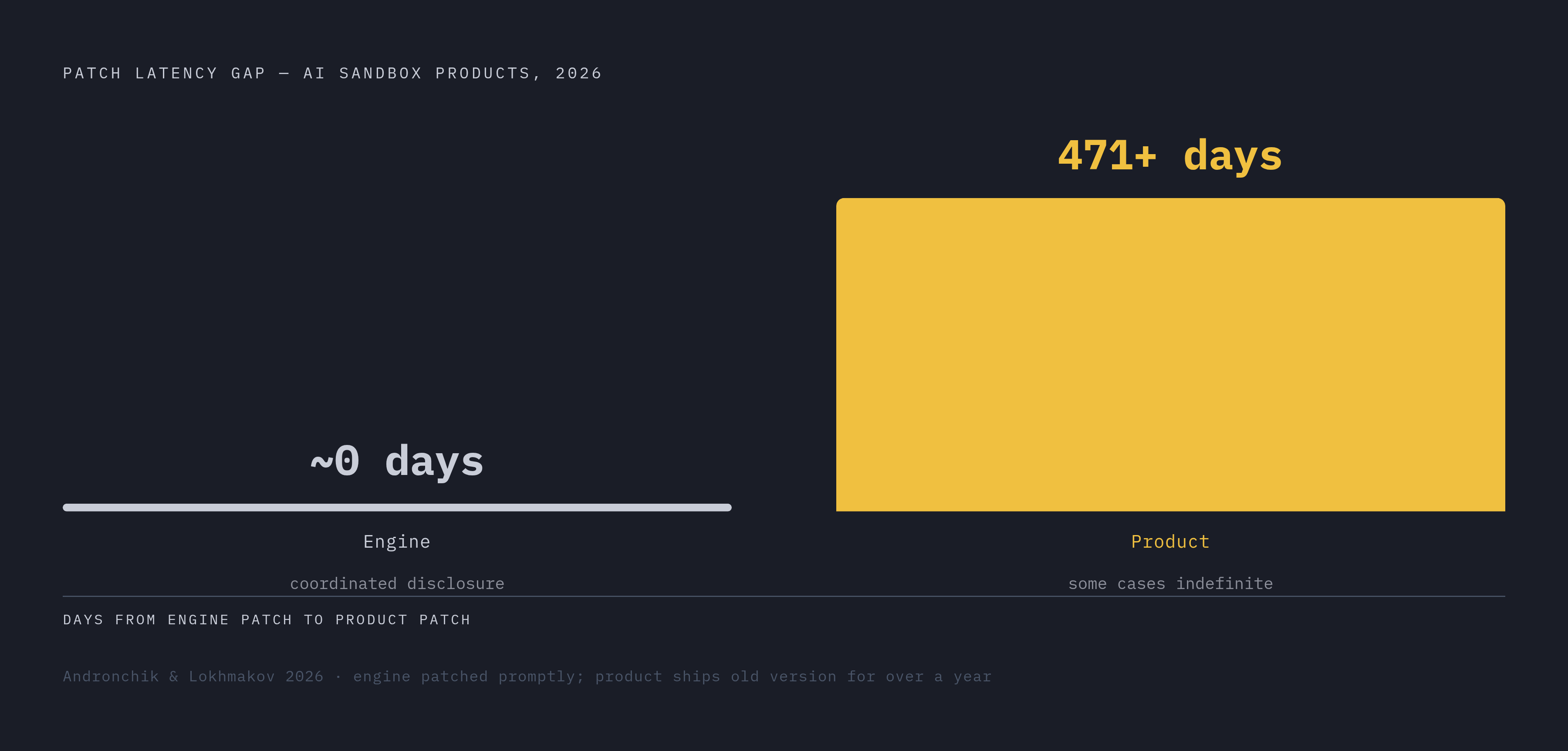
Andronchik and Lokhmakov’s 2026 comparative security study examined five AI-sandbox products across six engine-level measurements, including host attack surface, information leakage, defense-in-depth stackability, public CVE history, patch cadence, and upstream fuzzing posture. Engine classes separated cleanly on architectural properties. The less clear-cut separation of products within a class complicates any selection process that stops once a vendor names its isolation engine.
The study found approximately zero days of aggregate engine-side patch latency for coordinated disclosures, while downstream product lag ranged from zero days to over 471 days, with other cases opaque or indefinite. For operators, the biggest difference was the product’s pin policy. An upstream fix offers little protection if the product is still pinned to an older engine. For Java teams, native library loading and JIT compilation expose a larger syscall surface than a comparable Python workload, making both engine choice and update delivery consequential.
The study also divided fuzzing investment into three tiers, with no product in its set combining a microVM with continuous public fuzzing. Zero published CVEs was therefore not sufficient evidence of safety where an engine also lacked an upstream fuzzer and academic study. Teams should examine pin policy, historical CVE lag, and the underlying engine’s fuzzing investment as well as its isolation class.
The trust handoff flaw and why a perfectly isolated sandbox can still be bypassed
Even a well-maintained engine governs only the actions inside its boundary. A separate question concerns what happens to the files that leave it. Pillar Security’s “Week of Sandbox Escapes” disclosed seven issues affecting Cursor, OpenAI’s Codex CLI, Google’s Gemini CLI, and Google’s Antigravity. The sandbox itself held in all of those cases. Each issue exploited how a trusted component later handled something the sandboxed agent had produced.
The handoff is the point where trust changes. An agent writes a hook configuration, a virtual environment interpreter path, a Git config entry, or a task definition while obeying the sandbox’s restrictions. After its turn ends, an unsandboxed tool consumes that agent-authored file as trusted workspace infrastructure. For Java pipelines, the same exposure exists when compiled JARs, Maven wrapper scripts, build configuration files, or shell hooks reach a CI system, IDE plugin, or deployment tool without re-validation.
Cato Networks disclosed a different pair of Cursor flaws in February 2026, tracked as CVE-2026-50548 and CVE-2026-50549 and collectively named “DuneSlide”. Both received CVSS 9.8 scores and were fixed in Cursor version 3.0. They targeted enforcement logic through prompt-injected working-directory and symlink-validation manipulation. Strong isolation needs defense in depth around both enforcement and later consumption of agent-authored artifacts, rather than replacement with a different isolation primitive alone.
How persistence, snapshots, and stateful execution change the architecture for Java agents
The main choices are ephemeral per-task execution, persistent sessions, snapshot-resumable environments, and long-running background workflows. A code-interpreter task may need seconds, while a coding agent working across a large Java codebase may need hours. A browser automation flow may instead need restorable state when a human intervenes.
For Java, each fresh environment has to go through class loading and JIT compilation again before it reaches steady-state execution. Short tasks can spend disproportionately on that warm-up. Snapshot-based resume that preserves a warmed JVM is therefore an optimization. Persistent sessions keep the same environment across steps, while background workflows need checkpoint recovery so they can keep running. The snapshot pattern has become a baseline expectation for multi-step runtimes operating autonomously over large codebases for hours, where state persistence and cross-step resource management are part of the workload.
What enterprise compliance requirements impose on the sandbox stack for Java teams
Compliance narrows the feasible architecture before performance or convenience can settle the choice. In fintech, healthcare, and government environments, the requirements can rule out a whole hosting model. ISO/IEC 42001:2023 adds AI governance, training data quality and provenance, AI risk management, and lifecycle controls that traditional audits miss. Security teams are beginning to require it alongside SOC 2 Type II.
Data residency adds another limit for regulated workloads that use customer financial data or patient health records. Where the applicable requirements prohibit that data from leaving the VPC, a fully managed multi-tenant sandbox outside it is not viable. That deployment constraint permits cloud infrastructure within the required deployment perimeter. Fly.io Sprites offers a managed example with persistent Firecracker microVMs and 100GB NVMe storage, SOC 2 Type 2 attestation, HIPAA readiness with pre-signed BAAs, and support for GDPR compliance through a pre-signed DPA. Those provisions can satisfy relevant managed-service requirements, but they do not erase a separate VPC-residency restriction. For the most constrained environments, BYOC or self-hosted infrastructure provides the path that keeps the execution boundary within the required deployment perimeter.
Choosing the right sandbox architecture for a Java agent workload in practice
The practical decision follows four questions in sequence, covering the threat model, temporal profile, compliance constraints, and operational overhead the team can absorb. The threat model establishes the minimum acceptable isolation. For AI-generated code in a multi-tenant environment, Docker-by-default is not acceptable. The recommended minimum is gVisor for GPU-dependent workloads or Firecracker for other workloads. That decision must also include an audit of downstream artifact handling, because stronger confinement cannot correct a trusted tool’s decision to execute unvalidated agent output.
The temporal profile then determines how that isolation is allocated over time. Short-lived code-interpreter tasks can use a fresh ephemeral microVM for each run and bear the cold-start cost. Multi-step coding agents over large Java codebases fit persistent or snapshot-resumable environments that avoid repeating JVM warm-up at every step. Long-running background workflows need indefinite runtime with checkpoint recovery. These choices reflect different lifecycle needs.
Teams whose data cannot leave the VPC have a BYOC or self-hosted Firecracker path, either directly or through Kata Containers on Kubernetes. For eligible managed deployments, the recommended checks include SOC 2 Type II, a HIPAA BAA, and a GDPR DPA. Operational control then becomes a cost and staffing decision. When there are fewer executions each month, managed services usually let teams launch sooner, while self-hosting tends to cost less at much higher volumes. In the middle range, teams should compare both, since no single break-even point applies to all of them.
Teams must assess who maintains the boundary after deployment. Vendor pin policy, patch cadence, historical CVE lag, and fuzzing investment belong in that assessment because an engine’s design does not guarantee a product’s upkeep. Lifecycle and compliance choices likewise determine which boundary a team can provision and operate. The JVM belongs on the untrusted side, with the external boundary’s shape chosen deliberately for the code, its state, and the systems that later consume its output.