Coding Sandbox Environments for AI-Assisted Development
AI-generated code needs stronger boundaries than containers were built to provide.
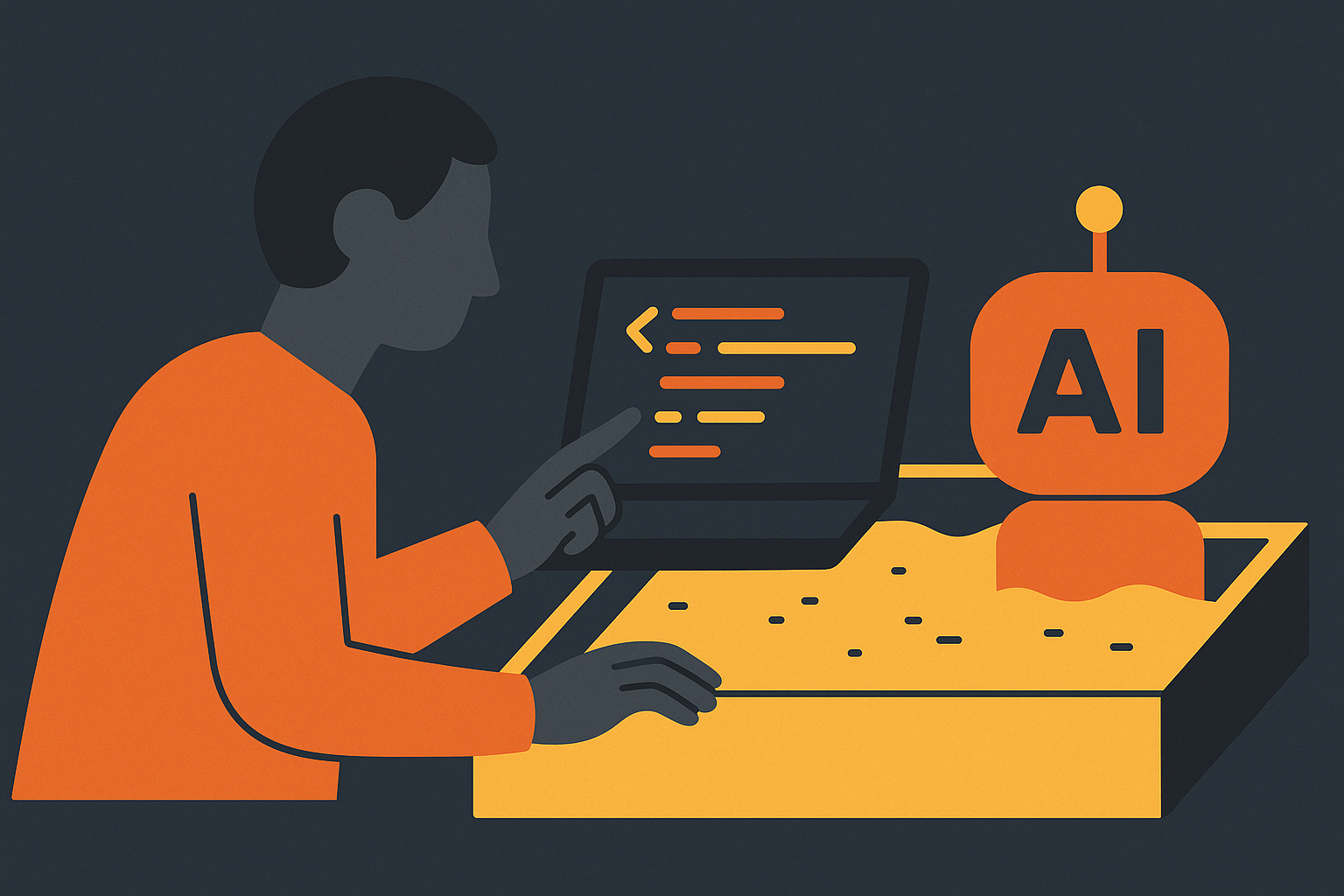
Coding sandbox environments are the infrastructure layer that decides whether AI-generated code can run safely at scale. This piece looks at what they are, why plain containers stopped being enough, and which properties actually matter once you're picking one for real work. The shift from developer-written to machine-generated code changes the threat model in a way most teams haven't fully caught up to yet. Human code gets reviewed, committed in small pieces, written by someone whose name is attached to it; AI-generated code shows up in bulk, its reasoning hidden, and in agentic workflows it doesn't wait around for a human to approve it before running.
That's the part that matters most. Agents don't just suggest code anymore, they execute it: file edits, shell commands, API calls, package installs, all happening without anyone clicking approve first. Veracode's 2025 report found that 45% of AI-generated code fails security tests, which tells you plainly that untrusted execution has become the normal condition rather than a rare edge case. The volume behind that risk has exploded too. Demand for sandboxed execution went from tens of thousands of sessions a month to tens of millions inside a year, tracking almost exactly with how fast coding agents got adopted. You can't hand this off to a general-purpose container and call it solved. The amount of code, its ability to act on its own, and where it came from have all changed at once.
What a coding sandbox environment actually is
A sandbox is an isolated place to run code. It executes whatever it's given while making sure nothing that code does can reach outside its own boundary; it gets its own filesystem, its own network stack, its own process space, with no shared state leaking to the host machine or to any sandbox sitting next to it. Whatever runs inside can't read the host, can't touch it, and if the isolation was built right, can't escape to it no matter what it tries.
Worth being precise about what a sandbox isn't, since people mix the terms up constantly. The model writes the code; the sandbox runs it. The orchestration framework, something like LangGraph or OpenAI's AgentKit, decides what happens next and routes tasks around, but it doesn't provide the actual execution boundary. A plain Docker container running with default settings still shares the host's kernel, and that's a meaningfully weaker wall than what agentic workloads need standing between them and the host.
The runtime-versus-framework split matters more than it sounds like it should, because it shapes how a team ends up building things. Frameworks hand you flexibility, but that flexibility comes with homework attached: you're the one stitching together security, compute provisioning, state management, all of it. Purpose-built sandbox runtimes arrive with those decisions already made, isolation defaults, provisioning rules, how state gets kept between runs. In an agentic system, the sandbox is where enforcement actually happens. It's the line between what an agent wants to do and what the system will let it do.
Why standard containers are not sufficient for AI-generated code
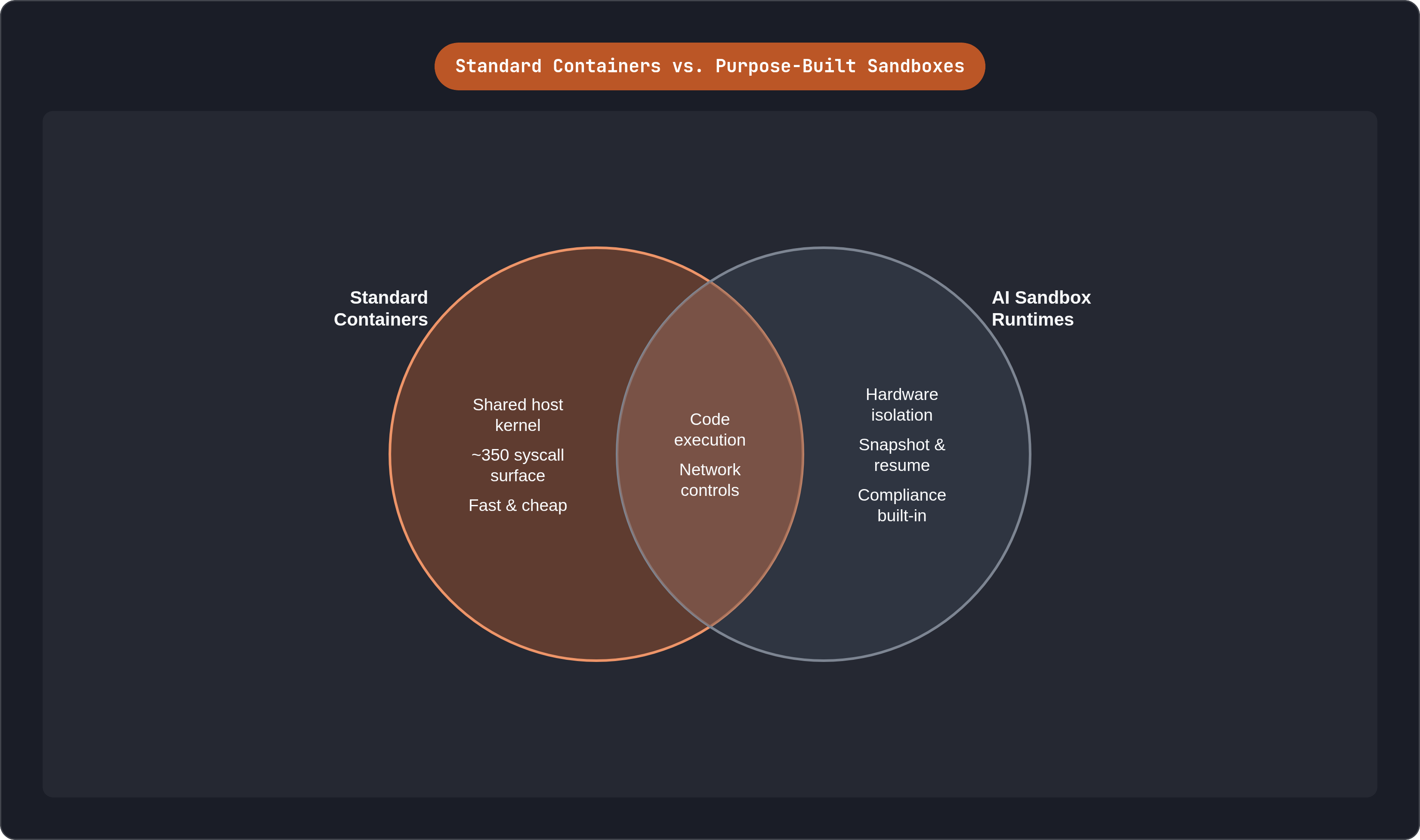
Here's the mechanical problem with containers, plainly. Every container on a host calls straight into the same Linux kernel as every other container on that host, the same kernel the host itself runs on. Linux exposes something like 350 system calls, and one exploitable bug in any single one of them is a potential container escape. That's true regardless of whether the code inside is trustworthy. But when the code is AI-generated and effectively untrusted, that attack surface stops being a theoretical concern and turns into something live on every execution.
Why does this matter more now than it did five years back? Because code execution is one of the more dangerous capabilities you can hand an agent, and a flaw in how that execution gets isolated can escalate straight into remote code execution on the host and full attacker control. CVE-2024-21626, nicknamed "Leaky Vessels," showed exactly this: a file descriptor leak in container tooling was enough on its own to let an attacker escape the container and reach the host. That's not some exotic vulnerability class either. It's the kind of bug that turns up in tooling that's mature and deployed everywhere.
The Snowflake Cortex incident in early 2026 is worth sitting with too. Indirect prompt injection, combined with a sandbox boundary that wasn't strong enough, let AI-generated instructions slip past human approval and reach cached credentials, which is more or less exactly what the theory predicts happening in a lab. Except this happened in production, not a researcher's proof-of-concept. At this point nobody building sandbox infrastructure argues the other side of this: a permissive container gets escaped fairly easily when it's running untrusted, LLM-generated code. That assumption sits underneath every serious sandbox platform built in the last couple of years.
The four isolation technologies the field has converged on
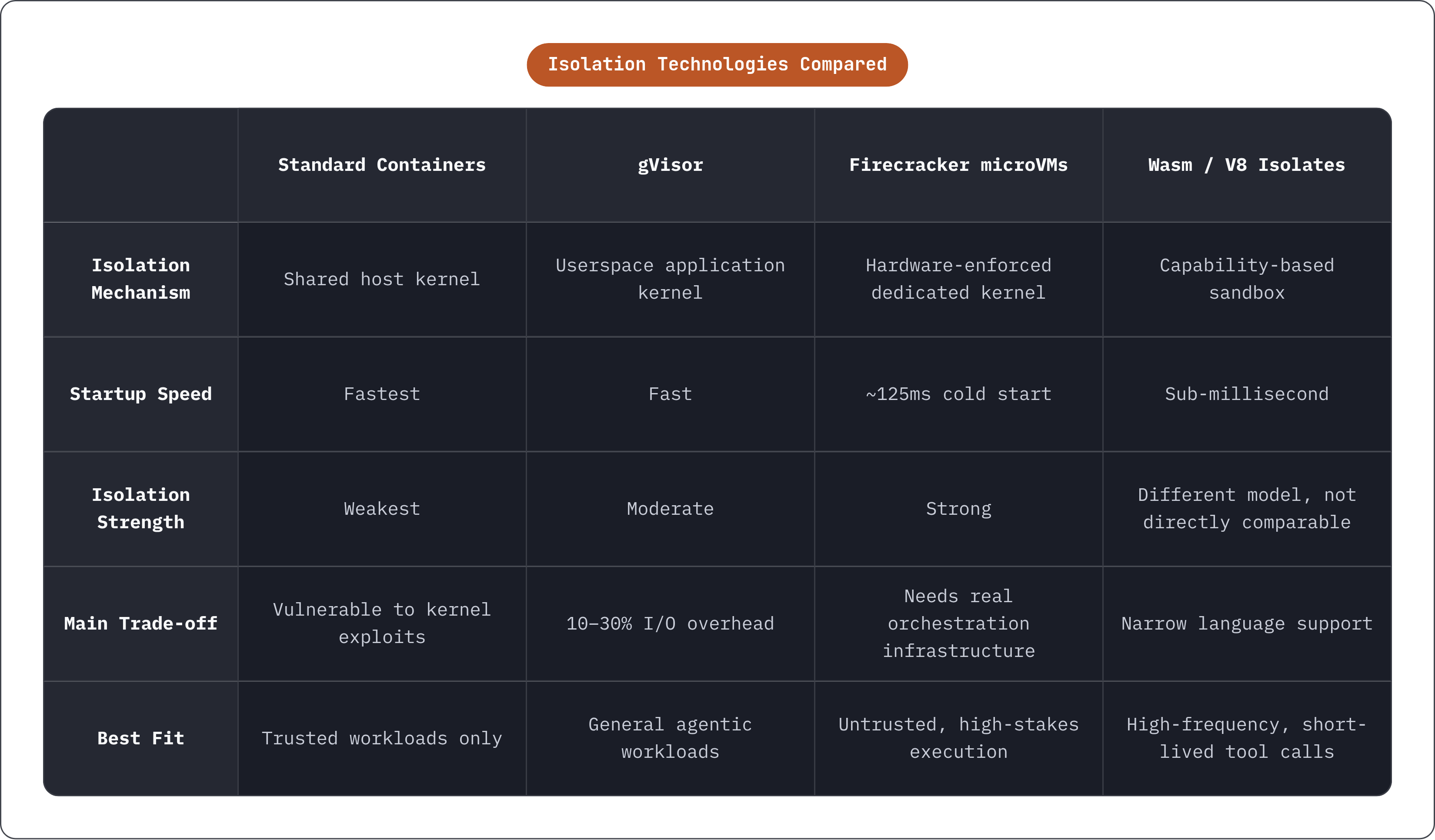
The field has settled on four primitives, and each one trades security for speed at a different point along the line.
Standard containers, running on runc or plain Docker, sit at one end. Fast to start, cheap to run, but they share the host kernel, so the isolation is the weakest of the four. Fine for trusted workloads. Not enough on their own for untrusted AI-generated code running at any real scale.
gVisor takes a different route: it puts a userspace "application kernel" between the workload and the real host kernel, intercepting system calls so the workload never touches the host kernel directly. That shrinks the exploitable surface quite a bit. The cost shows up as overhead, somewhere around 10 to 30% on I/O-heavy workloads, though startup stays fast. Google runs its Agent Sandbox on gVisor, and GKE reportedly saw sandbox usage grow 16-fold in under five months, which signals where demand is headed.
Firecracker microVMs go further. AWS built this VMM in Rust, and it uses KVM to give each workload hardware-enforced isolation and its own dedicated kernel rather than a shared one dressed up to look separate. It boots in around 125 milliseconds, adds less than 5 MiB of overhead per VM, and can spin up as many as 150 VMs per second on a single host. Short of a full traditional VM, this is the strongest isolation available, though it needs real orchestration infrastructure behind it to run well in production. It's also, right now, the most widely adopted isolation primitive among sandbox platforms built specifically for this problem.
Kata Containers is less a primitive and more a plumbing layer. It wires multiple VMMs, Firecracker among them, alongside Cloud Hypervisor and QEMU, into Kubernetes, so you get hardware-level isolation with something close to the feel of a normal container. It absorbs a lot of the operational mess that comes with running microVMs at scale, which makes it the practical path for teams already living inside Kubernetes.
Then there's WebAssembly and V8 isolates, which come at the problem from a completely different angle: a capability-first model with close to zero memory overhead and sub-millisecond startup, something like two orders of magnitude faster to boot than a microVM. The trade-off is narrower language support and a security model built around a different set of assumptions. It fits high-frequency, short-lived tool calls where waiting on a VM to boot would just waste time.
What's interesting is that most serious platforms don't pick just one of these anymore. They stack them: a microVM for the outer boundary, gVisor or Wasm managing the inner workload, spreading defense across several perimeters instead of resting on one.
The properties that determine whether a sandbox fits agentic workloads
Isolation technology only gets you halfway there. It doesn't tell you whether a sandbox actually holds up against how agents behave once they're running in production, and that's a separate question.
Startup latency is usually the first thing that bites teams. An agent sitting around for hundreds of milliseconds every time it needs a sandbox loses its responsiveness, and that cost stacks up across a multi-step workflow where the agent might spin up a dozen sandboxes in sequence. Sub-100ms cold start tends to be the line that keeps an agent loop feeling fluid instead of sluggish.
Statefulness matters just as much, maybe more, once you're past a single tool call. Ephemeral sandboxes that reset with every invocation force the agent to rebuild its context from nothing each time, which costs time and, worse, invites mistakes. Long-running agents, doing code review, multi-file refactors, research spanning many steps, need sandboxes that hold onto filesystem state, installed packages, running processes, across the whole session. Snapshot and resume, the ability to pause a sandbox and pick it back up exactly where it left off, becomes essential once a workflow runs into minutes or hours instead of seconds.
Network isolation is where a lot of the real damage happens when it's missing. Supply chain attacks aimed at AI agent workflows (the Shai-Hulud npm campaign in late 2025 being one example) exploit exactly this: open outbound network access nobody thought to lock down. Default-deny outbound, with allowlists set up for the specific registries or APIs an agent actually needs, is the posture that holds. Open by default with restrictions bolted on later tends not to.
Scale is its own problem entirely. Production agent systems rarely run one sandbox at a time; they fan out across dozens or hundreds at once, and a platform that can't provision and tear down fast enough to keep up just introduces queuing delays that ripple through everything downstream.
Then there's the question of where the compute actually sits. Regulated industries, healthcare, finance, anything government-adjacent, often can't send workloads to a shared multi-tenant cloud at all. For that group, bring-your-own-cloud and customer-managed compute are baseline requirements rather than optional extras. Compliance rides alongside this: SOC 2, HIPAA, GDPR coverage decides whether a platform even gets considered for production use in a regulated setting. In KPMG's Q4 2025 AI Pulse Survey, 65% of leaders named agentic system complexity as their top barrier to deployment. Building compliance into the sandbox layer cuts down that complexity rather than pushing the problem onto the team to solve later.
How leading sandbox platforms approach these requirements differently
Different platforms have made genuinely different bets on where to sit across these trade-offs.
Daytona built its infrastructure for AI agents specifically starting in early 2025, and raised a $24 million Series A in February 2026. It claims sub-90ms cold starts, runs Docker-native by default, and offers Kata Containers as an option for stronger isolation, giving each sandbox its own dedicated kernel, filesystem, and network stack. It's built around persistent, stateful workspaces rather than throwaway ones, and it supports customer-managed compute in the customer's own cloud, alongside SOC 2, HIPAA, and GDPR compliance. It's open source too, so you can actually inspect how the runtime behaves instead of trusting it blind. Customers include LangChain, n8n, Clay, SambaNova, and Parabola.
Northflank processes over 2 million isolated workloads a month, running on a mix of Kata Containers and gVisor. It supports self-serve bring-your-own-cloud across the major cloud providers plus on-premises deployments, and offers both ephemeral and long-running environments without forcing arbitrary time limits on either. It also gives on-demand GPU access alongside sandbox execution, which matters for workloads that need more than CPU can give them.
Fly.io's Sprites product uses persistent, stateful microVMs built on Firecracker that auto-idle when nothing's happening. It suits workloads that want the hardware isolation of a VM but need to keep costs sane through automatic idling instead of paying for idle compute around the clock.
Vercel Sandbox gives isolated Linux environments reachable through JavaScript and Python SDKs or a CLI, with full root access, package installation, external API calls, and custom runtime images. It leans toward developer experience and fits naturally for teams already building inside the Vercel ecosystem.
Cloudflare's Dynamic Workers, in open beta as of April 2026, took the V8 isolate route instead of microVMs, which buys sub-millisecond startup and much lower memory per execution context. The trade is you give up the hardware isolation boundary a microVM provides in exchange for speed and density. That makes it well-suited for high-frequency, short-lived tool calls and a poor fit for anything needing the strongest isolation guarantee available.
The managed hyperscaler runtimes (AWS Bedrock AgentCore, Google's Vertex AI Agent Engine, Azure AI Foundry Agent Service) take a different shape entirely: full-stack managed platforms where sandbox isolation sits as one layer inside a much larger agent orchestration offering. AWS Bedrock AgentCore reached general availability in October 2025 and is framework-agnostic; AWS has since moved its earlier Bedrock Agents "Classic" product to maintenance mode, closed to new customers as of mid-2026. These suit teams who want one vendor owning the whole agent stack end to end, and suit them less well if the team has specific requirements around isolation choice, compliance scope, or where the compute physically sits.
Choosing among all this comes back to the same handful of questions from the section before: how fast you need cold starts, whether your workflows are stateless or long-running, what compliance you're under, and whether owning your own compute is something you need or just something you'd prefer.
What "good isolation" looks like in practice for a team building with AI-generated code
Worth asking before locking in a sandbox choice: is the goal actually to lock everything down as tight as possible? Probably not. The right posture matches the actual threat model and the actual workflow rather than defaulting to the most defensive option on the shelf. A team running short, stateless tool calls faces a different risk profile than one running multi-hour autonomous coding sessions, and treating them the same wastes either latency or security margin, depending which way you overcorrect.
Defense-in-depth beats a single perimeter every time. Pair a strong outer boundary, a microVM or Kata Containers, with network egress controls and filesystem restrictions layered on top of it. Prompt engineering shapes the model's behavior, but the sandbox is what actually enforces the line, full stop.
Statefulness decisions deserve to get made on purpose, not by default. Ephemeral sandboxes are easier to reason about, and they work fine for isolated one-shot tasks. But long-running workflows need persistence and snapshot capability built into the platform from day one, rather than bolted on later once the team notices agents keep losing context between steps.
Compliance should factor into the platform decision earlier than most teams expect. Retrofitting SOC 2 or HIPAA controls onto a sandbox platform that wasn't built with them in mind is slow, expensive, and it tends to happen under pressure, right when a deal is stuck in a security review. Gartner projects that 40% of agentic AI projects will get canceled by 2027, pointing to rising costs, unclear value, and weak risk controls as the main reasons. Sandbox infrastructure decisions made early, quietly, before anyone's forced to ask hard questions, are part of what decides whether a given project clears that bar or ends up as another data point in it.