Autonomous Systems Engineering Principles for Agent Platforms
Fixing the pilot-to-production gap requires building agent runtimes first.
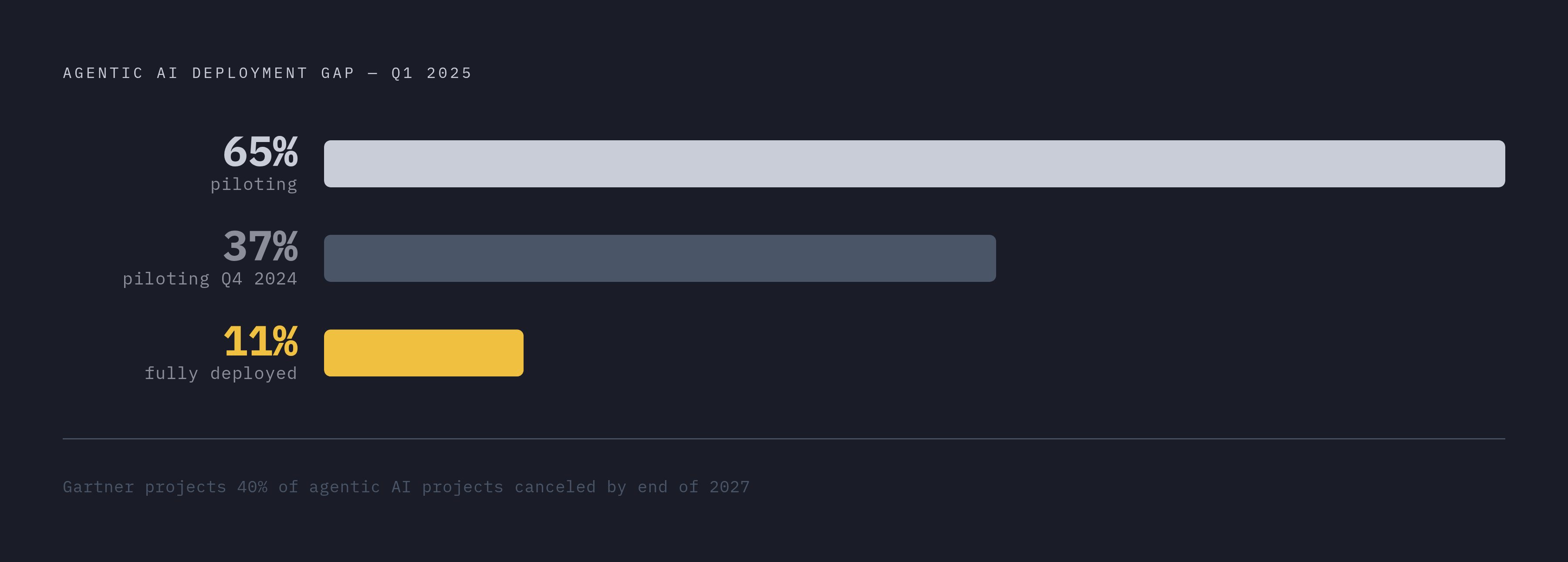
Agent runtime infrastructure is the reason most AI agents never make it out of pilot, more than model quality or the framework a team picked. Enterprises running agentic AI pilots nearly doubled in a single quarter, climbing from 37% in Q4 2024 to 65% in Q1 2025, while full deployment sits stuck at 11%. That gap, 65% piloting against 11% deployed, is what this piece is about, and the argument here is a narrow one: build the runtime first, or nothing built above it holds.
Industry surveys point to agentic system complexity as the top barrier to deployment, ahead of model capability or business logic concerns. Gartner projects that 40% of agentic AI projects will be canceled by the end of 2027, largely from costs that spiral, value that never materializes, or risk controls that were never really there in the first place. Read together, those numbers point somewhere specific: the stall is an infrastructure problem, which means it's fixable. Most teams are just fixing the wrong layer of it.
What an agent runtime actually is and why general-purpose infrastructure falls short
An agent runtime is the execution infrastructure that manages an agent's lifecycle: its state, its compute resources, its interactions with everything outside itself, so the agent runs reliably, securely, and at whatever scale the business needs. That sounds close to what cloud infrastructure already does, but the two diverge in ways that matter. Treating them as the same thing turns out to be the single most common mistake teams make when they move an agent out of a notebook and into production.
Traditional cloud infrastructure was built for stateless request-response work: a request comes in, a response goes out, the server forgets everything. Agents run long, they hold state, they call tools mid-task, and increasingly they coordinate with other agents. So what happens when a stateless system gets asked to carry a stateful, long-running process? Vercel and Lambda answer that question whether they mean to or not.
Both platforms cap execution at a matter of minutes, because the model underneath is synchronous HTTP: open a connection, and the infrastructure has to hold it open for as long as the work takes. An agent that needs an hour, or needs to pause for a human approval and pick back up six hours later, cannot live inside that constraint. Purpose-built agent runtimes solve this by running the agent asynchronously inside a sandbox with no dependency on any client connection. Send the input, disconnect, come back hours later, and the agent resumes exactly where it left off.
This isn't a theoretical distinction, and it isn't a minor one either. Scaling agents is a different exercise from scaling web servers, whatever the marketing slides suggest. Horizontal scaling for a web app means handling more HTTP requests; horizontal scaling for agents means handling more concurrent agent sessions, each with its own state, its own sandbox, its own lifecycle to track separately from every other session running at the same time. Isolation, statefulness, elastic provisioning, and compliance by design aren't upgrades layered on top of general-purpose infrastructure; they're the floor. Skip any one of them and a platform simply isn't built for what agents actually do, no matter how good the model sitting on top of it happens to be.
Isolation as a first-order requirement, not a security add-on
Start with what agent-generated code actually is: a sample pulled from a probability distribution, and that distribution includes destructive actions, infinite loops, and memory-exhausting patterns sitting right alongside the correct and helpful ones. There's no way to know in advance which side of that distribution a given output lands on. That's a property of how the code got generated in the first place, not something a training patch resolves next quarter.
The risk has sharpened as models have improved, which is the part people tend to get backwards. Better models should mean safer output. Instead, frontier models' success rates on cybersecurity benchmark tasks rose from under 10% in 2023 to roughly 50% in 2025, which means the code an agent generates can be adversarial in raw capability even when the agent's intent is entirely benign. A model good enough to find a real exploit is good enough to write one by accident.
The incidents aren't hypothetical, and they aren't rare edge cases either. In early 2026, PromptArmor disclosed a vulnerability in Snowflake's Cortex Code CLI, where indirect prompt injection combined with weak command validation let AI-generated instructions bypass human-in-the-loop approval entirely, escape sandbox mode, and reach cached credentials. Langflow carried its own flaw, tracked as CVE-2025-34291, an authentication bypass that opened the door to arbitrary Python code execution. Research examining LLM-generated code patches found that in 9.5% of cases, the patch fixed the original bug while introducing a brand-new security vulnerability in the process, which means the fix itself became the next incident.
Standard containers don't hold up against any of this. They were never built to. They share the host kernel, so a compromised container can, in principle, exploit a kernel vulnerability and reach the host machine or a neighboring workload sitting right next to it. That's disqualifying for agent-generated code specifically, whatever containers might be adequate for elsewhere. Platforms purpose-built for this problem, Daytona among them, take a different starting point: a secure, isolated runtime provisioned specifically around untrusted, AI-generated code rather than adapted from developer tooling. Three approaches close the gap, each with real tradeoffs. MicroVMs, the technology behind Firecracker and Kata Containers, give each workload a dedicated kernel with hardware-enforced boundaries; a compromised guest cannot touch the host or any sandbox running alongside it. That's the strongest isolation available, at the highest resource cost. gVisor takes a different route, intercepting system calls in user space through what amounts to an application kernel, denying direct access to the host kernel while running lighter than a full microVM. Hardened containers sit at the bottom of that stack: fine for code a team already trusts, but not an adequate control for anything an AI model wrote, full stop.
Isolation alone isn't the whole answer. Production-grade sandboxing needs resource limits, network controls, permission scoping, and monitoring stacked on top of the isolation boundary, not instead of it. The principle is easy to state and easy to skip anyway: treat all agent-generated code as potentially hostile by default. Sanitizing inputs helps, but it's not sufficient as a primary control. Sandboxing has to be a required security control from day one, not a bolt-on added after a proof of concept happens to work in a demo.
Statefulness as an architectural commitment, not a feature
Workflow state persistence means saving an agent's execution context, its variables, its progress, to durable storage, so the whole process can suspend and later resume with full context intact. In-memory session state, by contrast, disappears the moment a script ends or a server restarts. Confusing the two is how teams end up rebuilding the same "resume" logic badly, three times, in three different services, and never noticing they're solving the same problem repeatedly.
Agents fail in ways that ordinary retry logic was never built to catch. Failure can enter at the orchestration layer, through the inherent unpredictability of LLM output, through a tool call that times out, through a human-in-the-loop pause that runs long. Durable execution, meaning automatic state persistence, automatic retries, and the ability to resume a workflow mid-stream, is a correctness requirement for long-running agents, not a convenience. Without it, an agent that fails at step 40 of 50 starts back at step one, and depending on what those steps did, that isn't just wasteful. It can be actively wrong.
Durable execution crossed into mainstream adoption in 2025, driven by the demands of AI agent workloads. The architecture that's emerged wraps agent workflows in observability that lets a team see what actually happened and when. The execution history becomes a sequence of state snapshots: inspectable, replayable, diffable, the same way a git history shows exactly what changed and why.
Checkpointing does more than save memory, when it's done right. It captures the complete state of an agent at a given moment, not just its variables but running processes, filesystem contents, installed packages, all of it. That buys resilience against two different categories of disruption: technical failures like a crashed process, and workflow interruptions like a human approval gate or a rate limit on an external API.
The protocols emerging around agents back this reading up. The Model Context Protocol's task primitive models a task as a durable state machine, with statefulness built into the protocol layer itself rather than treated as optional. Google's Agent2Agent protocol similarly treats the task as the fundamental stateful unit of work, with statefulness baked into the protocol layer from the start. Neither protocol treats statefulness as optional. Both bake it into the protocol layer itself, which tells you where the industry has already placed its bet.
For teams building agents, the practical line is this: ephemeral sandboxes work fine for isolated, short code execution or a quick analysis pass. Anything longer, coding agents, research workflows, anything where installed packages or intermediate files need to survive between sessions, needs a stateful environment instead. Reaching for the ephemeral option out of habit, because it's simpler to reason about on day one, is the mistake worth naming directly. The operational bar worth aiming for is a resume time under 25 milliseconds, restoring the full filesystem, memory, and running processes exactly as they were left. Hit that number and cold-start penalties across sequential tool calls basically disappear.
Elastic provisioning and what it actually costs to ignore it
A mid-sized e-commerce firm building an agentic supply chain optimizer saw its infrastructure bill jump from $5,000 a month in prototyping to $50,000 a month in staging. Ten times the cost, and the root cause traced back to unoptimized RAG queries pulling in far more context than the task ever needed to complete it.
That's not a smooth cost curve. It's a cliff, and teams tend to hit it without warning because nothing in their provisioning was designed around how agent workloads actually behave under load. There's a second cost that's easier to miss, because it never shows up on an infrastructure invoice: senior engineers in many organizations spend up to a third of their active workweek triaging, debugging, and refactoring failures that came out of machine-generated code. That's a real drain on capacity, and it compounds the infrastructure spend instead of sitting apart from it as some separate line item.
For agents specifically, elastic provisioning means more than autoscaling compute up and down. It means spinning up isolated sandbox environments on demand, per session, without cold-start latency that makes the agent feel sluggish to whoever is waiting on it. Sub-25-millisecond sandbox startup is the threshold that keeps things responsive once agents run concurrently across dozens or hundreds of sessions; anything slower becomes a bottleneck the moment load increases, and load increases. Multiple agents running at once also need environments isolated from each other and reproducible on demand, and more agent-generated code means more artifacts, more versions, more things that need tracking and deploying correctly.
The supply side of the market is already moving to meet this demand. Parasail, which launched in April 2025, aggregates GPU compute across 40 data centers in 15 countries and processes more than 500 billion tokens a day. That's a signal that demand for flexible, on-demand agent compute is real rather than speculative. Amazon's Bedrock AgentCore, generally available since October 2025, points the same direction from a different angle: a framework-agnostic managed platform that can run LangGraph, CrewAI, Google's ADK, or the OpenAI Agents SDK on enterprise infrastructure, with deterministic policy enforcement built in from the start.
The engineering principle underneath all of it is straightforward even if teams routinely ignore it: design for burst concurrency on day one. Don't wait for the cost cliff to appear and then retrofit around it, because by the time it shows up in a bill, the architecture decisions that caused it are already baked in and expensive to unwind. Running on customer-managed compute, inside a team's own cloud, keeps cost visibility and control where the organization can actually act on it, which matters more than it sounds like it should, right up until the first surprise invoice arrives.
Compliance by design and why bolting it on later doesn't work for agent platforms
AI has become a primary author of production software, and compliance regimes built for a world where humans wrote every line are now operating inside a different reality entirely. Microsoft reports that AI generates 30% of its codebase. Google puts the figure at 75% of its production code.
Salesforce estimates that AI agents handle between 30% and 50% of workloads in the organizations deploying them. At that proportion, audit trails, access controls, and data handling rules cannot apply only to human actions and stop there. They have to cover what the agent did, too, and most compliance programs simply weren't written with that sentence in mind, because the sentence didn't need writing five years ago.
Retrofitting compliance onto an agent platform runs into a basic problem: agent actions are non-deterministic and generated at runtime, and no one can audit what was never logged at the moment it happened. The Snowflake Cortex incident illustrates a second problem just as clearly: a human-in-the-loop approval flow is only as good as its enforcement, and if that enforcement lives in the application layer instead of the infrastructure layer, it can be bypassed entirely, which is more or less what happened. Data residency rules under GDPR and HIPAA raise a third issue, since they require knowing exactly where code executed and what data it touched, information that's only available if the infrastructure was built from the start to track it rather than reconstructed after the fact.
Compliance by design means SOC 2, HIPAA, and GDPR controls live inside the runtime itself: isolation boundaries that satisfy data residency requirements on their own, logging that captures what an agent did the moment it did it, permission scoping that enforces least privilege on every tool call an agent makes. Customer-managed compute matters here too, for a different reason than the cost argument in the previous section: running workloads in an organization's own cloud keeps data and audit logs under that organization's control, which matters enormously for regulated industries that cannot send sensitive workloads to a shared, opaque service they have no way to inspect from the outside.
Open-source and transparent infrastructure plays a role that's easy to underrate here. A black-box execution service can't be audited or certified, full stop, and transparency in how the runtime works is a prerequisite for compliance certification, not a feature that happens to make auditors feel better about signing off. The direction the industry is heading backs this up: at re:Invent 2025, AWS previewed frontier agents, including dedicated security and DevOps agents, built to maintain state, log their own actions, operate inside policy guardrails, and plug directly into CI/CD pipelines. Compliance enforced at the infrastructure layer is becoming the baseline expectation, not a premium feature reserved for regulated industries alone.
How the four principles combine in a production agent platform architecture
None of these four principles work in isolation, and that word choice is deliberate. Isolation without statefulness gives an agent a secure sandbox that throws away all its work the moment it restarts. Statefulness without isolation gives an agent persistent memory that a compromised session can read straight across into another one. Elastic provisioning without compliance gives a platform scale with no way to prove, after the fact, what happened or why it happened that way. Each principle covers a gap the other three leave wide open, which is the whole argument of this piece compressed into one sentence.
The architecture the industry has converged on reflects that. Agent workflows get modeled as directed graphs with typed state and conditional routing built in from the start, and every execution runs inside a fully isolated sandbox, a microVM or its equivalent, provisioned in under 90 milliseconds. State gets checkpointed at strategic points along the way, with snapshots persisted so an agent can resume with full context after any interruption, whether that's a crash or a human approval gate sitting in the middle of the workflow. Compliance controls, logging, permission scoping, network rules, get enforced at the sandbox layer itself, not tacked onto the application code sitting somewhere above it.
The framework landscape reflects how fast this is moving, and it's worth naming the actual players rather than gesturing vaguely at "the ecosystem." Microsoft merged AutoGen and Semantic Kernel into a single Microsoft Agent Framework in late 2025, with general availability on GitHub expected in early 2026. OpenAI's Agents SDK takes a more minimalist stance, built around four primitives, agents, handoffs, guardrails, and sessions, leaving the harder orchestration decisions to whoever is building on top of it. LangGraph Platform offers several deployment tiers, including a bring-your-own-cloud option that runs inside a team's own VPC. None of these choices matters as much as one underlying question: does the runtime beneath whichever framework a team picks actually satisfy the four principles above? The API's feel is secondary to what's running underneath it, and teams that pick a framework before asking that question tend to find out the hard way, in production, six months later, when it's expensive to reverse.
That gives teams an actual test to run, and it's worth asking plainly rather than taking on faith. Does every agent execution run inside a fully separated environment with hardware-enforced boundaries? Can an agent pick a long-running task back up after an interruption without losing context? Can the platform provision a fresh sandbox in under 90 milliseconds even under burst concurrency? Are logging, data residency, and permission scoping enforced at the infrastructure layer, rather than somewhere in application code a future engineer might accidentally route around six months from now?
The gap this piece opened with, 65% piloting, 11% deployed, reflects an infrastructure problem more than a model problem, and treating it like the latter is the industry's most common and most expensive mistake. The teams closing that gap are the ones who treated isolation, statefulness, elastic provisioning, and compliance by design as the floor of the architecture rather than features to bolt on once the demo happens to work. That distinction is, in the end, the whole argument.