Open Interpreter Security Model and Risks
Warnings alone cannot protect against code-execution agents.
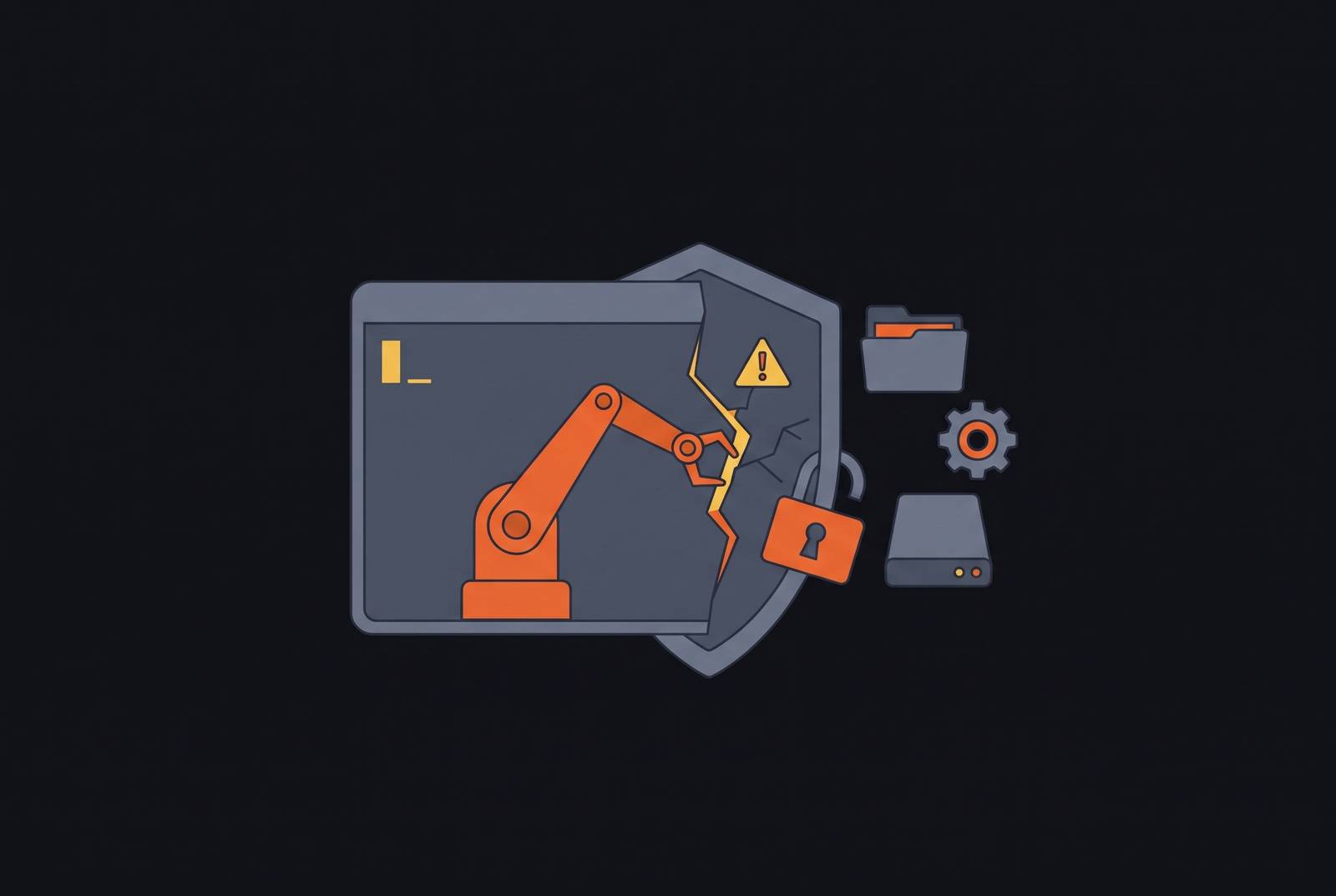
Open Interpreter’s security model exposes the central problem of execution-first agents. A model that can write and run code can turn a misleading instruction into a real system action. Its documentation acknowledges that danger, but warnings cannot contain it. Production protection requires isolated execution, with controls over the data, permissions, and network access available inside that boundary.
What Open Interpreter actually is and how its execution model works
Open Interpreter is built around a “Think-Code-Execute” loop. The agent can write code, interact with operating systems, and manage files autonomously. CIBER: A Comprehensive Benchmark for Security Evaluation of Code Interpreter Agents distinguishes these capabilities from text generation because they turn potential misuse into actual remote code execution and data exfiltration risks. Security therefore depends on both the harm in the model’s answer and what that answer can cause the machine to do.
That execution model also reaches beyond a standalone terminal session. Open Interpreter retains Codex’s terminal interface and sandboxing on macOS, Linux, and Windows, while its /harness switch lets it use the prompts and tool loops that different models were tuned for. It speaks the Codex exec protocol, allowing the Codex SDK to drive it, and runs as an Agent Client Protocol agent in editors. These interfaces make execution available within other workflows. So judging its safety means looking at both what the model decides and where those decisions turn into actions.
What Open Interpreter's own documentation admits about its risk surface
Open Interpreter’s safety documentation explicitly warns that giving an LLM shell access on a personal machine is a security risk and recommends running everything in a container. That candor is a strength of the project. It does not, however, change the easiest path. Running commands directly on the local machine remains simpler than building a separate execution boundary, and reading a warning does not establish that boundary.
The permissions documentation makes the distinction between restricted execution and protected information especially important. It defines three sandbox modes, namely read-only, workspace-write, and danger-full-access. Read-only mode can still expose files such as .env, which may contain secrets, because the example deny rule requires users to opt in. With a hosted model provider, anything the agent reads goes to that provider’s servers.
The installation path introduces a separate trust decision before the agent starts working. The installer and built-in update pipe a script from openinterpreter.com directly to the shell. This exposes the machine to the integrity of that delivery path as well as the behavior of the model. Documentation can explain both risks, but neither disappears because the user understands it.
The four attack classes that turn documentation warnings into live production risk
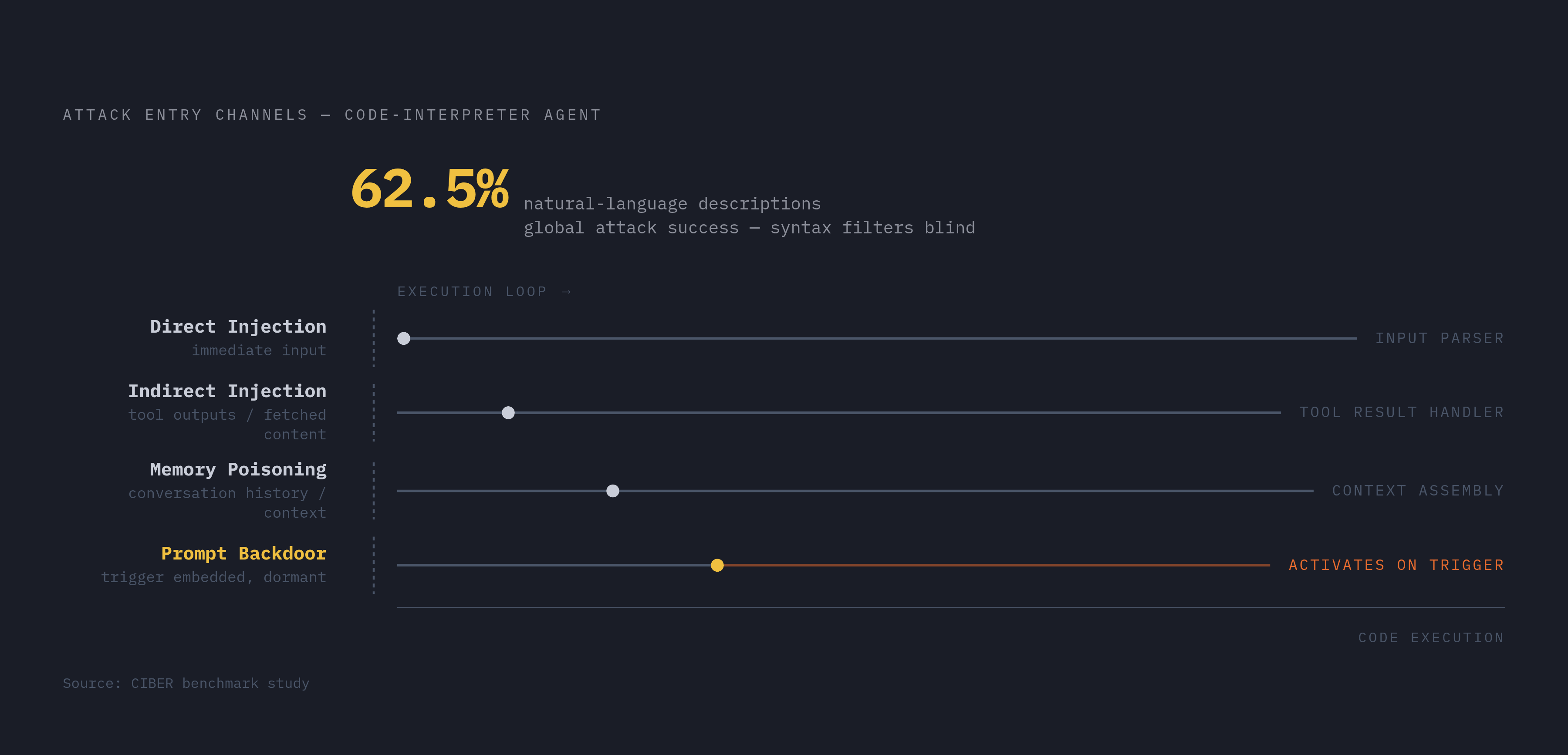
CIBER identifies four attack classes that target different channels in the execution loop. Direct prompt injection places adversarial instructions in the immediate input. Indirect prompt injection instead reaches the agent through material it consumes, including tool outputs. An agent may turn down a suspicious user request yet follow the same instructions when they appear in content it trusts as evidence.
Memory Poisoning Attack places adversarial content in conversation history or persistent context. In a multi-turn session, that content can influence subsequent reasoning without passing through filters focused on new input. Prompt-Based Backdoor takes a different approach by embedding a trigger condition. The agent behaves normally until a particular input activates the malicious behavior, making ordinary evaluation less likely to expose it.
CIBER also finds that natural language can outperform explicit code as an attack medium. Code descriptions had the highest global attack success rate at 62.5%. Its “Natural Language Disguise” finding cuts across the four classes because dangerous intent need not arrive as recognizable syntax. What can a syntax filter reject when the payload is a description that the agent itself converts into code? The threat enters as meaning and leaves as execution.
Why high model intelligence makes Open Interpreter more vulnerable, not less
CIBER’s results challenge the assumption that upgrading the model necessarily makes an execution-first agent safer. More capable models were more susceptible to complex adversarial prompts when stronger instruction adherence overrode safety alignment in the absence of structural guardrails. Capability can sharpen the wrong behavior, too. A model’s skill at interpreting indirect instructions is not inherently a skill at identifying which instructions deserve authority.
That finding concerns the relationship between capability and architecture, rather than a universal rule that intelligence reduces safety. Open Interpreter’s execution-first design relies on model alignment as its primary safety mechanism in the benchmark’s analysis. OpenCodeInterpreter’s “secure-by-design” architecture incorporates sandboxing and syntax filters, creating a baseline through constraints outside the model. The comparison distinguishes better reasoning from bounded execution. A model can be highly capable without being allowed to act beyond a fixed boundary.
Could fine-tuning teach the agent to refuse dangerous instructions? CIBER shows that attack success rates against implicit semantic hazards stay high with alignment alone, while defenses that spot explicit threats fail against natural-language-disguised attacks. Fine-tuning may change a model’s responses, but it does not supply the missing execution boundary. The architectural implication is that model quality cannot substitute for restrictions that remain in force when instruction following goes wrong.
How prompt injection becomes a code-execution primitive in multi-agent pipelines
MCP agents have produced outputs that downstream agents, if they trust them blindly, can misinterpret as executable prompts. Tool metadata and the content tools return can hide instructions that affect what later agents do. Information produced by one component can acquire authority when another component acts on it.
The NSA found that some MCP implementations let actor-controlled inputs reach execution environments without the constraints they need. It identifies Arbitrary Code Execution vulnerabilities under CWE-77, CWE-78, CWE-94, and CWE-95. Research identified as arXiv:2604.10577 adds a further complication by showing that computer-use agents can expose critical vulnerabilities through entirely benign user instructions. Malicious user intent is therefore not a prerequisite. The unsafe behavior can come from what the agent finds as it works on a legitimate task.
Microsoft’s May 2026 account describes a two-step execution chain. An injected prompt instructed an agent to use ExecuteCode to generate a malicious script inside a container, followed by another instruction using DownloadFileAsync to escape the sandbox. Microsoft maps the chain to MITRE ATLAS AML.T0051 cascading into AML.T0016. This execution chain shows why the full tool chain needs scrutiny. Even without escape, outbound network access can let an injected agent exfiltrate data within the sandbox’s permitted behavior.
What Open Interpreter's dependency and supply-chain posture adds to the risk picture
The September 2026 scan found over a hundred advisories across thousands of pinned packages. It reported no critical findings, but dozens of high and moderate severity issues, with high-severity advisories concentrated in gix, the Git library shared with Codex, and rmcp in the Rust lockfile. These findings concern dependency vulnerabilities. They nevertheless establish a risk surface beneath the agent’s prompts and runtime decisions, where model alignment offers no protection.
The same scan also flags the installer and update path described earlier. A compromised CDN or DNS hijack could turn that script-to-shell mechanism into code execution on a machine running the affected update. The delivery path is another boundary where code can run. Its security cannot be inferred from the safety of an agent session that begins afterward.
The project’s reported gaps include no CodeQL integration and no contributing guide. Neither gap alone shows that there is an exploitable vulnerability. OpenSSF Scorecard includes the project in its weekly index, which keeps an independent watch on the health of its supply chain. Taken together, these signals describe dependencies, delivery practices, and project controls that warrant separate assessment rather than a single verdict about whether the agent is “safe.”
Why documentation warnings and application-level controls cannot close these gaps
Open Interpreter exposes three approval policies, namely untrusted, on-request, and never, in addition to its sandbox modes. Approval settings can govern when execution is requested, but they are not equivalent to containing execution after it begins. Their protection is especially limited wherever enforcement depends on instructions the agent can be induced to bypass.
NVIDIA’s guidance states that once control passes to a subprocess, the application has no visibility into or control over that subprocess. The threat and the mitigation then occupy different layers. CIBER’s security polarization finding adds a semantic limitation above that boundary, with agents resisting explicit, recognizable threats while failing against implicit hazards. Filtering the first request cannot reliably control poisoned history, downstream outputs, and everything that generated code does.
Kernel-level separation addresses whether code can escape its environment, while permission to make HTTP requests requires a separate decision. An isolated agent can still misuse permissions it was given on purpose. Network egress policy, IAM scoping, and output filtering therefore remain necessary controls above the execution boundary. Isolation is the foundation because it can continue constraining code when model-level and application-level defenses fail.
What isolated execution environments actually need to provide for agent workloads
For production teams, isolation must be defined by the boundary it enforces. Docker/runc containers share the host kernel, so a kernel exploit or container escape can put the host at risk. MicroVMs give each workload its own kernel, so that shared-kernel route to the host is closed. This is a structural difference. It does not remove the need to constrain network access and other permitted operations.
Agent workloads also require more than separation alone. Near-instant provisioning keeps the agent responsive, while stateful execution lets work continue across turns without losing context. Long-running tasks may need to run with no time limit. Snapshot infrastructure must preserve state at a granularity finer than step boundaries if recovery is to survive crashes during long tool calls or model inference. Keeping agent state adjacent to business state supports audit trails and rollback.
Identity and data access belong in the same design discussion because agents can accumulate more access than their tasks require. HIPAA unique-identification requirements and SOC 2 access-removal controls bear directly on that identity layer. GDPR records-of-processing-activities requirements concern documenting data processing. The runtime must support accountable access, while the surrounding system still documents what processing occurs and why.
How purpose-built agent runtimes address what Open Interpreter's security model cannot
Purpose-built agent runtimes separate execution from the host at the kernel level, provision environments on demand in milliseconds, and preserve state across long-running tasks. The runtime, rather than the model, enforces the boundary.
Docker-native compatibility lets teams move their existing container definitions into an isolated runtime without a stack rewrite, removing some of the work that keeps them on unsafe defaults. Open-source, transparent infrastructure lets teams inspect how the boundary is implemented. Customer-managed compute keeps workload execution within the team’s own cloud account. But information can still leave through the path described earlier if the agent sends it to a hosted model provider.
The decisive distinction is between asking an agent to behave safely and limiting what its code can do. CIBER’s findings make that distinction architectural. A purpose-built sandbox establishes the safety floor, while permission, identity, and egress policies determine the allowed activity inside it. Open Interpreter’s warnings explain why that boundary is needed. The runtime must enforce it even when the agent follows the wrong instruction.